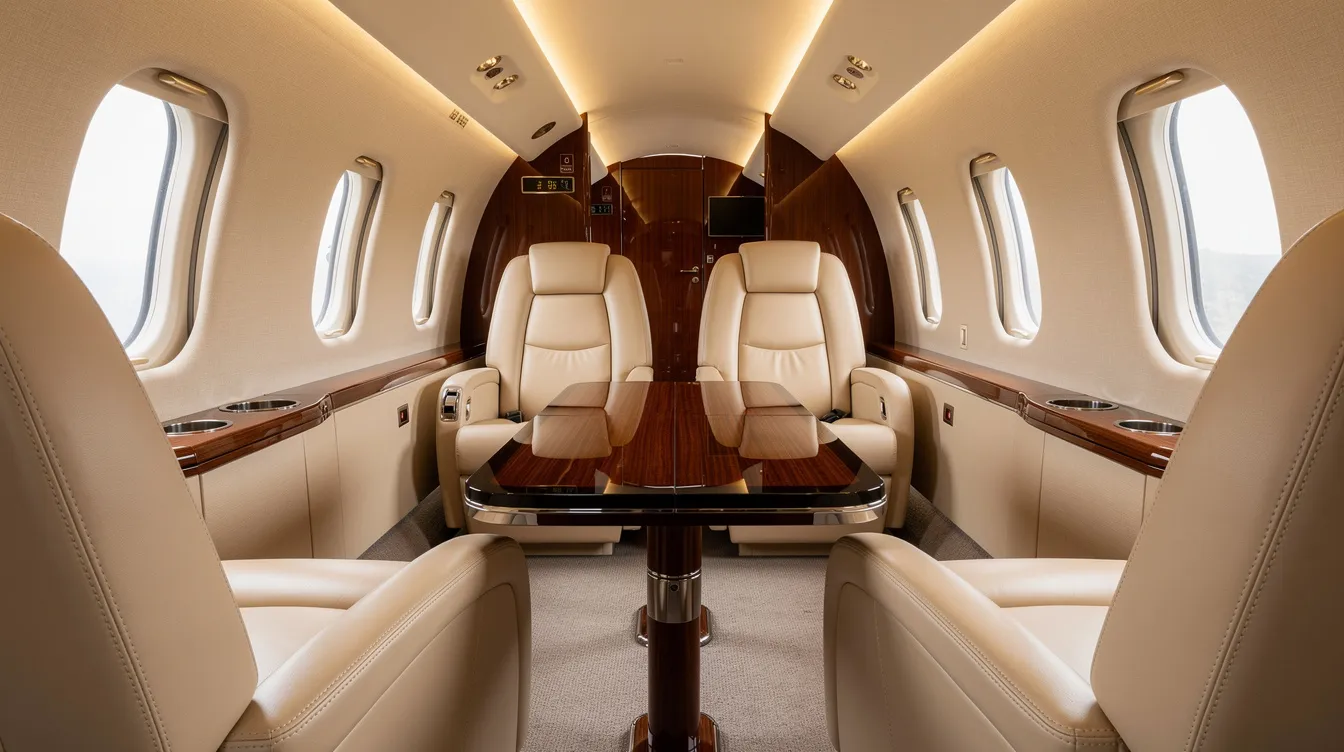
When executives start exploring private aviation, the phrase "private plane timeshare" comes up quickly. The concept sounds straightforward: buy a share of an aircraft, get a fixed block of flight hours each year, and let someone else handle operations. But the actual private plane timeshare cost is rarely as simple as the pitch suggests. Between upfront acquisition, monthly management fees, hourly rates, fuel surcharges, and a layer of taxes most buyers don't anticipate, the true annual spend often lands well above what headline numbers imply.
This guide breaks down every cost component of fractional jet ownership in 2026, with concrete figures, realistic scenarios, and a clear comparison against other ways of flying private.
Key takeaways
Private plane timeshares are structured as fractional ownership, with initial acquisition costs ranging from $275,000 to over $1.2 million, depending on aircraft size and share fraction. Light jets sit at the lower end; long-range and large cabin jet shares can exceed $1.5 million.
Ongoing costs include monthly management fees (typically $8,000 to $15,000 or more) and hourly occupied flight fees ranging from $1,800 to over $8,000, both of which vary by aircraft types and programme.
All-in effective cost per hour, once you account for acquisition depreciation, fixed fees, and variable charges, often runs $6,000 to $18,000 per occupied hour, depending on utilization and aircraft category.
Understanding federal excise tax, segment fees, short leg fees, fuel surcharges, and escalation clauses is essential before signing a multi-year timeshare contract.
Membership-based private aviation services like FLYT offer flexible jet access without ownership burdens, delivering fixed hourly rates and transparent pricing that eliminate the capital commitment and residual value risk embedded in fractional programmes.
What a private plane timeshare actually is
A private plane timeshare is the common shorthand for fractional ownership of private jets. In practice, you purchase a defined share of a specific private aircraft, typically a 1/16th, 1/8th, 1/4th, or 1/2 interest, and receive a proportional block of annual flight hours in return. A 1/16 share provides approximately 50 flight hours per year. A 1/8 share doubles that to roughly 100 hours. Across the industry, fractional ownership offers 50 to 200 flight hours annually, depending on share size.
Major providers such as NetJets, Flexjet, and PlaneSense structure their fractional ownership programs around multi-year commitments. Fractional ownership generally requires a contract of 3 to 5 years with early exit penalties. During that period, you own equity in the aircraft and pay for a service agreement covering crew, maintenance, dispatch, insurance, and scheduling.
Private plane timeshares offer fractional ownership to access aircraft without full ownership. That distinction matters because traditional private jet ownership requires paying the full market value of the aircraft plus absorbing all operational costs directly. Fractional ownership sits between full ownership and pure service models.
It is also worth noting that the pricing, obligations, and risk profile of fractional ownership differ substantially from on-demand private jet charter, jet card programs, and newer membership-based private aviation services like FLYT's asset-light floating fleet, which deliver flexible jet access without ownership burdens, shifting cost away from capital commitment and toward usage-based pricing.
Core cost components of a private plane timeshare
Every private plane timeshare cost boils down to three pillars: upfront acquisition, fixed monthly management fees, and variable hourly charges when you fly. Put simply, the fractional jet ownership cost combines upfront equity, fixed monthly fees, and variable hourly charges into a single cost structure that can be difficult to compare against simpler models.
Here are the key line items to understand before evaluating any fractional ownership program:
Initial share purchase price, which represents your equity stake in the entire aircraft. This capital cost is the largest single outlay.
Monthly management fees, which are fixed charges due whether or not you fly. Fixed management fees cover the administrative and logistical costs of owning a plane, including crew salaries, insurance, hangar fees, maintenance reserves, and dispatch.
Occupied hourly rate, the variable cost charged per flight hour (wheels up to wheels down). Variable costs are incurred only when the aircraft is in use.
Fuel surcharges are applied when jet fuel prices exceed a predefined baseline.
Federal excise tax (7.5% on applicable transportation charges for certain structures), per-segment fees, and potential short leg fees on very short flights.
Additional fees that may include landing fees, de-icing, international handling, repositioning, catering, and crew expenses on overnight missions.
These numbers shift significantly by aircraft category. Light jet costs look nothing like super midsize jets or long-range aircraft. The total hours you commit to also changes the math: fixed costs spread across more flight hours yield lower hourly costs per hour flown, while low utilization inflates effective cost dramatically.
Many buyers underestimate the ongoing costs and focus too heavily on the headline hourly rate. The sections below put real 2026 figures behind each component.
Upfront share prices by aircraft type in 2026
Share acquisition prices are driven by a few key factors: the underlying market value of the entire jet, the fractional ownership program's economics, the contract length, and the age and specification of the airframe. Newer, late-generation aircraft with better fuel burn and modern cabins price at a premium versus older airframes of the same aircraft size.
Here are approximate 2026 acquisition ranges by aircraft category:
Light jets (e.g., Citation CJ3+, Embraer Phenom 300), where a 1/16 share (~50 hours/year) might run roughly $250,000–$450,000; a 1/8 share can be $500,000–$800,000+.
Midsize jets (e.g., Citation XLS+, Hawker 800XP), where a 1/16 share might be in the $400,000–$700,000 range; 1/8 shares often cross $900,000–$1.2M.
Super midsize jets and long-range jets (e.g., Challenger 350, Gulfstream G450) where 1/16 shares can exceed $800,000–$1.5M+ depending on year and spec.
Across the board, fractional ownership initial costs range from $275,000 to over $1.2 million, with the specific type of aircraft and share size determining where you land in that range.
Most contracts include a projected residual value and a formula for buy-back at the end of the term. Typical residuals run 45–70% of purchase price after five years, depending on aircraft condition, hours flown, and prevailing market prices. That depreciation, the gap between what you pay and what you recover, is a real component of private jet cost that many fractional jet owners overlook when evaluating their initial investment.
Fractional ownership can lead to significant savings compared to full ownership of an entire aircraft, where you absorb 100% of depreciation and operational burden. But it is not a capital-light decision. The money you tie up in a share could be deployed elsewhere, and the residual you receive at exit is never guaranteed to match projections.
Monthly management fees and what they really cover
Monthly management fees are fixed charges billed per share, regardless of how much you fly. They represent the operational costs of keeping a private aircraft maintained, crewed, insured, and available for dispatch. Monthly management fees for fractional ownership can exceed $15,000 per month, and for larger aircraft types, the figures climb higher.
Realistic 2026 ranges by aircraft category:
Light jets: roughly $8,000–$13,000 per month per 1/16–1/8 share.
Midsize and super midsize jets: often $10,000–$18,000 per month.
Long-range jets: can exceed $18,000–$25,000+ per month.
Monthly management fees typically range from $8,000 to $15,000+ for light and midsize aircraft, with large cabin jet and long-range programmes pushing well beyond that.
What these fees usually include: hangar space, hull and liability insurance, scheduled maintenance planning and reserves, crew salaries and recurrent training, dispatch and scheduling operations, administrative overhead, and regulatory compliance.
What they usually exclude: actual occupied flight hours, fuel surcharges beyond baseline, catering upgrades, de-icing charges, international handling and permits, and some repositioning or ferry fees. Fractional aircraft owners share maintenance and operational costs proportionally based on their share size, but the fixed monthly fee remains due even in months with zero flights.
When comparing to membership models, these standing monthly costs are a key difference. Programmes like FLYT shift cost into all-in hourly rates rather than maintaining a large fixed overhead that accrues whether or not you are flying private. For executives whose travel schedule varies quarter to quarter, that distinction affects both cash flow and cost predictability.
Hourly rates, taxes, and extra fees
The apparent hourly rate in a fractional ownership program is only part of what appears on each trip invoice. Multiple layers of taxes, surcharges, and supplemental charges add to the final private jet cost of every private flight.
Indicative 2026 occupied hourly rate bands for fractional programmes:
Light jets: usually around $2,000–$3,200 per occupied hour. Hourly rates for light jets range from $2,900 to $3,500 for many current programmes, though hourly flight fees for light jets start at $1,800 on some older or lower-spec airframes.
Midsize: roughly $3,000–$4,800 per hour.
Super midsize and long-range: $5,000–$9,000+ per hour depending on cabin, range, and aircraft weight class.
Hourly occupied flight fees vary from $1,800 to $8,000+, depending on aircraft, and in some cases can run higher for ultra-long-range or heavy jets approaching Boeing Business Jet territory.
On the tax side, fractional ownership flights under FAA Part 91 Subpart K are structured differently from charter flight operations. Rather than applying the full 7.5% federal excise tax on transportation (as with Part 135 charters), fractional programmes often include a fuel surtax. There is also a per-segment tax of approximately $5.30 per domestic departure in 2026, indexed for inflation, plus per-person charges on international arrivals.
Common add-ons that affect total cost per trip:
Fuel surcharges when fuel prices exceed a programme's baseline
Short leg fees or minimum billing per flight segment (often a 1-hour minimum per leg)
Peak-day surcharges of 10–35% on holidays and high-demand dates
De-icing, international permits, ground transportation coordination, and catering beyond standard
Ferry fees for aircraft positioning when the same aircraft needs to reposition to your departure airport
Airport landing and handling fees at busy or remote regional airports
By contrast, modern membership models like FLYT aim for transparent pricing with fixed hourly rates where many of these elements are bundled or clearly itemized before you commit.
Sample annual cost scenarios for fractional ownership
Executives evaluating a private plane timeshare typically want to see the all-in annual picture rather than individual line items. Here are three realistic scenarios built on 2026 market data. The numbers are directional but grounded in the current programme pricing.
Scenario | Share Size & Aircraft Type | Acquisition Cost | Monthly Management Fees | Hourly Rate | Flight Hours per Year | Fuel & Surcharges | Annual Depreciation | Total Annual Cost | Effective Cost per Hour |
|---|
Business owner | 1/16 share, Light Jet (Phenom 300E) | $650,000 | $14,000/month ($168,000/year) | $5,000 | 50 | $20,000 | $52,000 | ~$460,000-$490,000 | $9,200-$9,800 |
Private equity firm | 1/8 share, Midsize Jet | $1.2 million | $20,000/month ($240,000/year) | $6,000 | 100 | $40,000 | $108,000 | ~$988,000 | ~$9,900 |
Global executive team | 1/16 share, Super-Midsize/Long-Range Jet | $1.4 million | $28,000/month ($336,000/year) | $11,500 | 75 | $50,000 | $140,000 | ~$1,388,500 | ~$18,500 |
Predictable costs simplify annual budgeting for fractional owners, but these scenarios illustrate why all-in modelling is essential. The headline hourly rate rarely tells the full story. Fractional ownership can be more cost-effective for those flying less than 300 hours annually compared to full ownership, but the effective cost per hour rises sharply at lower utilization levels.
How private plane timeshares compare to other ways of flying private
Private jet travel can be structured through several models, each with distinct cost profiles, availability characteristics, and commitment levels. Here is how fractional ownership compares:
Full aircraft ownership: lower capital outlay and operational burden in fractional versus full ownership, but less control and no exclusive use of a single tail number. Full ownership suits those flying 400+ hours per year who want complete operational authority over their private aircraft, but it requires absorbing all crew expenses, maintenance, insurance, and depreciation directly.
On-demand charter: lower commitment but more volatile hourly rate and less predictable aircraft availability during peak periods. Charter flights cost between $2,000 and $14,000 per hour, depending on aircraft category and flight time, and private jet charter prices can increase by 20–40% during peak demand. Private jet rental costs range from $2,000 to $14,000 per hour on a specific trip basis, with VIP airliners costing $16,000 to $23,000 per hour. Empty leg flights can lower charter costs but are route- and timing-dependent.
Jet cards: pre-paid blocks of hours with fixed hourly rates but no equity and often expiry rules and peak surcharges. Jet cards typically cost between $150,000 to $350,000 for 25 hours. Jet cards provide fixed hourly rates and guaranteed availability with relatively short notice. Jet cards provide flexibility without the long-term commitment of ownership, making them attractive for mid-frequency flyers. You can compare jet card economics against membership models like FLYT's memberships to see where the crossover points fall.
Membership programs (e.g., FLYT): asset-light access with fixed hourly rates, transparent pricing, and fleet interchange without buying a jet share. No initial investment in a depreciating asset. No large standing monthly fees when you are not flying. Fractional ownership allows access to a diverse fleet of aircraft, but membership models typically offer broader fleet interchange without conversion ratios or share-size constraints.
Many frequent flyers in the 50–150 hours per year range now reassess whether locking capital into a timeshare jet is optimal versus more flexible models. The private aviation market has evolved significantly since NetJets pioneered fractional ownership in 1986, and the private aviation industry now offers viable alternatives that did not exist a decade ago.
For a detailed comparison, see FLYT vs fractional ownership and FLYT vs jet cards.
When a private plane timeshare makes (and doesn't make) financial sense
The economics of a private plane timeshare hinge on a few key factors: annual flight hour volume, trip patterns, passenger count requirements, and how you prefer to allocate capital.
Fractional ownership can be attractive when:
You need 100–200+ private jet hours per year. Fractional ownership suits frequent flyers needing 100–200 hours annually where the fixed costs spread meaningfully across enough hours to justify the capital cost.
You fly predictable routes (e.g., New York to Chicago, or coast-to-coast round trip corridors) on relatively stable schedules, allowing the programme to manage aircraft positioning efficiently.
You want guaranteed access to specific aircraft types with short notice. Fractional ownership offers guaranteed aircraft availability with 4–6 hours' notice in most programmes, which is a meaningful advantage over on-demand charter.
It may not be optimal when:
You fly under approximately 50–75 hours per year of private jet travel. At that level, the fixed monthly management fees and capital depreciation produce an effective per-hour cost that makes a charter flight, jet card, or membership significantly more efficient.
You have highly variable routes or last-minute international travel where fleet interchange and floating fleet models deliver better efficiency. Jet cards are ideal for mid-frequency flyers needing 25–75 hours per year.
You prefer conserving capital, keeping your balance sheet light, or avoiding exposure to aircraft residual value risk. The initial investment in a fractional share is money that cannot be redeployed until the contract ends, and even then, the buy-back amount depends on market conditions.
Many executives now favour asset-light solutions such as FLYT's membership, which provide flexible aircraft access and predictable private jet cost without long-term ownership contracts. The question is not whether flying private makes sense; it is whether owning a piece of a private plane is the smartest structure for how you actually travel.
How FLYT approaches private jet cost without timeshare ownership
FLYT is a membership-based private aviation service built for founders, investors, and executives who want the benefits of private jet service without the complexity of aircraft ownership. The model is designed around access, not equity.
Core elements of the approach:
Fixed hourly rates across relevant aircraft types, designed for transparent pricing and predictable budgeting. Members know what each flight hour costs before they book.
Asset-light floating fleet and risk pool model instead of tying members to a single owned aircraft. This eliminates the residual value exposure that fractional jet owners carry.
Fleet interchange options so members can choose a smaller jet for short domestic leg flights or a larger cabin for longer missions and higher passenger count, all within a single membership.
The economic differences from fractional ownership are structural:
No multimillion-dollar upfront share purchase. Capital stays deployed where it generates returns.
No long-term residual risk on aircraft quality or market depreciation.
No large monthly management fees accumulating when you are not flying.
FLYT still provides global private jet travel access, concierge-level support, and operational efficiency, targeting the same need for time savings that drives interest in private plane timeshares. For executives who want to eliminate the ownership overhead while maintaining guaranteed aircraft availability across multiple aircraft types, membership models represent a fundamentally different way to budget for private aviation.
Explore how FLYT structures flexible access and predictable pricing as an alternative to traditional timeshare ownership through the FLYT platform.
Key questions to ask before signing a private plane timeshare contract
Due diligence on fractional ownership agreements is essential given the multi-year commitments and complex fee structures involved. Before signing, a sophisticated buyer should raise these questions with every provider under consideration:
How are hourly rates adjusted over the contract term? Escalation clauses tied to fuel prices, CPI, or maintenance cost indices can increase your operational costs by 2–6% annually. Over a five-year contract, that compounds significantly.
What are the minimum flight time and short leg fees for light jets and other categories? Many programmes impose a one-hour minimum billing per leg, meaning a 20-minute hop costs the same as a full hour.
How is federal excise tax applied to different components of the invoice? The treatment differs between Part 91K fractional operations and Part 135 charter, and affects your total cost.
What are the rules and penalties for peak-day flying, cancellations, and schedule changes? Holiday surcharges, black-out dates, and longer notice windows during busy periods can disrupt travel plans.
Equally important are exit and resale questions:
When can you sell your share? Owners of fractional shares can sell their share back to the provider after a period defined in the contract, but the terms vary significantly.
Is there a guaranteed buy-back formula or only "best efforts" resale? The difference between a firm residual guarantee and a market-dependent estimate can mean hundreds of thousands of dollars.
How are refurbishment or heavy maintenance events handled for cost sharing? Some programmes pass through scheduled overhaul costs proportionally, which can create unexpected bills.
Before committing capital, benchmark your projected all-in effective hourly rate against alternatives. Compare the economics of a timeshare against jet card programs, on-demand private jet charter, and membership models like FLYT to confirm that fractional ownership genuinely delivers lower hourly costs for your specific trip patterns and annual usage. Visit FLYT FAQ for more insights.
FAQs about private plane timeshare cost
How many flight hours justify buying a private plane timeshare versus using a membership?
Fractional ownership tends to become economically competitive above roughly 100–150 hours of private jet travel per year, particularly on repeat routes where aircraft positioning costs stay low. Below that threshold, the fixed monthly management fees and acquisition depreciation inflate your effective cost per hour to a point where membership or jet card models often deliver better value. In the 75–150 hour range, a careful total cost comparison including capital costs, monthly fees, and all surcharges is required to determine whether a timeshare or a model like FLYT's fixed hourly membership is more economical for your departure airport patterns and passenger count needs.
Can I change aircraft types easily within a timeshare program?
Many fractional providers allow limited fleet interchange, such as upgrading from a light jet to a midsize jet or a larger cabin for a specific trip. However, these interchanges typically involve conversion ratios that debit your hours at a faster rate, or surcharges that increase the effective cost per hour on the upgraded aircraft. You are generally tied to the aircraft category you purchased into. Membership programs like FLYT are designed from the ground up for flexible aircraft access across multiple aircraft types without the need to own a single dedicated share, making it straightforward to match the right aircraft size to each mission.
What happens to my money if the aircraft's value drops during my contract?
Most timeshare contracts embed a projected residual value, and at exit your share's repurchase price is based on that formula and current market conditions. If the market for that specific type of aircraft softens, aircraft owners can receive materially less than originally projected. Used aircraft values in the private aviation market fluctuate with economic cycles, new aircraft deliveries, and maintenance condition. This residual value risk is a meaningful component of private jet cost that does not exist in asset-light membership models like FLYT, where you never hold equity in a depreciating asset.
Are there limits on how often I can fly during peak periods?
Fractional ownership agreements usually include peak-day rules: designated black-out dates, longer minimum notice windows (sometimes 14+ days versus the standard 4–6 hours), or surcharges for high-demand dates such as Thanksgiving, Christmas, and major holiday weekends. Some programmes guarantee access even on peak days if you provide sufficient notice, while others apply surcharges of 10–35% on those flights. Review these clauses carefully and compare them to peak-day policies in jet card and membership programs before deciding which model best fits your travel calendar and preferred regional airports.
Is it possible to trial a timeshare jet before committing to a multi-year contract?
Some providers offer introductory jet cards or short-term lease arrangements using the same fleet, allowing potential fractional owner clients to test operations, aircraft quality, service levels, and scheduling responsiveness before buying a full share. These trial periods typically cost a premium per hour compared to fractional rates, but they prevent locking into a multi-year commitment based on a sales presentation alone. Executives who are unsure about committing capital can also start with asset-light options like FLYT's membership to understand their true annual private jet usage profile, preferred routes, and flight time patterns before deciding on any ownership-linked structure.
Conclusion: choosing the smartest way to access private jets
Private plane timeshare cost in 2026 is a composite of high upfront investment, recurring monthly management fees, variable hourly rates, and a layer of taxes and surcharges that can push effective cost per hour well above headline figures. For the right usage profile, fractional ownership delivers predictable access, guaranteed aircraft availability, and meaningful savings compared to full aircraft ownership. But the capital commitment, multi-year contract terms, and residual value risk make it a poor fit for executives who fly variable schedules or prefer to keep capital productive elsewhere.
The smartest approach is to model your total annual spend, effective per-hour private jet cost, and capital at risk over the full contract term, not just compare hourly rates across commercial airlines versus private aviation options.
Modern, asset-light membership models like FLYT now offer predictable pricing, fleet flexibility, and global reach without the ownership burden. The question is not whether private jet flight saves time. The question is whether tying up capital in a depreciating share is the best way to get that time back.
Define your annual flight hours, typical mission profile, flight distance requirements, and appetite for long-term commitments. Then decide whether fractional ownership or a membership-based approach to private jet travel is the smarter allocation.
Discover how FLYT delivers transparent, flexible private jet access without the complexity of timeshare ownership.