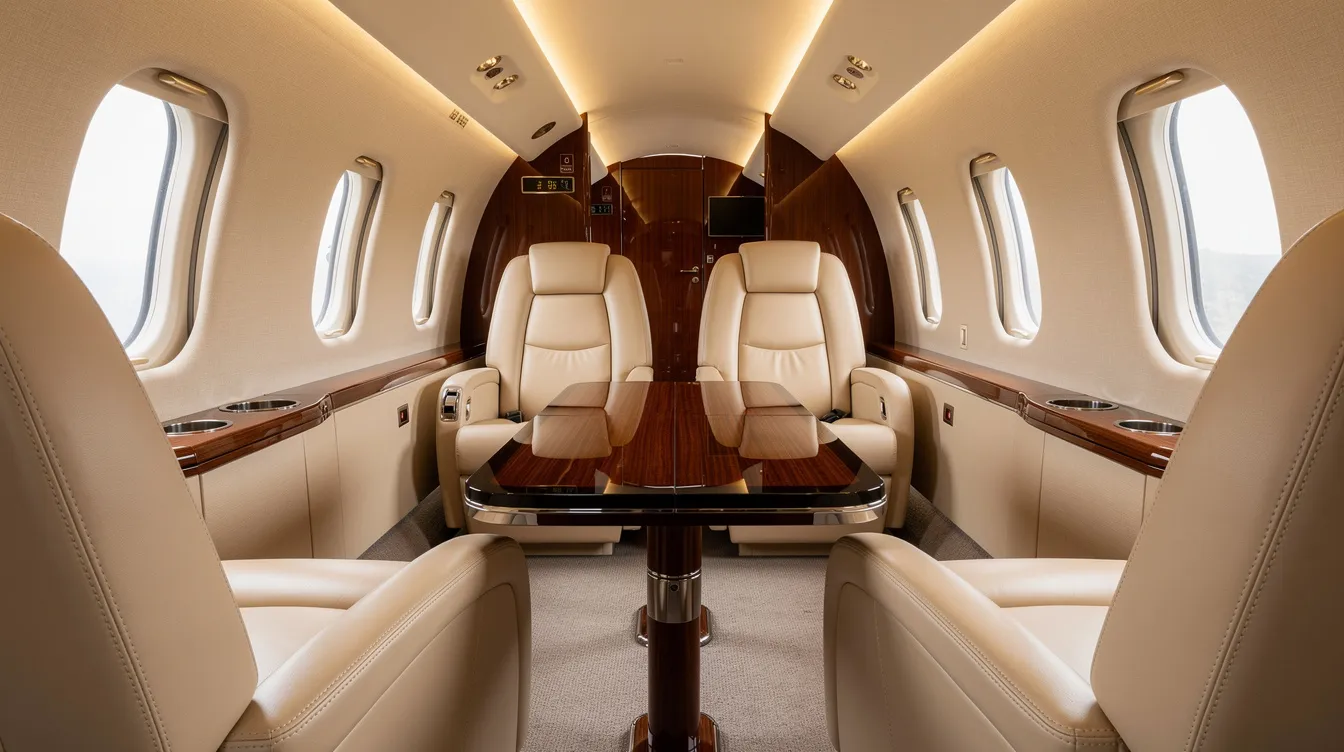
For executives and families who need to move between New York and any destination on the globe, private jets for hire offer schedule control, routing flexibility, and productive travel hours without the financial weight of owning an aircraft. The market for flexible private aviation access has grown steadily, with global private jet flight segments up approximately 3.9% year-over-year through the first 19 weeks of 2026 and North America leading that growth at roughly 4.7%. What follows is a practical guide to how private jet hire works, what it costs, and when a membership-based model like FLYT makes more financial sense than chartering one trip at a time.
This guide is designed for executives, frequent flyers, and families considering private jet travel, providing essential information on how private jet hire works, cost factors, and the advantages of membership-based models.
Key takeaways
Private jets for hire give frequent flyers access to the entire aircraft, from light jets for short regional hops to ultra long range jets for nonstop New York–London or New York–Dubai flights, without purchasing or leasing a plane.
FLYT operates a membership-based, asset-light model with fixed hourly rates and fleet interchange, providing access to over 20,000 aircraft through a curated global network of vetted operators. Learn more about FLYT’s asset-light floating fleet.
Hiring a private jet is primarily about time, predictability, and control over scheduling, aircraft type, and routing rather than flashy amenities.
Membership programs provide flexibility without ownership commitments, reducing upfront costs compared to fractional ownership or large jet card deposits. Explore FLYT’s membership options.
FLYT is positioned as a modern, transparent alternative to ownership, fractional shares, and legacy jet card programs, letting members adapt their flying patterns year by year. See the FLYT advantage.

What "private jets for hire" really means today
The private aviation landscape has shifted considerably since 2020. During the pandemic, executives and high-net-worth families revalued time, privacy, and flexibility. Many moved away from aircraft ownership or fractional ownership and toward on-demand access. Regulatory uncertainty, fuel price swings, crew shortages, and changing travel patterns have made the fixed costs of owning a jet harder to justify. The result is a growing market where flexible access models dominate.
So what does "private jets for hire" actually mean? At its broadest, it covers three access models. On-demand private jet charter is the simplest: you book individual charter flights through a broker or digital platform, pay per trip, and carry no long term commitment. Charter flights can be booked within three hours of contract signing, offering rapid access for urgent travel needs. A jet card involves pre-purchasing a block of flight hours at fixed or semi-fixed rates, typically with a minimum deposit of $50,000 to $150,000, giving you guaranteed availability and rate predictability. A private jet membership, like FLYT offers, is a newer hybrid that combines the fixed-rate structure and availability guarantees of a jet card with fleet interchange and minimal upfront capital, all without owning an aircraft. Private jet membership offers flexible access to aircraft, allowing members to book flights as needed without the obligations of ownership.
Digital platforms now offer access to over 20,000 aircraft globally, and instant pricing allows for quick comparison of charter options across aircraft types and routes. The practical use cases are straightforward: last-minute corporate flights from New York to Chicago, family trips from New York to Aspen, or long range missions like New York to London and New York to São Paulo. In each case, the value proposition is efficiency, privacy, and control over schedule and routing. Not champagne branding. Learn more about the FLYT platform.
How private jet hire works: from request to wheels up
The journey from initial request to wheels up follows a consistent process, whether you are booking a single private charter or flying under a membership. Here is how all the details come together.
Step 1: Trip definition
You provide the essentials: departure and arrival airports, exact dates and times (including alternatives), number of passengers, luggage requirements, pets, any medical or special needs, and whether the flight is one-way, round-trip, or multi-leg. The more detail you share at this stage, the more accurate and complete the initial pricing will be.
Step 2: Aircraft availability search
The platform or membership provider searches its network of vetted operators—or, in FLYT's case, its floating fleet—to find aircraft of the appropriate class. This matching process factors in aircraft size, proximity to your departure point (to minimize costly deadhead repositioning), crew duty availability, and runway limitations at your chosen airports. FLYT’s AI fleet engine supports this optimization.
Step 3: Charter quote and confirmation
A typical quote includes the aircraft hourly rate, crew, fuel or fuel surcharge, insurance, standard catering, and handling and landing fees. What can vary: positioning flights, overnight crew fees, out-of-hours surcharges, de-icing, international permits and customs, and taxes. Many operators set a minimum billable time of 1.5 to 2 hours plus taxi even for short hops. Booking can be completed in as little as three hours for straightforward missions. For more on pricing, visit FLYT pricing.
Step 4: Pre-flight coordination and concierge
Once confirmed, the support team handles ground transportation, selects the optimal departure airport (for example, choosing between Teterboro and JFK for New York departures), arranges catering to dietary specifications, ensures the cabin is configured for work or rest, and manages pets, luggage, and any security or privacy needs.
Day-of-flight experience
Passengers arrive at a Fixed Base Operator (FBO) or private terminal. Security takes minutes, not hours. You board directly onto the aircraft. Departure is flexible within the agreed operating window. No connections to miss, no queues to endure. Private jet users experience rapid departures by skipping traditional ticketing lines entirely.

Types of aircraft you can hire for private charter flights
The right aircraft depends on the mission: distance, passenger count, runway constraints, and budget. Private jet charter services span a wide spectrum, from turboprops suited to 200-mile hops to ultra-long-range jets capable of crossing oceans nonstop. Certain aircraft types accommodate specific passenger counts and flight durations effectively, which is why matching aircraft to mission is a critical step.
Aircraft Category | Typical Aircraft Examples | Passenger Capacity | Range (nautical miles) | Typical Hourly Charter Rate (USD) | Ideal Use Cases |
|---|
Turboprops | King Air 350 | Up to 9 | Up to 1,800 | Starting at $2,000 | Short regional hops, smaller airports |
Light Jets | Embraer Phenom 300E, Citation Encore | 4 to 6 | Up to 2,000 | $4,000 to $6,000 | Regional business trips, quick hops |
Midsize Jets | Citation Latitude | 6 to 9 | Up to 2,700 | Around $7,000 | Medium-haul flights, balanced comfort |
Super Midsize Jets | Challenger 300, Legacy 500 | 8 to 10 | Up to 3,500 | $8,000 | Longer regional, nonstop medium hauls |
Heavy Jets | Gulfstream G-IV, Falcon 2000 | 10 to 13 | Up to 4,000 | Starting at $10,000 | International, larger groups |
Ultra Long Range Jets | Gulfstream G650, Global 5000 | 12+ | 6,000+ | $12,000+ | Intercontinental, nonstop global travel |
VIP Airliners | Boeing Business Jets (BBJs) | 18+ | Variable | Custom pricing | Large groups, VVIP, government travel |
The Gulfstream G650, a flagship ultra-long-range jet, can fly up to 7,000 nautical miles nonstop and is among the few aircraft capable of over 10 hours of continuous flight, making it ideal for intercontinental missions like New York to London or Dubai. Light jets such as the Phenom 300 serve regional routes up to 2,000 nautical miles, perfect for quick business trips or weekend getaways. The midsize Citation Latitude has been a best-selling jet since 2015, offering a blend of range, comfort, and efficiency for medium-haul flights. Turboprops like the King Air 350 accommodate up to 9 passengers and excel at short regional hops into smaller airports.
Modern membership platforms like FLYT emphasize fleet interchange: members choose the right aircraft for each trip instead of being locked into a single jet or fractional share. A light jet for Monday's Boston day trip. Super midsize for Thursday's Miami meeting. Ultra-long range for next month's London board session. All under one membership.
Why executives and families choose private jets for hire
The decision to fly private is driven more by operational calculus than by amenity lists. Private jets save time by reducing travel delays, eliminating connections, and giving passengers direct flights to desired destinations that commercial flights either don't serve or serve poorly.
Schedule control and flexible scheduling
Private jet travel allows departures aligned to meeting schedules, not airline timetables. If a negotiation runs long, the aircraft waits. If a meeting is canceled, the flight adjusts. Charter services provide flexible scheduling for last-minute trips, which is a capability that commercial aviation simply cannot match.
Airport access
Charter flights provide access to more airports than commercial airlines—roughly 5,000 in the United States alone versus around 500 served by scheduled carriers. Flying into Teterboro or White Plains instead of JFK can save an hour of ground time in New York. Van Nuys or Santa Monica instead of LAX does the same in Los Angeles. London Farnborough, instead of Heathrow, eliminates terminal congestion entirely.
Privacy and confidentiality
Privacy and discretion are major benefits of private jet travel. A private cabin is not a perk—it is a working environment for board discussions, investor reviews, and sensitive negotiations. Small, vetted crews and private terminals limit exposure. Digital platforms eliminate traditional airport hassles for travelers who value anonymity.
Reliability and reduced friction
No missed connections. No lost luggage in transit systems. Fewer weather-related delays because private flights can reroute dynamically. Flexibility in scheduling characterizes private jet travel at every level.
Family and leisure travel
Multi-generational trips, ski weekends, school holiday departures—flying private with children and pets removes the friction of commercial cabins. Private aviation enhances comfort compared to traditional airline travel in ways that matter most to families: space, timing, and simplicity.
What drives the cost of hiring a private jet
Charter costs are mission-specific. Understanding the core cost drivers helps executives and corporate travel teams plan and budget realistically, rather than reacting to quotes that seem opaque.
The major components:
Aircraft type and size. Costs in private aviation can vary widely based on aircraft size and type. Turboprops at roughly $2,000 per hour versus ultra long range aircraft at $12,000 or more per hour represent the spectrum. The hourly rate reflects fuel burn, maintenance reserves, crew costs, and insurance.
Flight time and distance. Shorter private flights like New York to Boston may trigger minimum billable hours (often 1.5 to 2.0 hours plus taxi), while long range missions are priced closer to actual flight hour totals.
Positioning flights. If the aircraft must reposition to your departure airport, that deadhead cost adds to the total—sometimes 30 to 40 percent over a same-airport departure. Empty leg flights offer significant discounts on standard charters when you can match your itinerary to an aircraft already repositioning.
Seasonality and demand. Charter costs fluctuate based on peak travel days. Holiday periods, major sporting events, and conferences like Davos tighten aircraft availability and push rates higher.
Additional variables. De-icing in winter, hangar fees during storms, out-of-hours operations at smaller airports, and short-notice changes all add cost.
Fuel price volatility. Fuel surcharges are often passed through in on demand flights; some jet card and membership structures absorb or fix these for greater predictability.
Fixed hourly rates via a membership model like FLYT create predictable costs over a year, smoothing out the variability that defines purely on-demand charter flights. For discerning travelers and corporate travel departments, predictability is often worth as much as the rate itself. Learn more about charter volatility protection.
Membership vs on-demand charter vs jet cards
Once a traveler is flying private more than a few times per year, the access model matters more than any single charter price. The decision framework depends on annual hours, route patterns, and tolerance for financial variability.
On-demand private jet charter
Pay per trip, no commitments. This works well for occasional flyers doing fewer than 25 hours per year. Pricing fluctuates with market conditions, aircraft availability, and seasonality. Maximum flexibility, but no rate certainty. Charter flights allow access to over 20,000 aircraft globally, which provides breadth but not necessarily consistency.
Jet card programs
Pre-purchased hours at fixed or semi-fixed rates. Jet cards typically require a minimum deposit of $50,000 to $150,000 and are best suited for flyers doing 25 to 100 hours per year. They offer guaranteed availability and rate predictability, though blackout dates, category restrictions, and hidden surcharges vary by provider.
Fractional ownership
Fractional ownership allows individuals to buy a share in an aircraft for reduced management responsibilities, but the financial bar is high. Fractional ownership requires a capital commitment of $400,000 or more for a typical share, plus monthly management fees and hourly operating costs. Fractional ownership is ideal for those flying over 100 hours annually on consistent routes and aircraft types. Below that threshold, the economics rarely justify the capital commitment.
Private jet membership (FLYT model)
Membership programs like FLYT combine fixed hourly rates, fleet interchange, and global access without requiring aircraft ownership. Membership models can reduce upfront costs compared to ownership while still providing access to a diverse fleet across categories. Private jet memberships allow for global access to various destinations and popular destinations without locking capital into a depreciating asset.
For financially sophisticated clients, the evaluation is straightforward: map total annual flying hours, typical routes, and desired flexibility, then compare total cost across models. Ownership and fractional shares tie up capital and add operational complexity. Memberships and flexible access models optimize cash flow and reduce long-term risk. Compare FLYT vs charter, FLYT vs jet cards, and FLYT vs fractional.
How FLYT approaches private jets for hire
FLYT is a membership-based private aviation service focused on access to private jet flights through a global floating fleet rather than selling individual charter flights one at a time.
Asset-light, floating fleet model
FLYT does not require members to own aircraft. Instead, it operates through a curated global network of vetted operators, all meeting strict safety and service standards. This asset-light structure means members benefit from a diverse fleet without carrying depreciation, maintenance, or crew management overhead. Private jet membership offers access to over 20,000 aircraft through this network, providing global reach without capital exposure. Learn more about the risk pool model.
Fixed hourly rates
Members lock in transparent hourly pricing across selected aircraft categories—light, midsize, super midsize, heavy, and ultra long range. Private jet memberships often feature fixed hourly rates for flights, which simplifies budgeting for frequent private jet travelers and corporate travel teams. No hidden margins. No surprise repositioning surcharges at checkout.
Fleet interchange
Members choose different aircraft types per mission. A light jet for a New York to Boston day trip. A super midsize for New York to Miami. An ultra long range aircraft for New York to London. All within a single membership framework. This is the operational advantage of providing access across the full aircraft spectrum rather than tying a member to a single tail number.
Concierge-level support
FLYT's team assists with route planning, airport selection, ground transfers, catering, and last-minute schedule changes. Aviation experts on the team help clients choose the best aircraft and routing for each journey, functioning as personalized service advisors rather than booking agents.
Positioning against traditional models
Compared with fractional ownership, there is no capital tied up and no residual value risk. Compared with many legacy jet card programs, the pricing is more transparent and the fleet more flexible. FLYT members can adapt their flying patterns year by year without penalty—a critical advantage as business needs evolve. See how FLYT compares to brokers and jet cards.
Optimizing routes, time and aircraft choice
The real efficiency in private aviation comes from intelligent routing and aircraft selection—not just from flying private itself. A well-planned trip on a right-sized aircraft can save hours and thousands of dollars compared to a poorly matched booking.
Airport strategy
Secondary airports reduce ground time significantly. In New York, departing from Teterboro or White Plains instead of JFK or Newark can save 45 minutes to an hour each way. Around Los Angeles, Van Nuys or Santa Monica serve a similar purpose. In London, Farnborough or Luton eliminate the congestion of Heathrow. For major cities, airport choice is one of the highest-impact variables in the entire trip.
Matching aircraft to mission
Choose the smallest aircraft that fulfills mission constraints: range, passenger count, baggage. A light jet handles New York to Boston efficiently. A super midsize jet is appropriate when you need a stand-up cabin or nonstop range from New York to Miami. An ultra long range aircraft is necessary for intercontinental legs, but it is an expensive choice for a 400-mile hop.
Nonstop vs. cost trade-off
A nonstop flight eliminates stopover time, but ultra long range jets cost significantly more per flight hour. Sometimes a midsize jet with one planned fuel stop delivers the same total travel time at lower cost, depending on the route and number of passengers.
Recurring patterns
Many executives fly Monday-through-Thursday corporate rotations between hubs like New York, Chicago, and Toronto, with quarterly trips to Europe. FLYT advisors can map these patterns and suggest smarter routing—adjusting departure times to avoid slot constraints, selecting airports to minimize weather risk, and smoothing costs across recurring missions.
Comfort, connectivity and in-flight experience when flying private
Modern private jets for hire are designed as extensions of the office or home. The emphasis is on productivity, rest, and privacy—not spectacle.
Cabin features by category
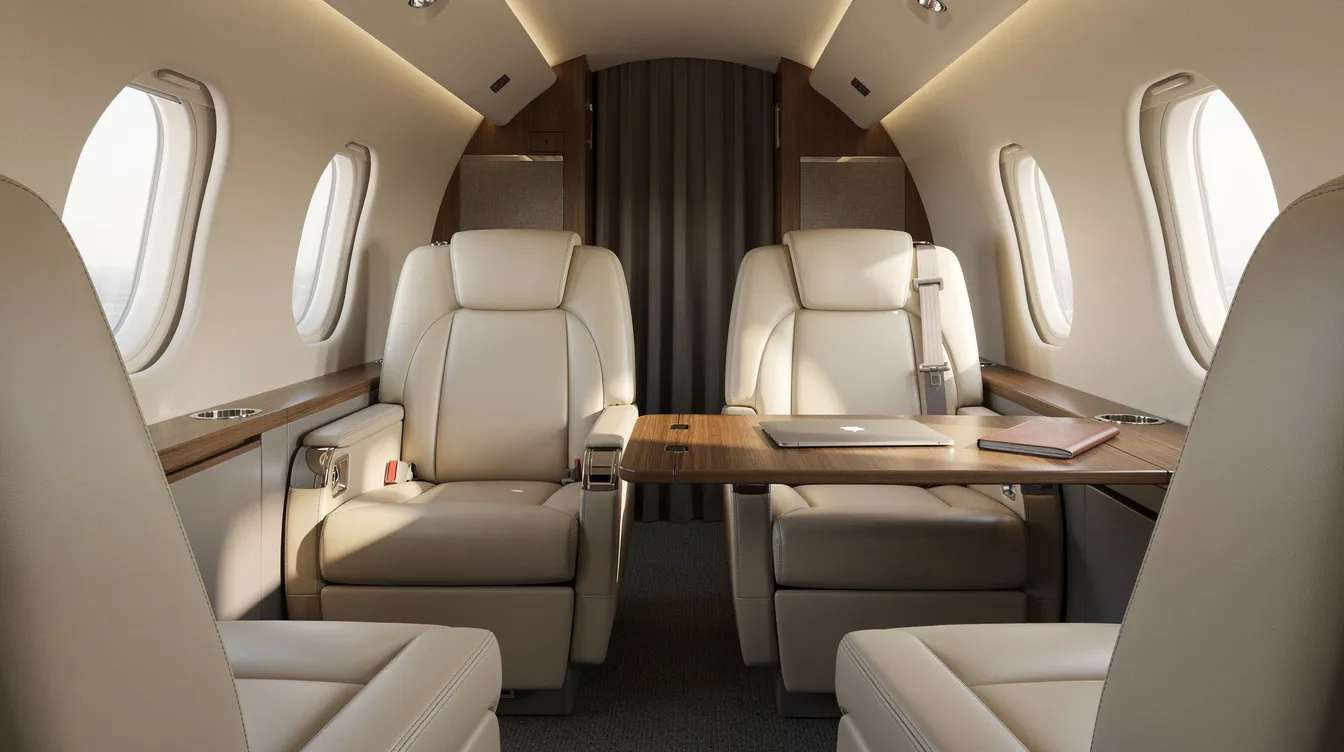
Midsize and larger jets offer comfortable seating in club or conference configurations, fold-down work tables, power outlets at every seat, and quiet cabins suitable for calls and presentations. Larger aircraft feature lie-flat seating and separate rest areas for longer international flights, offering spacious cabins for work and rest.
Connectivity
High-speed satellite internet is available on most midsize and larger jets. For executives conducting live financial reviews, board updates, or remote negotiations mid-flight, connectivity is not optional. Private aviation offers convenience and personalized service that extends to ensuring the cabin is configured for the traveler's needs.
Catering and amenities
Custom and tailored amenities enhance the private aviation travel experience. Catering ranges from simple, high-quality options for early-morning departures to tailored menus for longer journeys. Dietary preferences are accommodated by default. The focus is quality and appropriateness, not excess.
Pets and families
Many private aircraft are pet-friendly. Operators disclose any additional cleaning requirements and fees prior to booking. For families, the ability to plan around school schedules, pack freely, and travel without the friction of commercial cabins is often the deciding factor.
Risk, safety and operational standards in private aviation
Safety and operational rigor matter more to executives than cabin aesthetics. Standards in private aviation can vary by operator, which makes vetting essential.
Key regulatory frameworks
In the United States, FAR Part 135 governs commercial charter operations in aviation. FAR Part 135 governs commercial charter operations in the U.S. All aircraft must meet FAA Part 135 certification for safety compliance before they can legally carry charter passengers. This regulation covers pilot certification, crew duty limits, maintenance schedules, and inspection requirements.
Third-party safety audits
Operator safety audits from organizations like ARGUS or Wyvern provide important operator evaluations beyond the regulatory minimum. ARGUS Gold is the minimum safety benchmark for charter operators. ARGUS Platinum designation indicates high safety standards for operators with extensive track records and clean audit histories. IS-BAO Stage 3 is a safety designation that reflects a mature safety management system at the operator level. These audits assess maintenance records, crew training, insurance, and safety management practices.
Crew standards
Typical crew requirements include minimum flight hour thresholds, recurrent simulator training, and two-pilot operations even on aircraft certified for single-pilot use. Crew duty day constraints—often around 14 hours for charter flight crews—directly influence route planning, fuel stops, and whether an overnight crew layover is needed.
FLYT's approach
FLYT's membership model relies on a curated risk pool of operators and a floating fleet model, ensuring consistent safety expectations across different aircraft and regions. Every operator in the network is vetted against defined safety criteria before any member flies. Learn more about the FLYT risk pool.
A credible provider will be transparent about operators, aircraft age and configuration, tail numbers, crew credentials, and any operational constraints that might affect a proposed itinerary. If a provider is evasive about these details, it is a signal to look elsewhere.
When a private jet membership makes more sense than one-off hire
Beyond a certain annual flying threshold, the decision shifts from "Should I charter?" to "Which access structure is most rational for my flying profile?"
Common triggers for membership
Flying private more than 25 to 50 hours per year. Regular routes such as New York to Miami or New York to Los Angeles. A mix of corporate travel and family leisure travel requiring predictable aircraft availability. When these conditions apply, the economics of one-off charter—with its variable pricing, repositioning surprises, and limited guarantees—start to erode.
High-level economics
Fixed hourly rates and reduced repositioning costs under a membership simplify annual budgeting compared to fluctuating on-demand charter rates. The membership essentially converts unpredictable trip-by-trip costs into a more stable operating expense. Membership models can reduce upfront costs compared to ownership by eliminating the capital outlay, depreciation risk, and management overhead of fractional or full ownership.
Corporate use cases
CFOs and travel managers responsible for C-suite travel, investor roadshows, and multi-city deal processes benefit from predictable, auditable costs. A membership framework provides the documentation and consistency that corporate finance teams require.
FLYT's model
FLYT offers global reach with fleet interchange, allowing members to right-size aircraft for each mission without locking capital into a single jet. Whether the trip is a 90-minute domestic hop or a 10-hour transatlantic flight, the membership covers it. An initial consultation can map recent and expected flying into an annual profile to determine whether membership, on-demand charter, or another model is the most cost effective and efficient approach for your travel needs. Contact FLYT to learn more.

Frequently asked questions about private jets for hire
How far in advance should I arrange a private charter flight?
For most non-peak routes and common aircraft types, 24 to 72 hours' notice is sufficient to secure suitable aircraft availability. Same-day private flights are possible—charter services can accommodate last-minute trips within three hours—but shorter notice may limit options and increase positioning costs.
Peak periods deserve more planning. Holiday seasons, major sporting events, and global conferences benefit from at least 7 to 10 days' notice to secure preferred aircraft types and departure times. FLYT members typically receive faster confirmations and more consistent charter options due to pre-established terms and a defined service framework. See more in the FLYT FAQ.
Can I change my schedule after I've confirmed a private jet hire?
Schedule changes are usually possible, though they depend on aircraft and crew duty constraints, airport operating hours, and slot availability. Modest timing adjustments on the same day are often manageable, while date changes or significant rerouting may incur change fees or re-quoting of the charter flight.
One advantage of membership with FLYT is having a dedicated team to manage these changes quickly and to present alternatives when operational constraints arise. Clients working with a membership plan generally experience less friction during schedule shifts than those booking one-off on demand flights.
Is hiring a private jet between New York and London always nonstop?
Most modern long range and ultra long range jets—such as the Gulfstream G650 series and Bombardier Global family—can operate New York to London nonstop, even with typical passenger loads and full baggage. The Gulfstream G650 can fly up to 7,000 nautical miles nonstop, making it a top choice for transatlantic travel. However, specific aircraft selection, weather patterns, and headwinds can affect fuel planning. Smaller or older aircraft might require a brief technical stop under certain conditions.
Route planning is handled well in advance so clients know whether their chosen aircraft will fly nonstop or include a planned fuel stop. Travelers can book private jets with as little as three hours' notice for domestic routes, but transatlantic planning typically benefits from a longer lead time to confirm the best aircraft and routing.
How is privacy and confidentiality handled when flying private?
Private terminals, direct boarding, and small, vetted crews significantly reduce exposure compared with commercial flights. Reputable providers enforce strict confidentiality policies, limit access to passenger information, and use secure processes for payments and documentation.
FLYT works with operators who understand the needs of corporate, investor, and family offices, maintaining discretion around itineraries and passenger identities. This level of service is standard within FLYT's global network, not an add-on.
What information do I need to provide to get an accurate quote?
To receive a precise quote, provide: travel dates and preferred departure times, origin and destination airports, number of passengers, luggage details (including skis, golf bags, or oversized items), and whether pets will join. If you need specific in-cabin workspace, particular catering requests, or medical equipment, include those details as well so the right aircraft and configuration can be selected.
Greater detail at the quote stage leads to a more accurate all-in price with fewer adjustments later, which aligns with FLYT's focus on transparent, predictable pricing.
How does a private jet membership differ from buying a jet card?
A jet card is essentially a prepaid block of hours with a specific provider, often limited to a single aircraft category and subject to blackout periods or peak-day surcharges. A membership like FLYT offers fleet interchange across multiple aircraft categories, fixed hourly rates without hidden margins, and the ability to adapt your flying patterns annually. For a global leader in private travel flexibility, the membership approach is designed for clients whose missions vary in distance, aircraft size, and destination rather than fitting a single pattern.
Are there cost savings for one-way private flights?
Yes. One-way private charter flights avoid the cost of the return leg, and when your itinerary aligns with an aircraft that needs to reposition, empty leg flights offer significant discounts on standard charters. FLYT's team actively monitors repositioning opportunities within the network to surface cost effective options for members booking one-way trips between major cities.
The market for private jets for hire is growing because the underlying logic is sound: access the aircraft you need, when you need it, at a predictable cost, without carrying the financial burden of ownership. For executives and families who book regularly enough that on-demand charter pricing becomes unpredictable, a membership model offers a rational middle path—structured enough for budget certainty, flexible enough for real-world travel.
Explore how FLYT's membership model can align with your flying profile and travel needs.
Conclusion
Private jets for hire represent a strategic evolution in private aviation, offering executives, entrepreneurs, and families the operational efficiency and flexibility they demand without the complexities of ownership. By choosing a membership model like FLYT’s, travelers gain access to a diverse global fleet, predictable fixed hourly rates, and concierge-level support tailored to their unique mission profiles. This asset-light approach optimizes capital allocation while delivering seamless, secure, and confidential travel experiences worldwide.
For those seeking a smarter, more adaptable way to fly private, FLYT provides a transparent, flexible alternative to traditional ownership, fractional shares, and jet cards. Discover how FLYT’s innovative membership model can transform your travel—offering global reach, fleet interchange, and a commitment to operational excellence.
Explore more at www.flyt.com and see how modern private aviation can work without ownership complexity.