Most conversations about private aviation focus on the departure or the destination. Rarely does anyone explain what actually happens on a private jet in flight—how the cabin functions, how performance varies by aircraft type, or how pricing works beneath the surface. This article covers the operational reality of flying private, from cruise altitude to cost structure, and explains how membership-based access through FLYT gives frequent travelers predictability without ownership complexity.
Key takeaways
Private jet travel turns dead transit time into productive, controllable hours. Instead of arriving two hours early for commercial flights, clearing security, and competing for overhead bin space, private travelers drive to an FBO, board in minutes, and depart on their schedule. Private jet travelers save an average of 127 minutes per flight compared to commercial alternatives. FLYT offers membership-based access to this experience, replacing the burden of aircraft ownership with fixed hourly rates and global reach.
The core advantages of flying private in flight include:
Privacy that enables confidential work, board-level discussions, or uninterrupted family time—none of which is practical in a first-class cabin surrounded by other passengers.
Schedule control that allows same-day return trips more easily than commercial flights, with departures timed around your agenda rather than an airline's.
Access to over 5,000 airports worldwide, including smaller airports closer to final destinations that commercial airlines simply do not serve.
The ability to work or rest in a spacious cabin equipped with high-speed Wi-Fi, power outlets, and customizable lighting.
Customizable flight experiences, including catering, cabin temperature, and seating configuration.
FLYT's membership model provides predictable fixed hourly rates, fleet interchange across aircraft types from light jets to long-range jets, and an asset-light floating fleet that eliminates the capital and operational drag of ownership. Private jet hourly rates range from $2,000 to $15,000, depending on aircraft category, and FLYT members lock in transparent pricing rather than navigating volatile charter markets.
Members can access everything from short regional flights on turboprops to nonstop international flights on long-range private jets covering routes such as New York–London or Los Angeles–Honolulu. The following sections explain what happens on a private jet in flight, how charter flights are priced, how membership compares to jet cards and fractional ownership, and how to select the right aircraft for each mission.
Flying private versus flying first class
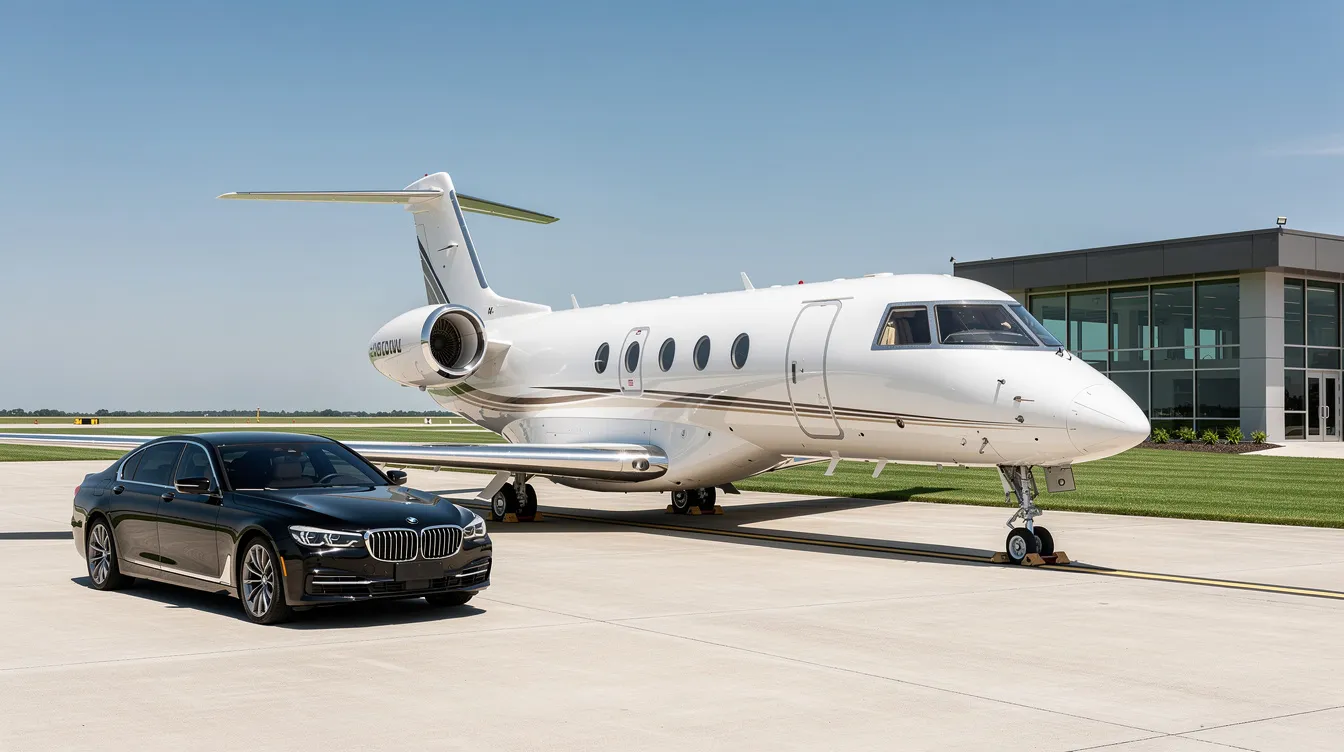
Picture a Monday morning JFK–LAX trip. In first class, you arrive 90 minutes early, wait in the security line, navigate the terminal, settle into a seat beside strangers, and land at a congested airport on the far side of the city from your meeting. Now consider the private alternative: you arrive at Teterboro, 20 minutes from midtown Manhattan, 15 minutes before departure. Your car pulls up to the aircraft. You board, greet the flight crew, and taxi to the runway. Passengers can check in just 15 minutes before departure for private flights—a stark contrast to the regimented boarding process of a commercial airline.
The operational differences between private air travel and commercial travel go well beyond check-in time:
Private terminals and Fixed Base Operators replace crowded airline terminals with quiet, efficient facilities designed for rapid boarding.
Arrival windows of 15–20 minutes before takeoff versus 60–120 minutes at commercial airports.
Direct routings and the ability to fly higher than commercial jets, often cruising above air traffic and weather at FL410–FL450.
Use of secondary airports closer to meetings or homes—Teterboro instead of JFK, Van Nuys instead of LAX, Farnborough instead of Heathrow.
No connections, no layovers, and no risk of missed flights due to delayed scheduled service on a prior segment.
Privacy in flight transforms the cabin into a boardroom, family room, or quiet workspace. A first-class suite on a commercial airline cannot replicate the conditions needed for a confidential investor call, a sensitive HR discussion, or simply a family with young children who need space and calm. Private jets provide enhanced privacy without disturbances from other passengers or cabin announcements.
The cost structure also differs fundamentally. Ad-hoc charter flight pricing is quoted per trip, often with opaque surcharges for fuel, positioning, and peak-period premiums. FLYT membership provides predictable fixed hourly rates, making private aviation a budgetable line item rather than a variable expense. For travelers flying 50–150 hours per year, this predictability changes the financial calculus entirely.
Private aviation is primarily a time and control tool. It is not simply a luxury upgrade from commercial first class—it is a different operating model for people whose schedules, privacy requirements, and travel needs justify the investment.
What actually happens on a private jet in flight
Think of a typical 2.5-hour private charter flight as three distinct phases, each managed around the passenger's preferences rather than an airline's operational template.
Departure
You arrive at the FBO by car. There are no ticket counters, no security queues, and no gate changes. You greet the flight crew on the tarmac or inside a small lounge, receive a brief safety overview on board, and the aircraft taxis to the runway. At many smaller airports, taxi times are a fraction of what you would experience at a major hub. Private jets allow travelers to bypass long lines and rigid schedules entirely.
Climb and Cruise
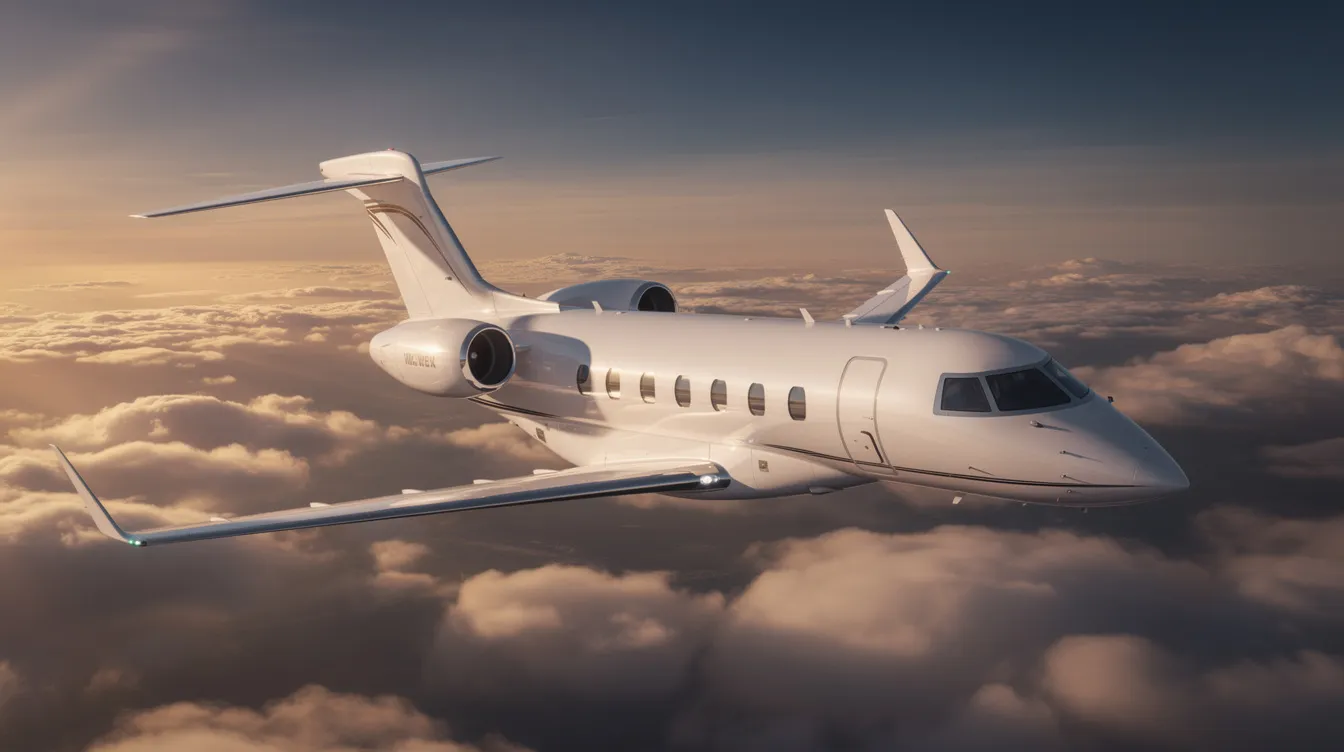
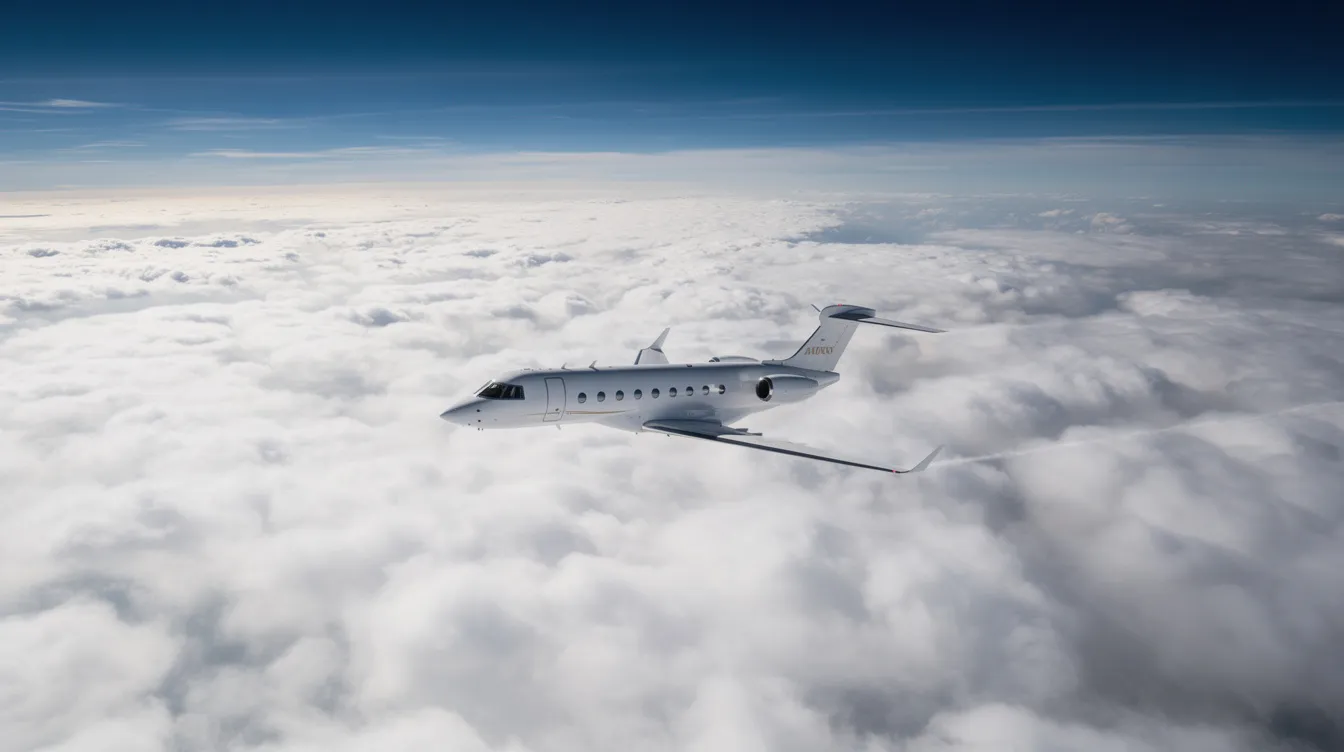
Midsize and long-range jets typically climb to FL410–FL450, where they cruise above most weather systems and commercial air traffic. Private jets can fly higher than commercial jets, avoiding traffic and turbulence at lower flight levels. This altitude advantage translates to smoother rides and more consistent flight times. Routing can also be adjusted when ATC allows, and dispatchers coordinate with pilots to optimize the path for weather conditions and timing.
Common in-flight activities include:
Running a financial review or building a presentation on a laptop at a club-style table.
Confidential calls over onboard Wi-Fi with enough bandwidth for video conferencing on many aircraft.
Children sleeping on divans while a parent works in a separate seating zone.
Reviewing a pitch deck with co-founders in a quiet, distraction-free environment.
Cabin Experience
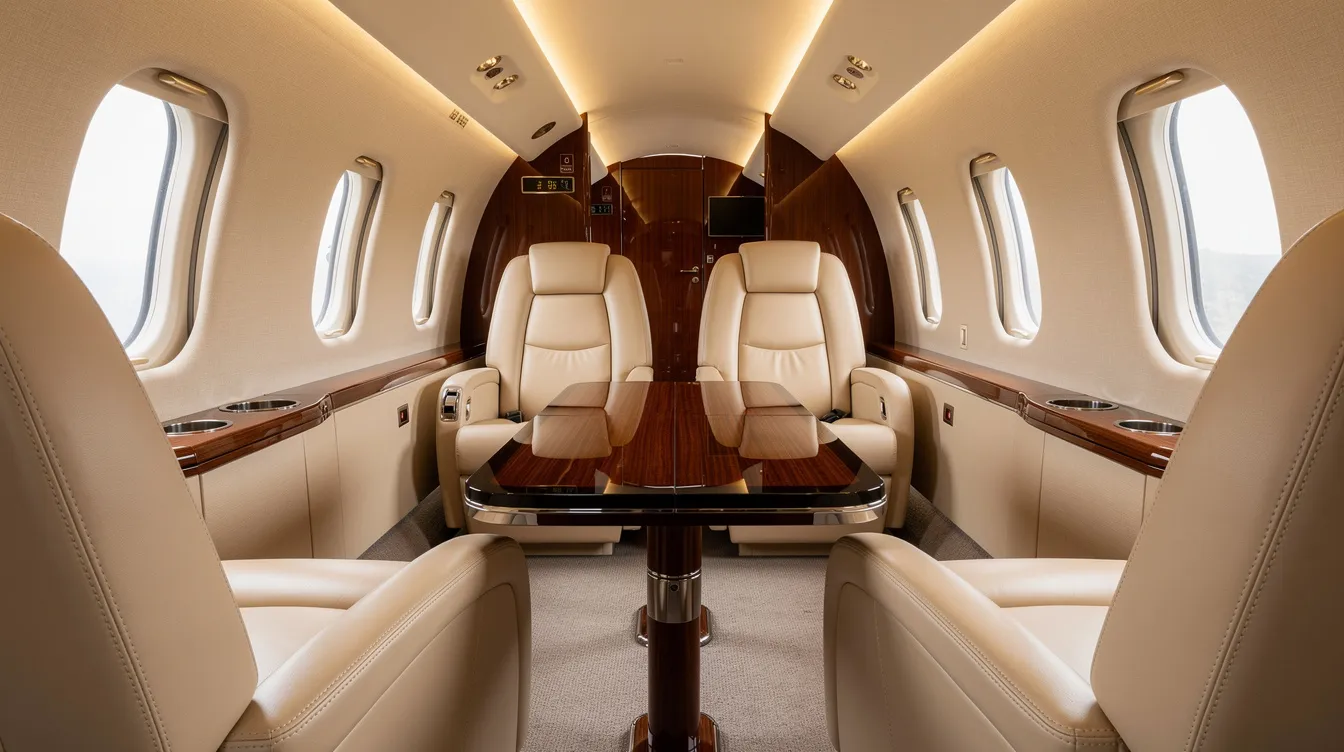
Cabin layout shapes the in-flight experience significantly. On a light jet handling a New York–Chicago leg, you get a compact but functional cabin for two to four passengers, limited galley space, and a small lavatory. A midsize jet on the same route offers stand-up headroom, an enclosed lavatory, and more space for luggage and movement. For a New York–Zurich mission on a long-range jet, expect multiple living zones, a full galley for hot meals, and private jets can have fully enclosed bathrooms with sinks and mirrors—amenities that make a nine-hour flight genuinely productive or restful.
The flight crew manages cabin temperature, lighting, and catering to match passenger preferences. If you need wheels down by 15:00 to make a 16:00 board meeting, that target is coordinated into the flight plan from the start. Flight details like descent timing, approach routing, and ground transport handoff are all aligned around your schedule, not the airline's.
Choosing the perfect plane for each mission
Aircraft selection is a strategic decision. The goal is to match range, passenger count, runway requirements, and budget to the mission—not to default to the largest or most expensive private plane available.
Core categories and their typical use cases:
Turboprops (e.g., King Air 350): ideal for short regional flights under 500–1,000 miles, capable of using shorter runways, and highly cost-effective for regional hops. Charter rates for the King Air 350 start in the mid-$2,000s per hour.
Light jets: suited for two to six passengers on sub-1,500-mile legs, offering faster cruise speeds than turboprops and access to almost any airport with a paved runway of moderate length.
Midsize jets (e.g., Citation XLS, Learjet 60): the workhorse for coast-to-coast US flights like Boston–Atlanta or New York–Dallas, seating seven to nine passengers with enclosed lavatories and reasonable baggage capacity.
Super midsize and heavy jets: bridge the gap to intercontinental capability, handling longer routes with more cabin volume and range.
Long-range jets (e.g., Gulfstream G550, Global 6000): required for nonstop missions such as New York–London, Miami–São Paulo, or Los Angeles–Tokyo, carrying passengers in full comfort with multiple cabin zones.
Weight, runway length, and weather conditions can influence the right aircraft choice, even on routes under 3,000 miles. A hot day at a high-elevation airport may require a more powerful aircraft than the same route would need in cooler conditions. Payload trade-offs—more passengers or luggage means potentially reduced range—are part of every dispatch calculation.
FLYT's fleet interchange approach allows members to switch between aircraft types from trip to trip. You are not tied to a single asset. A light jet for a Tuesday shuttle between regional offices and a long-range jet for a Friday transatlantic crossing can both be sourced through the same membership structure.
FLYT advisors help non-aviation experts define each mission profile—route, passenger count, luggage, timing—and then recommend options that balance comfort, cost per hour, and operational resilience. Finding the perfect plane for each trip is part of the personalized service that comes with membership.
Speed, range, and performance in flight
In-flight performance comes down to three variables: high-speed cruise capability, nonstop range, and the ability to climb above weather and traffic.
Guideline cruise speeds by category: long-range
Turboprops: 220–315 mph, suitable for legs like Los Angeles–San Francisco or regional business corridors.
Light jets: 400–480 mph, covering short to medium-range city pairs efficiently.
Midsize and long-range jets: 450–520 mph, enabling cross-country or intercontinental travel at competitive flight times.
Typical nonstop ranges tell you which missions each category can handle:
Light jets: 1,000–1,500 miles, covering most regional domestic routes.
Midsize jets: approximately 2,300–2,800 miles—midsize jets can fly 2,450 miles in under five hours, making routes like Chicago–San José or New York–Los Angeles (with favorable winds) viable.
Long-range jets: 6,000–7,000+ miles, supporting routes like New York–Dubai with reserves for alternate airports.
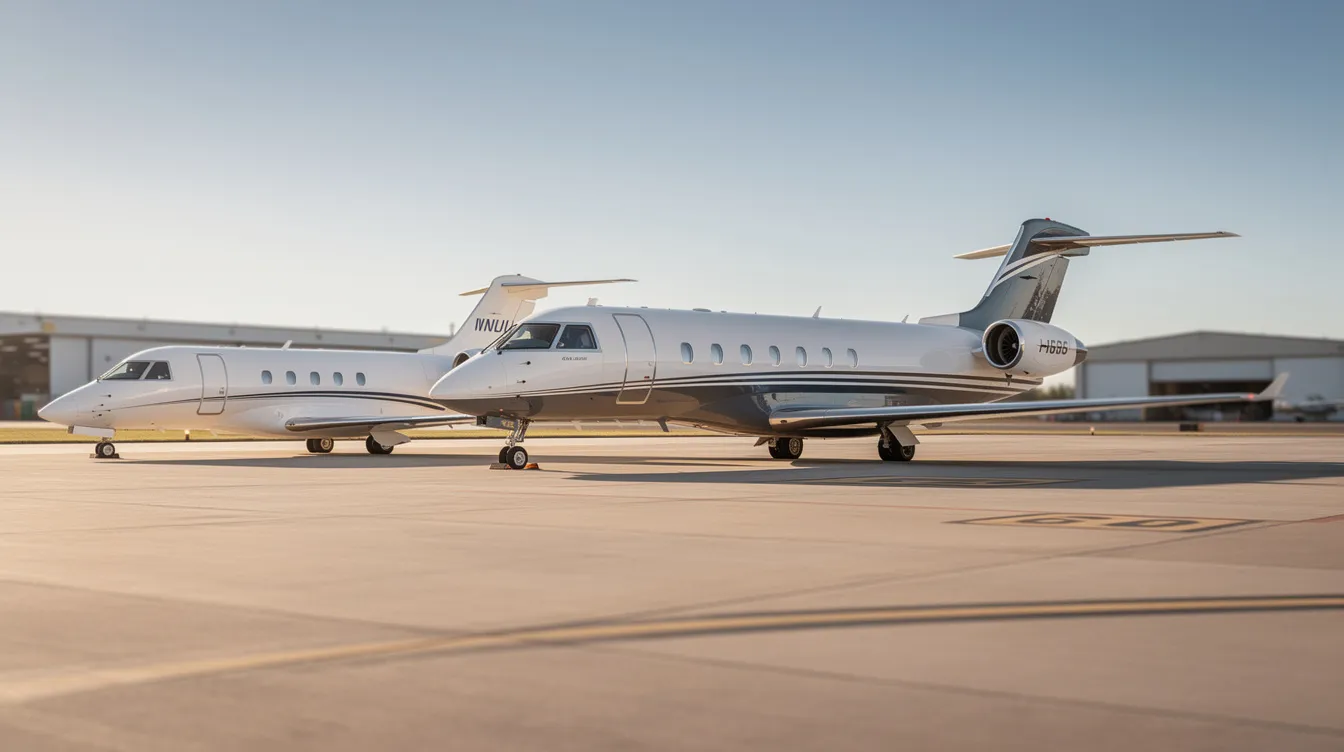
Performance data can be reduced by strong headwinds, high temperatures, or heavy passenger and luggage loads. Dispatchers plan fuel, step-climbs, and alternate airports accordingly. FLYT's planning team uses real-time data to advise members if a nonstop leg is realistic on a chosen type or if a technical fuel stop will be required—an honest assessment that prevents mid-trip surprises.
Charter flights, pricing, and the role of membership
Traditional ad-hoc charter pricing is variable, often opaque, and quoted on a trip-by-trip basis. For executives who value predictability, this model creates friction. Modern private aviation solutions are designed to replace that uncertainty with structure.
Aircraft Category | Typical Cruise Speed (mph) | Typical Range (miles) | Charter Hourly Rate (USD) | Typical Use Case |
|---|
Turboprops | 220–315 | Up to 1,000 | $2,000–$3,500 | Short regional flights, access to short runways |
Light jets | 400–480 | 1,000–1,500 | $3,500–$6,500 | Regional trips, 2–6 passengers |
Midsize jets | 450–520 | 2,300–2,800 | $5,000–$8,500 | Coast-to-coast US flights, 7–9 passengers |
Super midsize & heavy jets | 450–520 | 3,000–6,000+ | $6,500–$17,000+ | Intercontinental flights, larger cabins |
Long-range jets | 450–520 | 6,000–7,000+ | $9,000+ (e.g., Gulfstream G650) | Nonstop global routes, full comfort |
Key pricing drivers for any charter jet include:
Flight distance and total flight time
Aircraft category—fuel burn, crew costs, and maintenance reserves vary dramatically between a turboprop and a heavy jet
Airport selection, including landing fees and handling charges
Time of year—peak demand during late December holidays, major conferences, or sporting events drives rates higher
Repositioning requirements when the aircraft must deadhead to your departure airport
Operational constraints such as crew duty limits and airport curfews
A Gulfstream G650 charter costs around $9,000 per hour, placing it in the premium tier but well below the cost of owning and operating that aircraft outright.
Empty leg flights occur when an aircraft must reposition without paying passengers. These segments are sold at a discount but come with constraints: fixed departure dates, fixed airport pairs, and limited schedule flexibility. They can be useful for leisure travel or opportunistic trips, but they are rarely suitable for business-critical itineraries.
Charter flights can be booked as late as 24 hours before departure, and booking a private jet typically requires a personal charter specialist to coordinate aircraft, crew, and logistics. Instant pricing tools give directional cost estimates in seconds, but serious travelers benefit more from structured programs. FLYT's membership model secures transparent hourly pricing, reduces exposure to last-minute market spikes, and avoids the capital lock-up associated with fractional ownership or large jet card deposits.
One-way private jet charters offer flexibility for uncertain return plans, and private jets allow customized flight routes based on passenger needs—advantages that the rigid network structure of commercial airlines cannot replicate.
Membership vs jet cards vs fractional ownership
Many readers evaluating private aviation are actively comparing models: on-demand charter, jet card, fractional ownership, and membership. Each serves a different profile.
Fractional ownership means buying a share—say 1/8—of a specific aircraft, entitling you to roughly 100 occupied hours per year. The acquisition cost is high, monthly management fees cover crew and maintenance, and at contract end, you are exposed to residual value risk. Private jet ownership costs can exceed $1 million annually when accounting for depreciation, crew salaries, hangar fees, insurance, and maintenance reserves. This model suits very high-usage travelers (200+ hours per year) who want a guaranteed tail number.
Jet card programs involve prepaying for a block of hours—typically 25–50 hours—at a published rate within a defined aircraft category. A jet card often includes aircraft category guarantees, but terms vary around peak-day availability, fuel surcharges, and geographic service areas. Cards require meaningful upfront capital and may carry expiration dates or limited flexibility on long-term commitments. Learn more about how FLYT compares to jet cards.
FLYT's membership is asset-light: no aircraft acquisition, no equity share, and no need to manage crew, maintenance, or hangars. Members access predictable fixed hourly rates and global reach through a floating fleet. FLYT's risk pool model spreads operational risk across many trips and aircraft, stabilizing member pricing while preserving flexibility on aircraft type and routing. This structure suits executives and families flying roughly 50–200 hours per year who value capital efficiency and optionality over aircraft "ownership pride." For a detailed breakdown, see FLYT vs fractional ownership.
Life and productivity on board: inside the cabin
The value of a private jet in flight is not just the aircraft itself—it is how the cabin can be configured around work, rest, or family time, sometimes all on the same day.
Cabin Layout
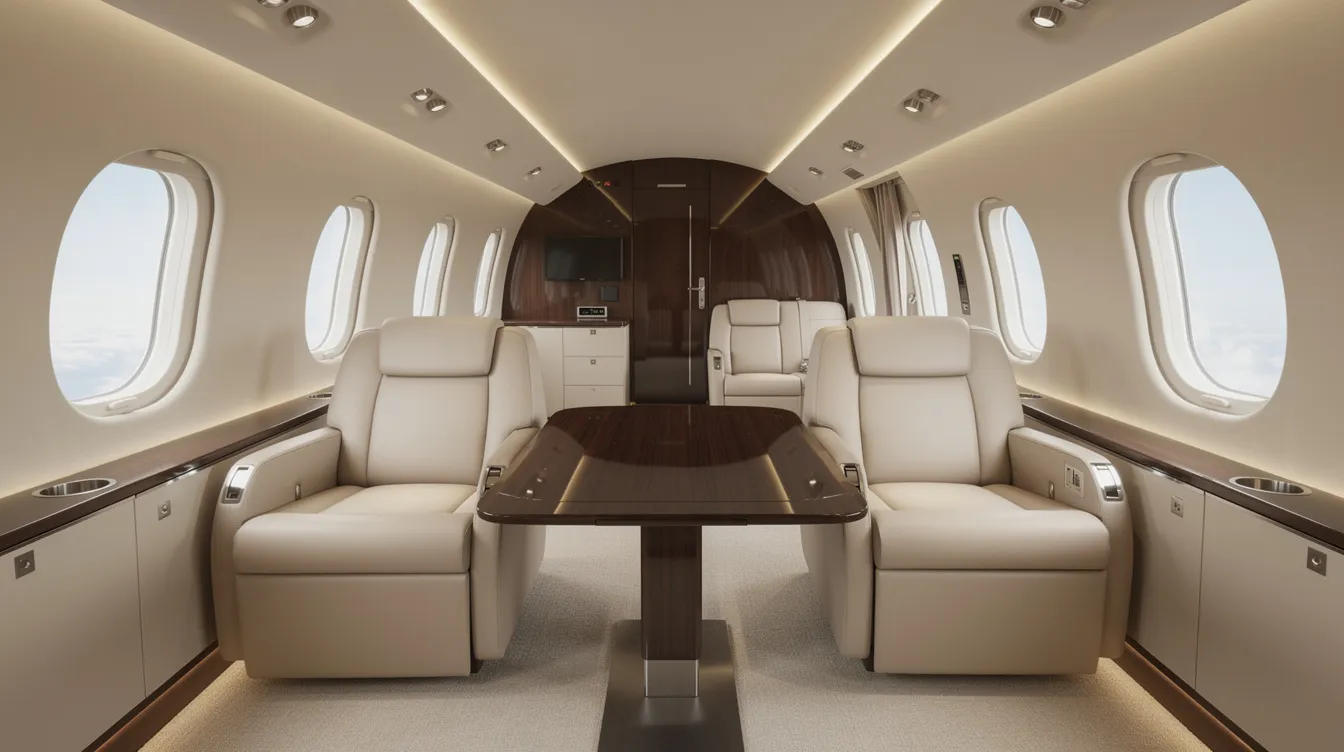
On midsize and long-range jets, the cabin typically divides into functional zones:
Club seats are arranged in facing pairs with a shared table, ideal for meetings or dining.
Divans or sofas along one side, used for rest, children's sleeping space, or informal seating.
A galley area for food and beverage preparation, ranging from a small refreshment center on light jets to a full galley on heavy jets supporting hot meals and curated wine service.
Cabin Features
Frequent travelers prioritize:
High-speed Wi-Fi for video conferencing (Ka- or Ku-band systems common in long-range jets)
Power outlets and USB charging at every seat
Quiet cabins with acoustic insulation for focused work or rest
Adjustable lighting for red-eye flights or daytime productivity
Cabin altitude is maintained at 6,000–8,000 feet equivalent (some ultra-long-range jets hold 4,500–6,000 feet for reduced fatigue)
Spacious and comfortable seating
Fewer restrictions on luggage and pets compared to commercial flights
Ability to bring larger quantities of liquids
Personalized Experience
Traveling on a private jet offers a highly personalized experience. Private jets allow customized flight menus and meal options tailored to dietary preferences, flight duration, and time of day. FLYT's concierge team standardizes favorite onboard preferences—catering partners, specific wines, children's snacks, or privacy requirements—across multiple flights and aircraft types for clients. This consistency is something even the best first-class cabin on a commercial airline cannot deliver, because on a commercial flight, every detail is dictated by the air carrier certificate holder's standard service model rather than the passenger's preferences.
Private jets offer a more luxurious and intimate environment than any commercial cabin, and the ability to fully control schedule and cabin setup across trips makes private travel fundamentally different from even premium commercial air travel. They also often allow more luggage than commercial airlines, with fewer restrictions on pets.
Working in the Sky
The cabin in flight functions as an extension of the office or boardroom. For senior executives, recovering productive hours that would otherwise be lost to airport dwell time and connection risk can mean recovering a full business day per multi-city trip.
Typical use cases for onboard work:
Confidential M&A calls where the discussion cannot risk being overheard by other passengers
Investor updates before quarterly earnings, reviewed and rehearsed en route
Strategy sessions with a leadership team en route to an offsite, using the club-seat configuration as a working table
Quiet preparation before a keynote speech, with no interruptions from cabin announcements or beverage carts
Technical enablers that make this possible:
Ka- or Ku-band Wi-Fi on long-range jets, supporting VPN access and video conferencing
Onboard charging at every seat for laptops, tablets, and phones
Sound levels engineered to keep conversations private within the cabin
Many private jets offer Wi-Fi for passenger use during flights, and cabins in private jets are equipped with high-speed Wi-Fi and power outlets across most modern fleet types
FLYT's operations team can pre-coordinate connectivity requirements, seating layouts, and even presentation setups where aircraft layouts allow, ensuring the cabin is configured for your working agenda before you board. This level of preparation through the FLYT platform is part of what separates membership from ad hoc charter.
Global reach, routing, and operational control
The strategic strength of private aviation is access. Private jets can access over 5,000 airports worldwide, far beyond the hub-and-spoke networks that commercial airlines operate. Private jets can land at almost any airport, big or small, which means your routing is built around your destination, not an airline's network map.
Airport Access
Advantages of secondary airports:
Closer proximity to city centers, industrial sites, or resort destinations—Teterboro for New York, London Farnborough for the City, or Naples Municipal for southwest Florida.
Easier slot availability, faster turns between flights, and less ground congestion.
Reduced ground transfer times that compound the time savings already gained in the air.
Long-range jets make nonstop direct flights possible on routes such as New York–Rome, Los Angeles–Honolulu, or Miami–São Paulo, reducing layovers and eliminating the missed-connection risk that plagues complex international travel itineraries. Private jets allow for same-day return trips more easily than commercial flights, which is particularly valuable for board meetings, site visits, or investor meetings that do not justify an overnight stay.
Operational Flexibility
Charter flights can be re-timed the same day if an investor meeting runs long or a site visit overruns, subject to crew duty limits and airport curfews. This flexibility is built into private charter operations and is a significant advantage over commercial travel, where rescheduling means rebooking, standby lists, and additional cost.
FLYT's floating fleet and global network of vetted partner operators give members access to aircraft in North America, Europe, and key business corridors in the Middle East and Asia, all through the same membership structure. Members use one relationship and one pricing framework regardless of geography.
Risk Management
Operational risk management includes 24/7 support, backup aircraft sourcing when disruptions occur, and route planning that accounts for weather systems, bad weather contingencies, and ATC constraints. This layer of operational control is what distinguishes serious private aviation providers from simple booking platforms.
Empty leg flights and multi-leg itineraries
Empty leg flights occur when aircraft reposition for their next customer, creating discounted segments with inherent constraints.
Common use cases for leg flights:
Last-minute leisure travel, such as Miami–Nassau, when the timing aligns.
Opportunistic city breaks where flexibility on departure time is acceptable.
Aligning a known business route with an available empty leg to reduce cost.
Constraints are real: fixed departure date, fixed airport pair, and a specific aircraft type. Empty legs are less suitable for board meetings or high-stakes events where timing cannot slip.
For members planning multi-leg itineraries—say New York–Toronto–Chicago–New York over two days—FLYT structures the routing, aircraft type selection, and crew duty limits for a seamless series of private flights. The team advises when combining segments on a single aircraft is operationally smart versus when separate point-to-point charter flights create better cost efficiency and risk control. This advisory layer is part of providing access to all the benefits of private aviation without requiring the traveler to become an aviation expert.
Why executives choose FLYT for private aviation
Founders, executives, and family offices who have evaluated or previously used ownership, jet cards, or ad-hoc charter often arrive at the same conclusion: they want the access and flexibility of private air travel without the capital exposure, operational burden, or pricing unpredictability that comes with traditional models.
FLYT's key differentiators:
Membership-based access with no aircraft acquisition or equity share required.
Fixed hourly rates that eliminate the surcharge uncertainty of ad hoc charter.
Fleet interchange across aircraft categories, from turboprops to long-range, co-owning or managing a private plane.
Concierge-level support, including dedicated aviation experts for route planning, aircraft selection, and on-the-ground logistics.
Transparent pricing and clear terms replace the opaque surcharges and seasonal fees often embedded in traditional charter or jet card programs. FLYT's risk pool model and floating fleet create resilience during peak periods such as year-end holidays or major industry events, minimizing disruption risk for members.
A dedicated advisor handles route planning, the selection of the right aircraft for each journey, ground transport coordination, catering, and multi-time-zone scheduling—all managed as part of the membership rather than billed as add-on services.
For executives, families, and business travelers whose travel needs span domestic shuttles and intercontinental crossings, FLYT membership offers a smarter way to access flying private globally without ownership complexity or capital lock-up. Explore how FLYT membership works.
FAQ
How far in advance do I need to book a private jet through a membership like FLYT?
For domestic US trips, executives typically secure aircraft three to seven days ahead, which provides strong availability across most aircraft types. For long-range jets on transatlantic or transpacific routes, seven to fourteen days of lead time is standard to ensure the right aircraft and crew are positioned.
Membership provides priority access during busier periods such as major conferences, sporting events, or holiday peaks, reducing the risk of last-minute price spikes or limited availability. Charter flights can be booked 24 hours in advance, and FLYT's team can assist with urgent same-day or next-day requirements, subject to aircraft and crew availability. Learn more in the FLYT FAQ.
Can I combine private aviation with commercial flights on the same itinerary?
Many executives pair long-haul commercial flights with private jet segments. For example, flying business class from London to Dubai, then using a charter jet to reach a regional city with limited airline service. This hybrid approach optimizes cost while preserving the time savings and access to smaller airports that private charter provides.
FLYT's concierge can coordinate schedules around commercial arrivals and departures, including buffer times for immigration and baggage, ensuring ground transport and the private segment connect without gaps.
What kind of documentation do I need to fly private internationally?
Passports and visas are required for international charter flights, just as with commercial travel. Requirements vary by country. Pets and accompanying staff may need separate documentation and vaccinations, which should be organized well in advance of the departure date. Passengers can also bring more luggage and personal items compared to commercial airlines, but customs declarations and manifests must still be filed properly.
FLYT's team advises on typical lead times and coordinates with operators to ensure manifests and customs details are submitted correctly before each flight.
How does safety on a private jet compare to that of commercial airlines?
Reputable private operators follow the same core regulatory framework as commercial airlines. FAR Part 135 governs commercial charter operations for safety, and private jets must meet FAA maintenance and safety standards. Private jet pilots must have specific qualifications and training, and TSA has specific security recommendations for private jet operations.
Beyond regulation, many operators hold third-party certifications. ARGUS ratings indicate safety standards for private jet operators and provide an independent assessment of operational quality. FLYT works only with vetted operators meeting defined safety and operational standards, and members can ask about audit status, pilot experience, and insurance levels for any flight. Safety is treated as non-negotiable and managed systematically.
Is private jet membership worthwhile if I only fly 20–40 hours per year?
For 20–40 hours annually, some travelers find a well-structured on-demand charter sufficient. However, others value membership for priority access during peak periods, fixed hourly rates that remove pricing uncertainty, and concierge support that simplifies every aspect of the journey.
Consider the comparison: 30 hours of ad-hoc midsize charter at fluctuating rates—potentially spiking 20–40% during peak demand—versus membership with locked-in hourly rates and consistent service. When flights cluster around holidays, industry events, or seasonal travel patterns, the predictability and guaranteed access of membership can deliver meaningful financial and operational benefits.
FLYT can review a prospective member's historical travel pattern—routes, seasonality, passenger mix—and provide an honest assessment of whether membership will deliver value at their usage level. Contact FLYT to learn more.
Conclusion
Flying private is a strategic choice that extends well beyond luxury—it is about reclaiming time, ensuring operational control, and accessing a global network of airports with unmatched flexibility. Modern private aviation, especially through membership models like FLYT, offers executives, entrepreneurs, and families a smarter alternative to ownership, jet cards, or ad-hoc charters. With predictable fixed hourly rates, fleet interchange options, and concierge-level support, FLYT delivers a premium yet efficient private jet experience tailored to your unique travel needs.
Explore how FLYT’s asset-light, global membership model can transform your approach to private aviation—providing seamless access to the world’s most capable aircraft without the capital commitment or complexity of ownership. Discover a more flexible, transparent, and operationally intelligent way to fly private at www.flyt.com.