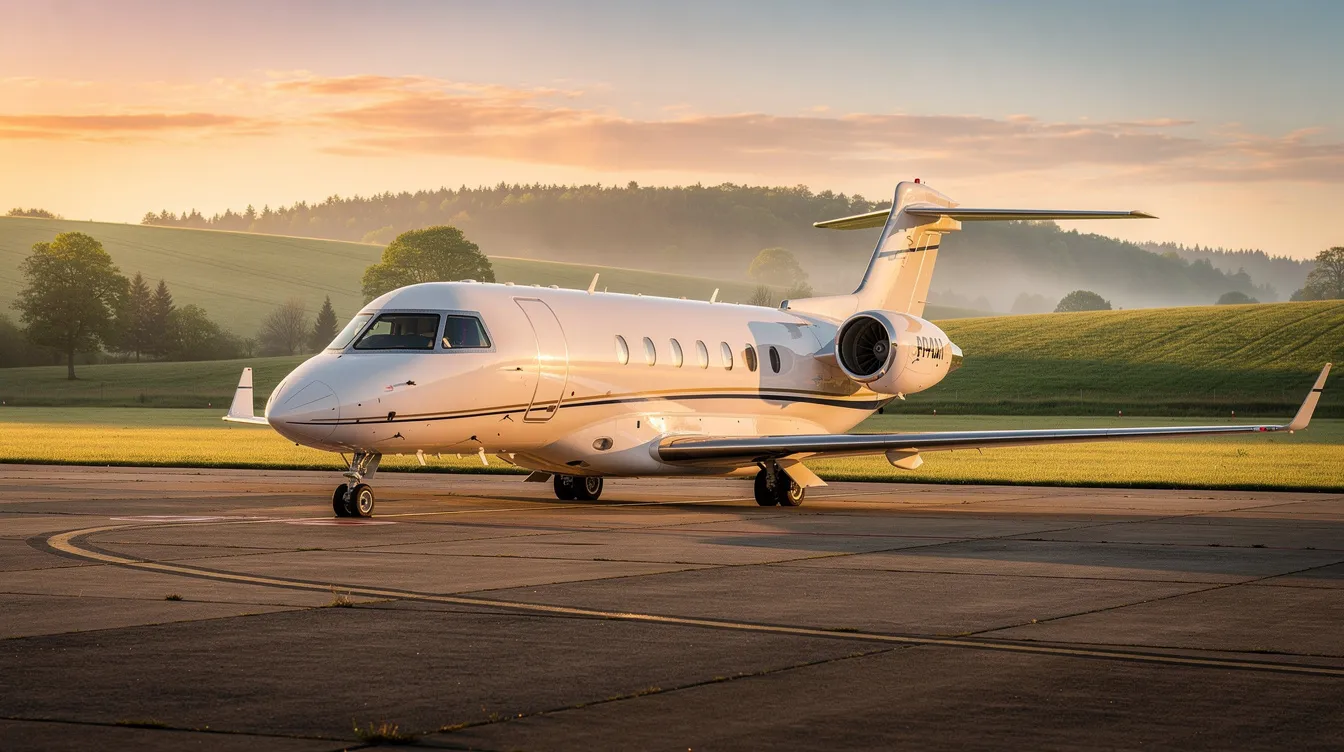
Private jet flights are no longer only a question of whether to own, charter, or buy hours in advance. For frequent flyers, business travelers, and families considering private aviation, the more important question in 2026 is how to secure reliable access, predictable cost, and the right aircraft without tying capital to a single asset. As the private aviation landscape evolves, understanding new access models—such as membership-based programs, fixed hourly rates, and floating fleets—has become essential for those seeking efficiency, flexibility, and transparency in their travel.
Who should read this?
This article is designed for:
Frequent flyers who need consistent, reliable access to private jets.
Business travelers are managing demanding schedules and multiple destinations.
Families considering private aviation for seamless travel between homes or vacation spots.
Investors and executives are balancing business and leisure trips.
Why does this matter in 2026?
The private aviation industry is rapidly evolving. New access models are reshaping how travelers approach private jet flights, offering smarter alternatives to traditional ownership, jet cards, and ad hoc charter. Understanding these options is crucial for anyone seeking to optimize cost, flexibility, and convenience in their private travel.
FLYT approaches that question through membership-based private aviation: fixed hourly rates, fleet interchange, global access, and concierge support designed around operational efficiency rather than ownership complexity.
Key takeaways
Private jet flights are shifting from full ownership and long jet card commitments toward flexible membership models that prioritize access, transparent charter pricing, and predictable hourly rates.
Charter flights are priced around aircraft type, aircraft size, flight time, positioning, crew requirements, airport fees, and empty leg opportunities.
FLYT standardizes access through fixed hourly rates, a floating fleet model, and a risk-pool approach that reduces exposure to depreciation and ownership costs.
For many frequent flyers in the 25–150-hour annual range, membership can offer a more cost-effective balance than ad hoc charter, jet cards, or fractional ownership.
FLYT supports business and leisure travel with aircraft interchange, concierge planning, ground transportation, catering, and global private jet travel coordination.

Why private jet flights are changing in 2026
Private aviation has continued to grow since 2020. According to VOLO Insights, global business jet departures reached 3,515,618 in 2025, up about 6.2% over 2024, with North America accounting for roughly three-quarters of departures and Europe remaining the second-largest region.
That growth has also exposed the limits of traditional access models. Owning a private jet ties up millions in capital; fractional ownership (where you purchase a share of an aircraft and pay for a set number of hours per year) can include acquisition costs and long contracts, and ad hoc private jet charter can produce uneven charter costs when aircraft availability is tight.
Fractional ownership is a model where multiple owners share the costs and usage of a single aircraft, typically purchasing a share (such as 1/16) for a set number of annual hours.
Private jet charters can be booked on-demand, typically requiring 3-6 hours' notice, although complex international flights may need longer. This flexibility allows travelers to access over 10,000 airports worldwide and fly to destinations around the world, including thousands of smaller regional airports and those with shorter runways inaccessible to commercial airlines.
This article explains:
How charter pricing and hourly rates actually work
Why private jet charter flights vary so much by route, aircraft, and timing
Where empty leg flights (discounted one-way repositioning flights offered when an aircraft needs to return to base or move for its next booking) can reduce costs
How FLYT uses membership, fixed hourly rates, and a floating fleet to provide access without ownership burden
When membership is more efficient than a traditional charter, jet cards (prepaid programs where travelers purchase a block of flight hours at a fixed rate), or buying a jet
Empty leg flights refer to one-way journeys flown without passengers when an aircraft must return to its base or reposition for its next assignment. These flights can reduce costs by up to 75%, but only when the traveler can match the route and timing.
One important context: private jets are significantly more expensive than commercial flights, and private jets emit significantly more carbon per passenger than commercial planes. That makes smarter aircraft selection, efficient routing, and transparent planning more important for discerning travelers.
How charter flights and private jet pricing actually work
Pricing Factors
Every charter flight is custom-priced. Two brokers can quote the same trip on the same date and return different numbers because they may be using different charter companies, aircraft, positioning assumptions, and crew plans.
The main pricing inputs are straightforward, but they interact in ways that can materially change the final cost:
Aircraft type and aircraft size: Very light jets, light jets, midsize aircraft, super midsize cabins, heavy jets, long-range jets, and ultra-long-range aircraft each carry different operating costs, fuel burn, crew requirements, and runway limitations.
Flight time: A short domestic flight may be inefficient if the plane has to reposition, while a longer direct route may be more economical per mile.
Number of leg flights: Multi-leg flights, overnight stops, crew rest, and repositioning all influence charter costs.
Airport costs: Landing fees, handling, parking, slots, customs, and de-icing can all change pricing, especially for international flights or winter operations.
Crew duty limits: If a trip requires overnight crew accommodation or a second crew, the cost can increase.
Operational costs: Private jet operational costs are paid per hour for the entire aircraft. The hourly rate typically covers exclusive use of the entire jet, including crew and fuel, before additional trip-specific charges are added, which is why group size affects value per passenger but not the base aircraft operating cost.
Charter costs range from $2,000 to $18,000 per hour. Hourly rates for turboprops start around $2,000, while heavy or ultra-long-range jets can move well above $15,000 per hour.
A one-off charter quote is not the same as a published hourly rate. The quote may include positioning, handling, taxes, crew costs, fuel adjustments, and special services. This is where hidden fees and surprise charges can appear if the quote is not itemized.
For example, a Gulfstream G450 round trip from New York to Los Angeles costs $102,000 in many market examples, but the actual number can vary depending on the airport, dates, overnight requirements, and itinerary changes. Private jet rental prices increase for multi-night stays and itinerary changes.
Empty Leg Flights
Empty leg flights are one-way journeys flown without passengers when an aircraft must reposition or return to its base for the next assignment. These flights can reduce costs by up to 75%, but only when the traveler can match the route and timing.
Membership Benefits
FLYT’s membership model simplifies this complexity. Instead of shopping for every private charter as a separate transaction, members access fixed hourly rates within agreed service parameters, with transparent disclosure of applicable surcharges.
Private jet flights vs ownership, jet cards, and fractional shares
Most travelers comparing private jet flights weigh four models: on-demand charter, jet cards, fractional ownership, and membership-based access.
Model | Description | Pros | Cons | Typical Use Case |
|---|
On-demand charter | Pay-as-you-go charter flights are booked as needed | Maximum flexibility, no long-term commitment | Pricing varies, availability not guaranteed | Occasional flyers |
Fractional ownership | Purchase a share of a specific aircraft with set annual hours | Guaranteed access, consistent aircraft | High upfront cost, long-term commitment | Frequent flyers (100+ hours/year) |
Jet cards | Prepaid blocks of flight hours at fixed rates | Predictable pricing, some guaranteed availability | Restrictions, blackout dates, surcharges | Moderate flyers (25-100 hours/year) |
FLYT membership | Access to a floating fleet with fixed hourly rates and concierge support | Flexibility, predictable costs, fleet interchange | Requires minimum usage, membership fee | Frequent flyers (25-150 hours/year) |
Table: Comparison of private jet access models
The distinction is capital allocation. Full ownership gives maximum control over a specific aircraft, but ownership costs include depreciation, crew, hangar, insurance, maintenance, management, and downtime. Fractional ownership reduces the commitment but still ties capital to an aircraft share.
Consider a founder flying London–Zurich twice a month and New York–Miami monthly. A fractional model may require upfront capital and monthly fees even during lighter travel periods. A FLYT membership aligns spending more closely with actual flight activity while giving the traveler the option to select the best aircraft for each trip.
Or consider a family office flying 100–120 hours per year across business and leisure routes. A single-owned jet may be too large for short regional travel and too small for long-range family trips. Fleet interchange can be more efficient than forcing every mission onto one aircraft.
Aircraft types, aircraft options, and matching the jet to the mission
Aircraft Categories
The best aircraft depends on distance, passengers, luggage, runway performance, cabin expectations, and whether the trip is for business, family, or leisure. Private jets provide access to over 10,000 airports worldwide, and private jets can access thousands of smaller regional airports. Private jets can utilize roughly 5,000 airports in the U.S.
That access matters because private jets can operate from shorter runways than commercial airlines, allowing travelers to land closer to their actual destination. Private jets typically have direct routes, eliminating layovers, which is one reason private flights provide unparalleled time savings.
Turboprops and Very Light Jets
Efficient for short regional charter flights such as Dallas–Houston or London–Paris.
Turboprops can carry 6 to 8 passengers and operate from shorter runways.
Very light jets offer higher speed for short missions with lower hourly rates than larger jets.
Light and Midsize Jets
Suitable for many domestic flights.
Light jets are designed for 4 to 6 passengers on shorter trips.
Midsize jets usually seat 6 to 9 passengers comfortably, making them practical for routes such as New York–Palm Beach or Los Angeles–Aspen.
Super Midsize and Heavy Jets
Work better for longer business trips and larger groups.
Heavy jets typically accommodate 12 to 18 passengers.
Offer more cabin space, range, and baggage capacity for coast-to-coast or transcontinental routes.
Ultra Long Range Jets and VIP Airliners
Built for nonstop intercontinental travel.
Ultra-long-range jets can fly non-stop for over 8,000 miles, supporting routes such as New York–Tokyo or London–Singapore.
Ultra-long range capability carries higher hourly rates, but it can eliminate fuel stops and reduce fatigue.
A Citation Latitude class aircraft may be suitable for a midsize business trip, while a larger cabin jet may be more appropriate for an international family itinerary. The point is not to choose the largest plane. The point is to choose the right aircraft.
FLYT’s diverse fleet access and aircraft interchange allow members to right-size each trip. A light jet may be the right choice for a short meeting. A super midsize or long-range aircraft may be better for a multi-city itinerary. Members are not locked into one owned or fractionally owned aircraft.
Flexible scheduling, aircraft availability, and global reach
Membership Benefits
Time is the primary currency in private aviation. Private jet flights allow you to dictate the exact departure time, and private jets allow for customized itineraries tailored to individual needs.
Charter flights can be arranged for any destination worldwide, subject to aircraft capability, airport rules, permits, and safety requirements. Large marketplaces show the scale of modern access: Jettly offers access to over 20,000 aircraft globally, illustrating how broad operator networks have become.
In traditional private jet charter services, the process begins with local aircraft availability. If the right jet is not near the departure airport, an operator may need to reposition an aircraft, which adds time and cost. Crew duty rules, airport slots, and weather can further affect the final schedule.
FLYT’s floating, asset-light model is designed to reduce those frictions. Instead of assigning every member to a home aircraft, FLYT coordinates access through a distributed fleet and partner network across major business hubs in North America, Europe, and beyond.
This supports both business and lifestyle travel:
Same-day out-and-back meetings
Multi-city investor roadshows
Family holidays to the Caribbean, Mediterranean, or mountain resorts
Late changes to departure time on a London–Geneva flight
Combined business and leisure itineraries over several days
Chartering a private jet can save time by bypassing crowded terminals. Private jets bypass crowded terminals and TSA lines, and private jet passengers use Fixed-Base Operators (FBOs) as private terminals. Fixed-Base Operators (FBOs) are private airport facilities that provide services such as fueling, hangar space, and passenger lounges for private jet travelers. Private jet passengers can arrive just 15 to 30 minutes before takeoff.
From a safety and compliance perspective, private jet operations sit within regulated general aviation frameworks. In the U.S., many charter operations operate under FAA Part 135, and operators require an air carrier certificate. Private jets are subject to the same FAA regulations as commercial flights, with rules governing safety, maintenance, crew qualification, and operational oversight.

Understanding hourly rates, charter costs, and transparent pricing
Pricing Factors
Many travelers see hourly rates quoted anywhere from around $3,000 to more than $15,000 per hour. The number only becomes useful when you understand what is included.
A typical hourly rate may cover the aircraft, standard crew, fuel assumptions, and basic operating costs. It may not include airport handling, de-icing, international permits, taxes, premium catering, ground transport, or ground transportation.
One-off private jet charter pricing can vary because of:
Peak periods such as holidays, major events, and school breaks
Short-leg minimums, where a one-hour flight may be billed at a higher minimum
Aircraft positioning before or after the trip
Multi-night crew stays
Last-minute schedule changes
International handling, permits, and customs
This is why private jet rental can feel unpredictable for most travelers who charter a private jet only trip by trip. The headline rate rarely tells the whole story.
FLYT’s model is built around fixed hourly rates for members. When surcharges apply, the goal is to show them clearly before the flight is confirmed. That makes it easier for clients to forecast spend.
For example, a traveler flying four 2.5-hour legs per month is using about 10 hours monthly, or 120 hours per year. Under an ad hoc charter, every trip may involve different charter companies, different aircraft, and different pricing assumptions. Under a membership model, the traveler can forecast the year based on expected hours, aircraft category, and known incremental costs.
Transparent pricing is not only a financial benefit. It reduces administrative drag for assistants, finance teams, and aviation experts coordinating travel plans.
Empty leg flights and when they make sense
Empty Leg Flights
An empty leg is a repositioning flight flown without passengers. For example, an aircraft may finish a charter in Miami and need to return empty to New York for its next booking.
Empty leg flights can reduce costs by 25% to 75%. Operators often discount an empty leg because the aircraft is flying the route anyway. That can create meaningful value for flexible travelers.
Common examples include:
London–Nice during peak summer travel
New York–South Florida during winter
Geneva, Milan, or Paris repositioning around major events
Caribbean return legs after holiday periods
The limitation is reliability. Empty leg flights depend on another customer’s primary booking. If that booking changes, the empty leg can change or disappear. Timing is also less flexible than a standard private jet charter.
FLYT can surface relevant empty leg opportunities to members when they make sense. But the core value of membership is not chasing discounts. It is reliable on-demand access, predictable pricing, and aircraft availability when the trip matters.
What to expect on board: productivity, privacy, and service
Onboard Experience
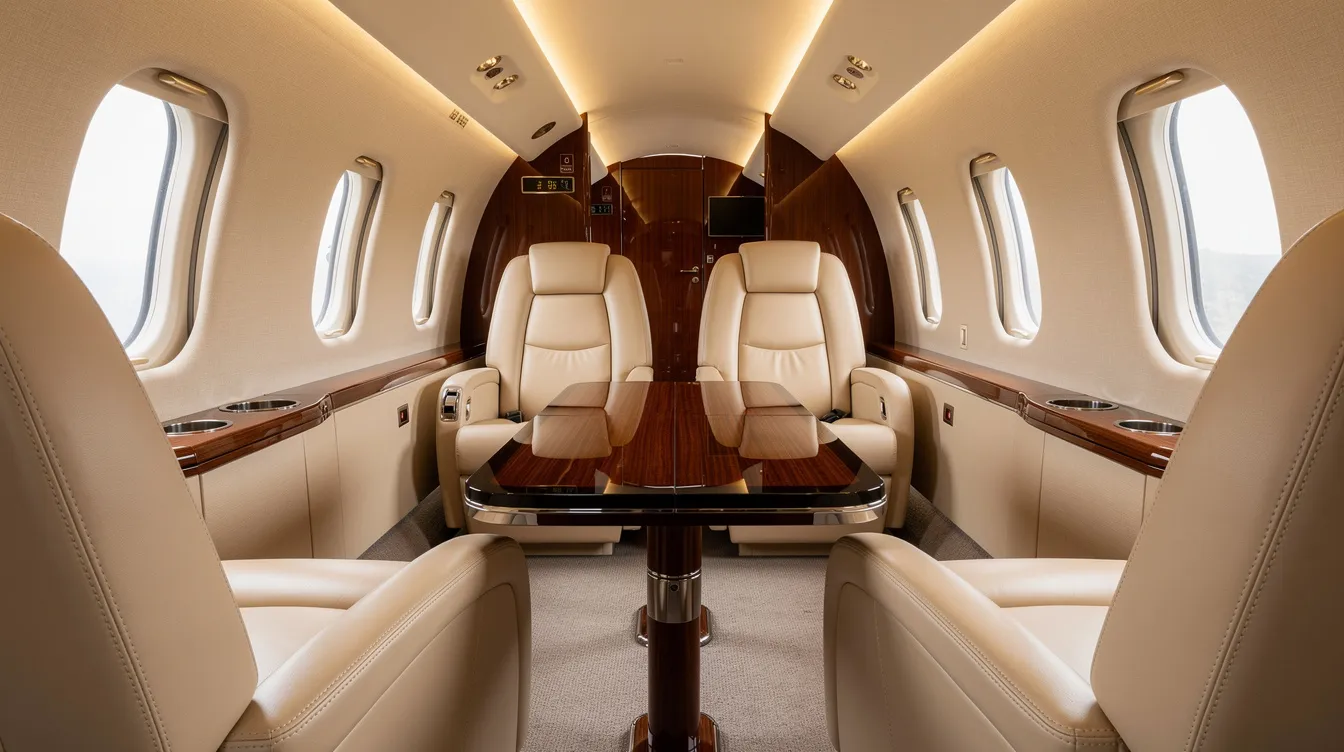
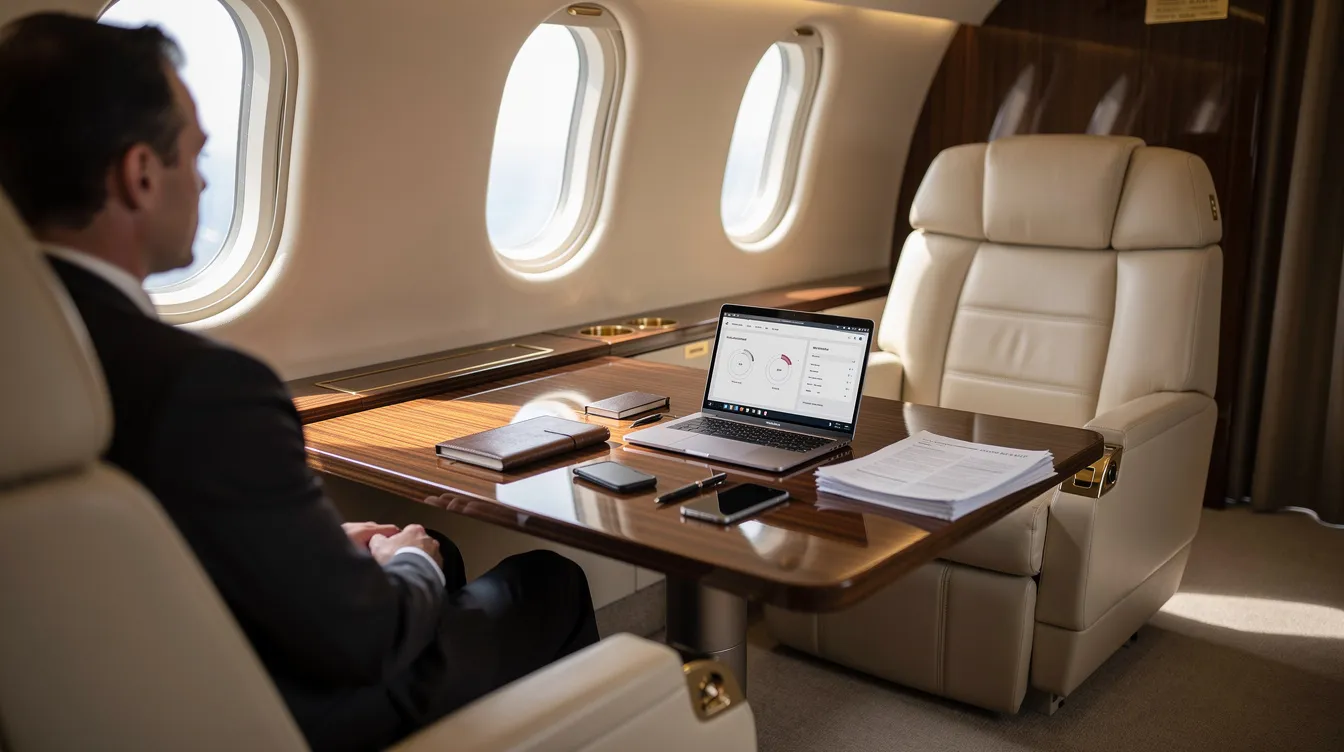
For FLYT members, private jet travel is often an extension of the office or home. The value is control, privacy, and time saved, not display.
Modern private jet cabins support work and rest. Many aircraft include Wi-Fi for email and video calls, power outlets, quiet seating configurations, and advanced technology for communications and cabin comfort. Private flights allow passengers to control the in-flight entertainment.
Privacy is equally important. A closed cabin allows executives to review financials, discuss acquisitions, prepare board materials, or speak with advisors without unknown passengers nearby. Private jet security screenings are fast and discreet, and FBO access limits exposure to public terminals.
Private jet amenities and catering are fully customized. Private jet travel enhances comfort with personalized in-flight services, including tailored meals, dietary requirements, cabin preferences, and route-specific service details. Private jet flights offer a highly customized premium travel experience.
Pets are often easier to manage than on commercial travel. Pets usually sit beside you in the cabin on private jets, and private jets often allow pets to fly freely in the cabin, subject to operator policy and safety guidance.
FLYT’s concierge team coordinates personalized service before departure: catering, ground transportation, child seats, ski equipment, golf bags, pets, and onward ground transport. The traveler should not have to manage operational details across multiple vendors.
How FLYT membership makes private jet flights more efficient
FLYT is a membership-based private aviation service for frequent flyers who want the benefits of private jet access without buying or co-owning an aircraft.
The core idea is simple: provide access to a floating fleet and partner network, fixed hourly rates, and transparent charter pricing instead of opaque trip-by-trip negotiation. FLYT is providing access to aircraft options across mission types while reducing the burden of ownership.
Fleet interchange is central to the model. A member might use a light jet for a short Paris–Zurich meeting, a midsize cabin for a domestic business trip, and a larger long-range jet for a family itinerary to the Maldives. The member does not need to own multiple jets or accept the inefficiency of using the wrong aircraft for the mission.
FLYT also uses an asset-light and risk pool model. Rather than concentrating capital into a single aircraft, members participate in a structure supported by distributed fleet access. Operational risk, aircraft downtime, and depreciation are not concentrated in one tail owned by the traveler.
Consider a European private equity partner flying 80–100 hours per year. Some weeks require short intra-European travel. Other months include transatlantic meetings or family travel. A traditional private charter approach may work, but pricing and availability can change. Fractional ownership may create fixed obligations. FLYT membership gives the traveler a more predictable operating framework.
Or consider clients who split time between New York, Aspen, and the Caribbean. The best aircraft may change depending on the season, passengers, luggage, and weather. FLYT’s model keeps the focus on access and planning rather than aircraft administration.
When a private jet membership is the right choice
Not every traveler needs a membership. If you fly only a few times per year, on-demand charter options may remain the simplest route.
Membership begins to make more sense when travel becomes frequent enough that predictability, support, and flexible scheduling matter more than one-off pricing.
As a practical guide:
25–50 hours per year: membership may outperform an ad hoc charter when trips are recurring, time-sensitive, or involve multiple airports.
50–100 hours per year: membership often becomes more efficient because fixed hourly rates, concierge planning, and aircraft interchange reduce both cost uncertainty and administrative work.
100–150 hours per year: membership can be especially useful for executives, investors, and families with mixed domestic flights, international flights, business, and leisure needs.
Under 20–25 hours per year: private charter may be more appropriate than membership.
Above 200–250 hours per year: managed aircraft, fractional ownership, or hybrid structures may be worth evaluating alongside membership.
Common FLYT member profiles include founders and CEOs with regional teams, investors and family offices moving between financial hubs, and families splitting time between homes, schools, and seasonal destinations.
If your annual usage falls in the 25–150-hour range, FLYT can help evaluate whether a membership tier provides a more efficient structure than traditional private jet charter services
Conclusion: Embrace smarter private jet flights with FLYT
As private aviation continues to evolve, the traditional models of ownership, fractional shares, and ad hoc charter no longer meet the needs of many frequent flyers and business travelers. FLYT offers a modern alternative—membership-based private jet flights designed around flexibility, predictability, and operational efficiency. By combining fixed hourly rates, a floating fleet model, global access, and concierge-level support, FLYT removes the complexities and capital burdens of ownership while delivering a premium travel experience tailored to your schedule and mission.
Whether you fly 25 or 150 hours annually, FLYT’s membership approach provides transparent pricing, aircraft interchange options, and seamless coordination to optimize every journey. This asset-light model aligns with the demands of executives, founders, and families who value time, reliability, and access without compromise.
Discover how FLYT redefines private jet flights with smarter, more flexible solutions that put you in control of your travel. Learn more at www.flyt.com.