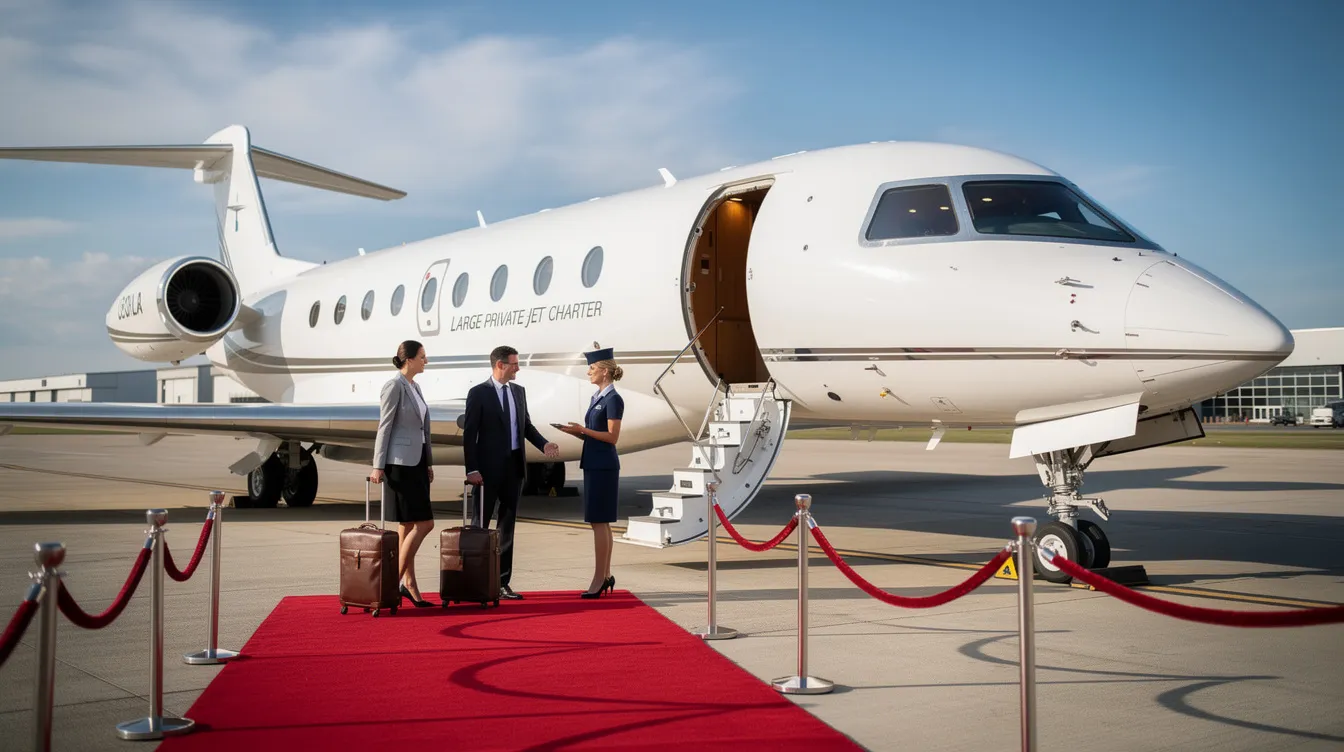
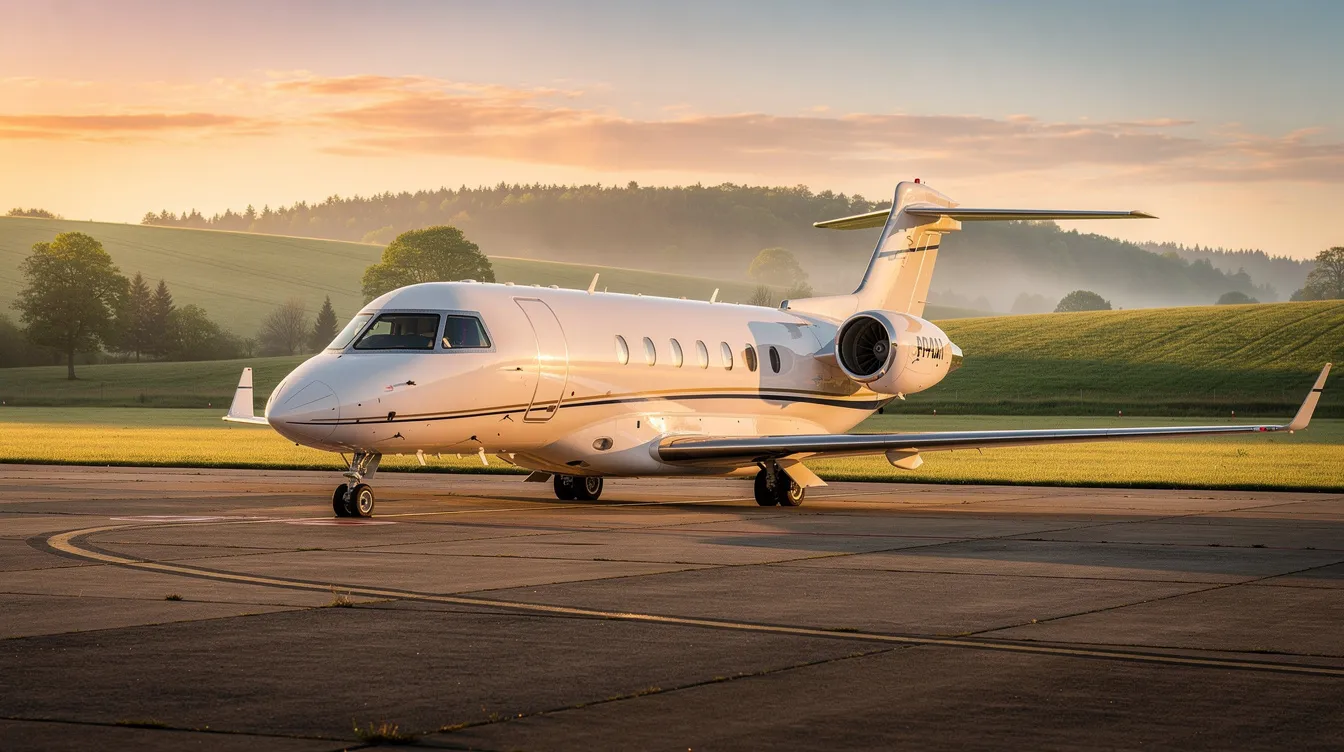
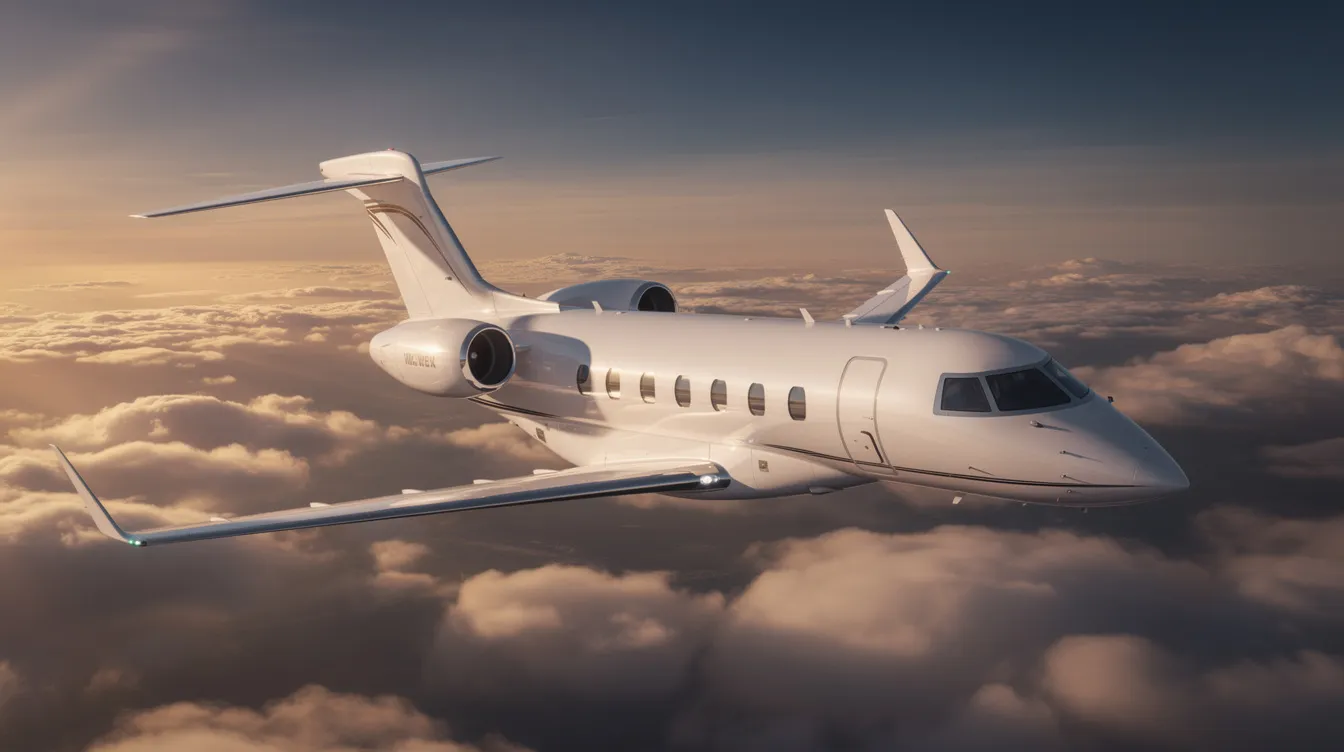
Large and heavy jets are the backbone of nonstop transatlantic and long-range private travel. For executive teams, UHNW families, and discerning travelers who need to cross oceans or continents without connections, these aircraft deliver what smaller jets simply cannot: beds, dedicated crew, stand-up cabins, and the range to fly city pairs like New York to London or Dubai to Nice without stopping.
This guide is intended for executive teams, frequent flyers, and discerning travelers considering a large private jet charter for business or personal travel.
This article breaks down what large private jet charter actually involves, which aircraft types fit which missions, how pricing works, and how membership-based access through FLYT compares to ad-hoc charter and fractional ownership for frequent flyers.
Key takeaways
Large private jets can accommodate 12 to 19 passengers in executive configurations, with stand-up cabins, beds, and full galleys. They are built for nonstop flights of 4 to 8 hours or more, covering routes that define serious private travel.
FLYT offers membership-based access to large and long-range private jets at fixed hourly rates with global reach, removing the capital lock-up, depreciation risk, and operational burden of full or fractional ownership.
"Large private jet charter" typically involves aircraft such as the Bombardier Challenger 605/650, Gulfstream G450/G500, and Bombardier Global series, flying missions like New York to London, Los Angeles to Honolulu, or Dubai to Geneva nonstop.
Private jet memberships offer flexible access to aircraft, adding predictability through transparent pricing and guaranteed access bands, along with fleet interchange that lets members choose the right aircraft type for each trip. Learn more about aircraft interchange.
The article compares jet charter vs fractional ownership vs jet cards for large and heavy jets, and shows how FLYT's asset-light floating fleet model serves frequent flyers who value time, cost control, and capital efficiency.
What counts as a "large" or "heavy" private jet?
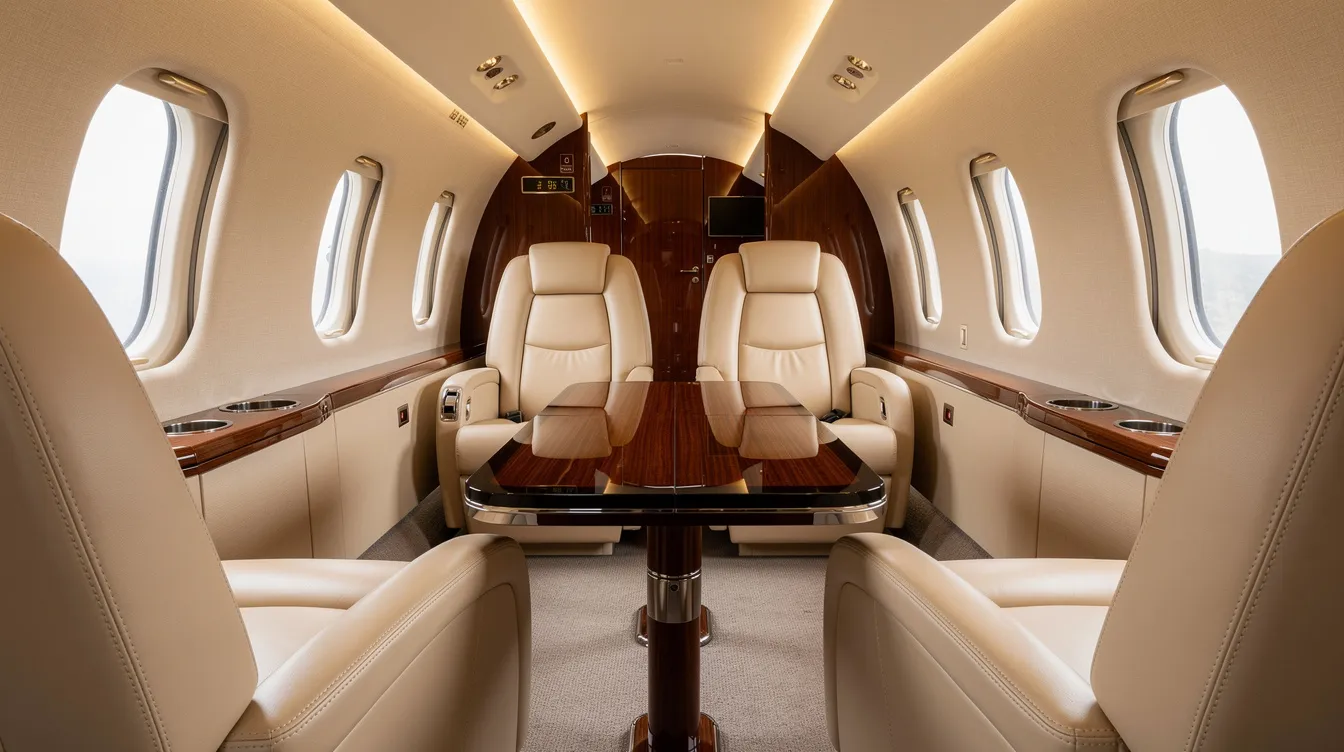
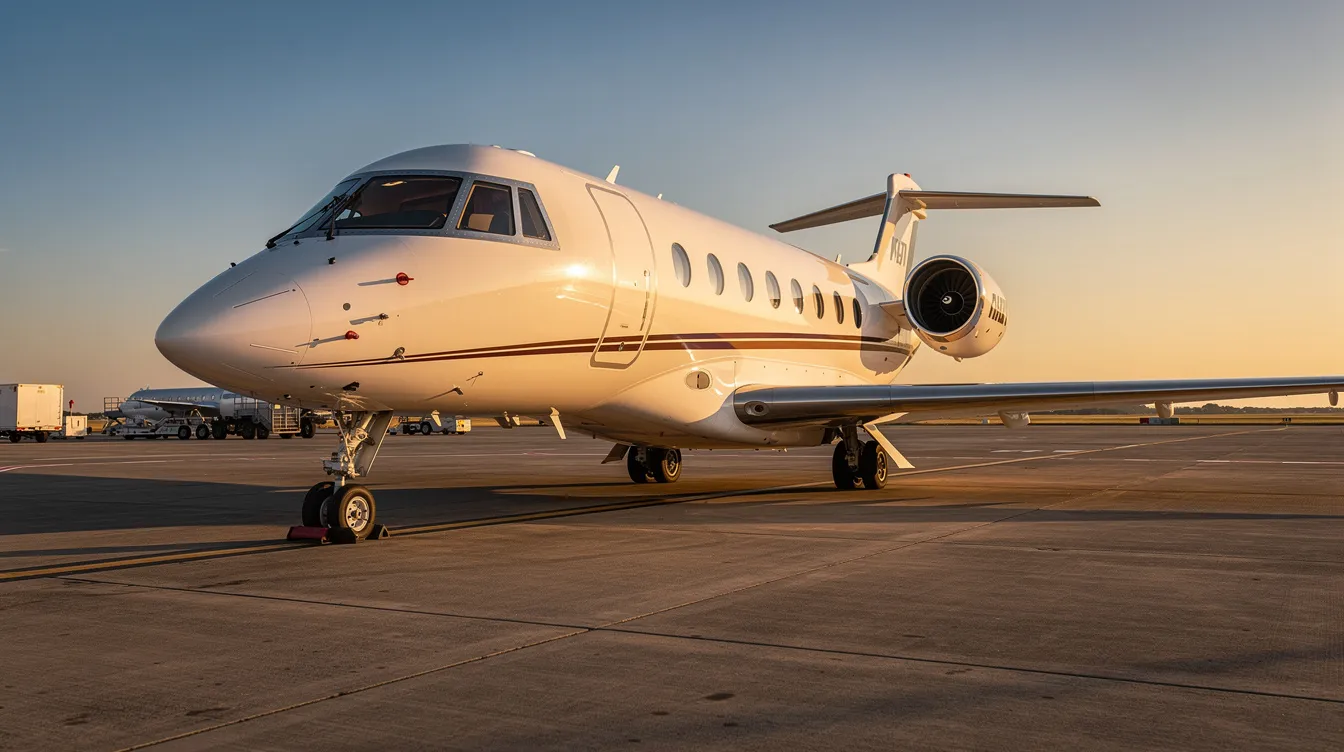
In business aviation, large jets and heavy jets refer to aircraft that typically seat 10 to 16 passengers in executive layouts, offer stand-up cabins of roughly six feet or more in height, carry a dedicated flight attendant, and include a fully equipped galley. Large private jets feature stand-up cabins and dedicated flight attendants as standard, and large jets often feature multiple cabin zones for enhanced comfort, separating work, dining, and rest areas within a single fuselage.
Heavy jets are ideal for flights lasting up to 7-8 hours, covering most transatlantic and transcontinental city pairs nonstop. Ultra-long-range aircraft push further: ultra-long-range jets can fly non-stop for 12+ hours, reaching destinations like New York to Tokyo or Los Angeles to London without a fuel stop.
To clarify terminology: large jets include models like the Bombardier Challenger 605 and 650, the Dassault Falcon 900LX, the Gulfstream G450 and G500, and the Embraer Legacy 600. Ultra-long-range jets, such as the Bombardier Global 6500, Global 7500, and Gulfstream G650, sit a tier above in both range and cabin size. VIP airliners, like converted Boeing or Airbus widebodies, represent an entirely different class. For context, the Boeing 747 can accommodate up to 500 passengers, while the ATR 72-500 seats 68 to 74 passengers, and the Embraer ERJ 190 accommodates 50 to 100 passengers. These are regional and commercial airframes, not business jets.
On the smaller end of business aviation, an aircraft like the Beechcraft King Air C90A seats only 4-6 passengers, while the Cessna Citation Latitude offers a range of 2,700 nautical miles. Stepping up from midsize or super midsize jets to large or heavy jets makes sense when you need nonstop transatlantic capability, overnight flights with real beds, full executive teams flying together, or privacy across distinct cabin zones. The Gulfstream G550 has a maximum range of 6,750 nautical miles, placing it squarely in the long-range jets category that bridges the gap between standard heavy jets and ultra-long-range aircraft.
Large private jets can access over 5,000 general aviation airports, giving travelers significantly more routing options than commercial flights, which are constrained to major hub airports.
Comparison of aircraft categories by size, range, and typical passenger capacity
Aircraft Category | Typical Passenger Capacity | Range (Nautical Miles) | Cabin Features | Example Models |
|---|
Small Business Jets | 4-6 | Up to 2,700 | Limited cabin space, no dedicated crew | Beechcraft King Air C90A, Citation Latitude |
Large Private Jets | 10-16 | 3,500-4,000 | Stand-up cabins, dedicated flight attendant, multiple cabin zones | Bombardier Challenger 605/650, Gulfstream G450/G500 |
Ultra Long Range Jets | 12-19 | 6,000-7,700+ | Multiple zones, full galley, beds, high-speed internet | Bombardier Global 7500, Gulfstream G650 |
VIP Airliners | 50-500+ | Varies | Fully customized conference rooms and bedrooms | Boeing 747 (VIP configured), Airbus A380 (VIP configured) |
When a large private jet charter makes strategic sense
The decision to fly private on a large jet is rarely about luxury alone. It is about operational logic. Consider executive roadshows across Europe or North America, where a team needs to visit three cities in two days. Or investor meetings, where arriving rested, prepared, and on schedule directly affects outcomes. Family holidays with multiple generations, staff, and sports equipment to destinations like St. Barts or the Maldives often demand the space and baggage capacity of heavy jets. High-traffic events like the World Economic Forum in Davos or Art Basel Miami Beach make commercial itineraries unreliable, while private charter flights offer schedule certainty.
Large and heavy jets unlock nonstop city pairs: New York to London, San Francisco to Honolulu, Dubai to Geneva. Each eliminated connection saves hours, removes hotel nights, and reduces the risk of delays or missed meetings. Chartering large private jets provides time savings and flexibility that compound across a busy travel calendar.
The cabin layout supports real productivity. Many large private jets come equipped with high-speed internet and conference facilities, allowing executives to run video calls or review documents mid-flight. Separate zones for work, dining, and rest mean one group can hold a meeting while another sleeps. Private jets provide quiet spaces suitable for work or meetings, while luxurious interiors also make longer flights more comfortable, and the entire cabin of a private jet is exclusively yours during the flight. Private jets offer enhanced privacy compared to commercial flights, which matters for sensitive deal discussions or confidential board preparations.
Group dynamics also favor large jets. Eight to twelve business executives on one aircraft avoid the coordination headaches of splitting onto multiple smaller business jets or commercial flights. Confidentiality, schedule control, and team cohesion all improve. For families traveling with nannies, security, or children, the extra seats, luggage room, and personalized service of large jets make long-range trips more straightforward than complex commercial itineraries. Passengers can often bring specialized luggage without hassle on private jets, whether that means ski gear, golf clubs, or instruments. Large private jets offer superior comfort and long-range capabilities for these demanding missions.
Core aircraft types in the large and long-range jet category
FLYT's membership unlocks a curated set of large and long-range jets across leading manufacturers, with aircraft options selected for safety, reliability, and mission fit rather than brand heritage alone. Below are the aircraft families most commonly requested in this category.
Bombardier Challenger series: the large-jet workhorse
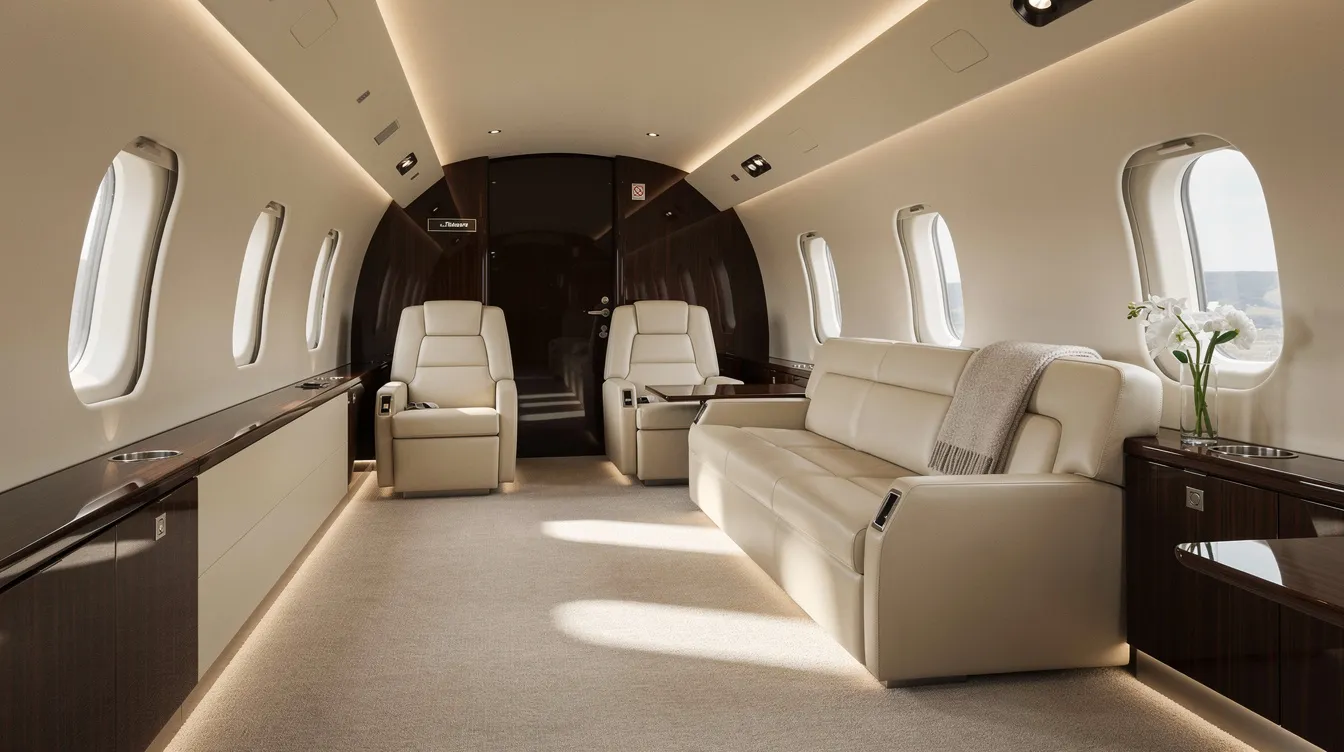
Models like the Bombardier Challenger 604, 605, 650, and the newer 3500 are among the most requested large private jets globally for both business and family travel. The Challenger 605, for example, offers a flat-floor cabin with a stand-up height of roughly 6 feet, a width of about 8.2 feet, and a cabin length of nearly 28 feet. Typical cabin configurations seat 8 to 12 passengers in club and conference seating, with divans that convert to beds for overnight sectors.
Typical mission profiles include nonstop New York to Los Angeles, London to Dubai with a tech stop, or Chicago to San José del Cabo. Range under full payload reaches roughly 3,750 to 4,000 nautical miles, with a cruise speed near 488 knots at high-speed cruise. Executives appreciate the Challenger for jet charter because of its predictable operating performance, generous baggage capacity for multiple travelers, and a cabin quiet enough for working or sleeping on long sectors. Gourmet dining is available on large private jets like the Challenger, served by experienced flight attendants from a well-stocked galley.
Gulfstream large-cabin jets: range and brand recognition
Gulfstream models common in large private jet charter include the G350, G450, and G500. These sit between super midsize jets and the flagship ultra-long-range G650 and G700 class. The G450 provides roughly 3,900 nautical miles of range, a cabin height of nearly 6 feet 2 inches, and layouts accommodating 10 to 14 passengers across multiple zones.
Key characteristics include the signature large oval windows, generous cabin width, and strong long-range capability for private flights like New York to London or London to Dubai nonstop. For some corporate flyers, Gulfstream's brand heritage and cabin ambiance matter. But FLYT's focus remains on matching aircraft performance and pricing to the mission rather than the name alone. A member might choose a Gulfstream large-cabin over a Challenger for slightly longer sectors, a preference for a particular cabin feel, or requirements for specific avionics or connectivity packages.
Ultra-long-range jets: Global and similar heavy jets
Ultra-long-range heavy jets like the Bombardier Global 6000, Global 6500, Global 7500, and Gulfstream G650 and G700 extend the envelope. These aircraft enable nonstop missions like Los Angeles to London, New York to Tokyo, or Dubai to Singapore. The Global 7500 offers a maximum range of nearly 7,700 nautical miles, a cabin length of roughly 54 feet, and operates at altitudes above 50,000 feet.
The typical cabin layout includes three to four distinct zones: work, dining, lounge, and a private stateroom with a full-flat bed. A full-size galley supports multi-course catering. These aircraft serve executives managing global operations, families traveling between home bases and vacation properties on different continents, or high-stakes trips where late arrival is not an option. While hourly jet charter rates for ultra-long-range jets run higher than standard large jets, overall trip economics can be more cost-effective when they eliminate fuel stops, hotel nights, and schedule risks.
Large private jet charter pricing and cost drivers
Private jet charter rates for large and heavy jets sit at the upper end of the market, but the effective cost per passenger and per productive hour often justifies the investment for executive teams and frequent travelers.
Private jet charter rates range from $2,000 to $14,000 per hour across the full spectrum of private aviation. Hourly rates for turboprops start around $2,000, while charter rates can start around $2,000 per hour for turboprops at the low end. Charter rates for the Embraer ERJ 190 start at $14,000 per hour at the higher end. Large jets typically fall in the $8,500 to $15,000+ per hour band, with ultra-long-range aircraft often commanding more. According to recent market data, charter rates for large-cabin jets on popular US routes have exceeded $20,000 per hour during peak demand in 2026.
The main pricing components include:
Hourly rate by aircraft type and age
Repositioning costs when the aircraft must fly empty to reach your departure city
Crew overnight fees and international handling charges
Airport landing fees, de-icing, and customs or immigration processing
Peak-demand surcharges around holidays, major events, or high-traffic corridors
Empty leg flights can reduce costs by 25-75%. Empty leg flights occur when jets reposition without passengers, and travelers who maintain flexibility can save 25-75% off standard rates on these segments. Empty leg flights can save travelers 25-75% on charter costs, making them a useful tool for budget-conscious private travel.
Timing, routing, and airport choice all affect cost. Peak days around events like the Super Bowl or Cannes Film Festival push rates higher. Short legs on large jets are inefficient. Remote airports that require extra repositioning miles add expense. FLYT's emphasis on transparent pricing and fixed hourly rate structures within membership contrasts with opaque, one-off quotes that can vary sharply from trip to trip in the traditional spot charter market.
Membership-based access vs ad-hoc charter and fractional ownership
Frequent flyers on large and heavy jets typically evaluate three models: ad-hoc charter, fractional ownership, and newer membership models like FLYT's. Each carries distinct capital and flexibility profiles.
Ad hoc large jet charter works for occasional trips. It involves:
Variable pricing that shifts with demand, fuel costs, and availability
No long-term commitment, which appeals to travelers flying fewer than 50 hours annually
Limited predictability, especially during peak travel windows
Chartering avoids long-term contracts and ownership costs, but offers less budget certainty
Chartering offers flexibility for travelers flying fewer than 50 hours annually, but above that threshold, the friction of constant sourcing and unpredictable pricing adds up. Learn why FLYT vs charter matters for frequent flyers.
Fractional ownership means buying a share of a specific aircraft, such as a 1/16 or 1/8 share in a Challenger or Gulfstream. Fractional ownership requires management fees and maintenance costs on top of acquisition costs and occupied hourly rates. Entry for heavy jet fractional shares often exceeds $1 million for the initial share alone. This model may make sense for flyers consistently above 100+ hours per year, but it locks capital into a depreciating asset and limits fleet flexibility. Learn more about FLYT vs fractional ownership.
Membership-based access sits between these models. Memberships provide cost efficiencies compared to traditional ownership. Members gain fixed hourly rates, access to multiple aircraft types across large and long-range jets, no depreciation risk, and the ability to shift between light jets, midsize, and heavy jets as travel needs change. Membership models typically require no long-term commitments in the traditional ownership sense, and members can access over 20,000 aircraft globally through networked fleets. Private jet memberships often include concierge-level service that handles logistics end to end. Explore the FLYT advantage and how our risk pool and charter volatility protection models enhance reliability.
FLYT's model is designed for financially sophisticated customers who prefer to allocate capital to their core businesses or investments rather than into an aircraft that loses value from the day it enters service. See how FLYT compares to charter, jet cards, and fractional ownership.
How FLYT structures large private jet access
FLYT is a membership-based private aviation service that gives clients consistent access to large and long-range aircraft through a floating, asset-light fleet model. Rather than owning every aircraft, FLYT leverages a network of vetted operators to provide access and improve availability.
The fixed hourly rate concept is central. Members lock in transparent, predictable pricing bands for specific aircraft categories, including large jets and heavy jets. This minimizes exposure to seasonal or market volatility that plagues spot charter. Customized in-flight amenities are a benefit of chartering a private jet through FLYT, and these preferences are tracked across trips.
Fleet interchange is a core advantage. Members can select a Bombardier Challenger for a transcontinental business trip one week, then pivot to a super midsize jet for a shorter regional leg, or an ultra-long-range aircraft for a nonstop international flight. All of this operates under a unified membership framework with consistent pricing and service standards. Learn more about FLYT's fleet interchange and how our AI fleet engine optimizes availability.
The operational benefits of FLYT's floating fleet and risk pool model include better positioning efficiency, more aircraft options on busy dates, and a higher probability of finding the optimal aircraft type for each charter flight. Booking a private jet can be done in as little as 4 hours in many cases, and real-time pricing for private jet charters can be obtained in 60 seconds through modern platforms like FLYT's platform.
Concierge-level support is woven throughout. A dedicated team is capable of advising on aircraft options, routing, and schedule design through FLYT's platform, so members do not need to become aviation experts to optimize each trip. Contact FLYT anytime via contact us.
Personalized service on long-range large jet missions
On flights of 6 to 12 hours, personalized service and thoughtful planning matter as much as the jet itself. The difference between a good flight and an exceptional one often comes down to preparation.
FLYT's team works with members to tailor each long-range flight. This includes seating layouts, balancing work versus rest priorities, accommodating dietary preferences, and timing arrivals around business meetings or family commitments at the destination. Special requests, from specific wine selections to particular reading materials, are coordinated in advance.
Typical concierge elements include:
Coordinated ground transport at both departure and arrival airports
Preferred catering, from simple healthy options to full multi-course meals
Specific cabin configurations, when available, including arrangements for pets or children
Luggage coordination for oversized or specialized gear
Service expectations on large jets are high. Experienced flight attendants, well-stocked galleys with room for gourmet dining, high-speed connectivity where the aircraft is equipped, and discreet crew accustomed to handling sensitive business travel all contribute to the charter experience. Sports teams, corporate delegations, and families with complex logistics all benefit from this level of coordination.
FLYT's approach emphasizes efficiency and comfort rather than spectacle, aligning with clients who value a quiet, productive, and predictable environment. The goal is to serve each journey so that members can focus on what matters at their destination, not on managing the mechanics of getting there. See how FLYT manages premiums to keep service consistent.
Planning your first large private jet charter with FLYT
If you are considering membership or approaching your first large jet trip with FLYT, the process is designed to be straightforward.
Start by gathering the key information your planning team will need:
Preferred dates and any flexibility in timing
Departure and arrival airports (including secondary or regional airports if relevant)
Passenger count and general luggage details
Time-critical commitments at destination (meetings, events, connections)
Any requirements for in-flight meetings, overnight rest, conference rooms, or specific amenities
FLYT's team translates this into aircraft options. For example, a 10-passenger New York to Los Angeles flight with a board presentation en route might call for a Challenger with a conference table layout. A nonstop New York to London overnight mission for four executives would likely point toward a Global or similar ultra-long-range jet with sleeping quarters.
For peak periods, including holidays, major conferences, and school vacation windows, confirming large private jet charter flights 4 to 8 weeks in advance is advisable. Outside peak windows, FLYT can often accommodate shorter-notice requests due to its networked, asset-light model, where the floating fleet provides broader access than a single operator could offer.
If you fly private regularly and want to explore whether a structured membership could improve cost predictability and aircraft access compared to ad-hoc charter, FLYT's team can model your travel patterns and recommend a framework built around your specific journey requirements. Visit FLYT FAQ for more details.
FAQ
These questions address common concerns about large private jet charter and membership that are not fully covered in the main sections above.
How many hours of flying per year justify considering a large private jet membership instead of an ad hoc charter?
Once a traveler or organization consistently flies more than roughly 50 to 75 hours per year, especially on large jets and long-range missions, predictable membership-style pricing and access often become more efficient than repeated spot charters. Above this threshold, volatility in ad-hoc pricing, seasonal availability constraints, and the time cost of constantly sourcing new quotes can outweigh any savings from occasional cheaper private flights. FLYT can model a prospective member's past 12 to 24 months of travel to indicate whether a structured program would likely improve cost predictability and aircraft access.
Can I switch between large jets and smaller aircraft within the same FLYT membership?
One of FLYT's core advantages is flexible fleet interchange. Members are not tied to one aircraft type and can choose from light jets, midsize, super midsize, large, and long-range jets based on each trip's requirements. This allows using a large jet for a 12-passenger transatlantic flight and a smaller business jet for a two-person regional hop, while still benefiting from the same transparent pricing framework. The FLYT team helps members select the most efficient option per mission, balancing cost, comfort, and schedule.
How far in advance should I book a large or heavy jet for peak travel dates?
For major holidays, large international events like the Monaco Grand Prix or World Economic Forum, and school vacation periods, clients should aim to confirm large jet charters 4 to 8 weeks in advance where possible. Outside of peak windows, FLYT can often secure suitable large jets with significantly shorter lead times due to its broad network and floating fleet model. Membership improves odds of securing preferred aircraft categories and departure times compared with last-minute spot charters into a tight market.
Is there a difference in safety standards between large jets and smaller business jets?
All jets operate under the same regulatory safety frameworks, but large jet operations often involve additional layers of crew training, international procedures, and long-range planning. Independent safety ratings like ARG/US or Wyvern are important for charter safety, and safety ratings should be verified when selecting a charter service. FLYT works only with operators and aircraft that meet stringent safety and maintenance standards, and aircraft selection prioritizes operator quality and track record rather than size alone. Members can request additional safety information on specific missions or aircraft when desired.
Can large private jets access the same smaller airports as light jets?
While large jets can access many secondary airports and over 5,000 general aviation airports overall, they are more constrained by runway length, weight limits, and local infrastructure than light jets or turboprops. For some destinations, the optimal itinerary may involve flying a large jet into the closest suitable major or regional airport, then using ground transport or a smaller aircraft for the final segment. Flexibility is key to benefiting from optimal routing, and travelers can book empty-leg flights through digital platforms like Jettly for repositioning segments. Jettly provides instant pricing for over 20,000 aircraft and connects users to aircraft globally for charter, while travelers can also book private jets without long-term commitments through such platforms. FLYT's planning team evaluates runway data, performance requirements, wind conditions, and airport operating hours for each mission to recommend the most efficient and safe routing that can accommodate your group.
Conclusion
Choosing a large private jet charter offers a strategic advantage for executives, entrepreneurs, and discerning travelers who prioritize efficiency, flexibility, and comfort on long-range missions. These aircraft provide the space, amenities, and nonstop range required for seamless intercontinental travel, supporting productivity and privacy in the air. While ad-hoc charter and fractional ownership remain options, membership-based access through providers like FLYT delivers a modern, asset-light approach that balances predictable pricing, fleet interchange, and concierge-level support. FLYT’s innovative model removes the complexities and capital risks of ownership while ensuring global reach and operational efficiency. For frequent flyers seeking a smarter alternative to traditional private aviation, exploring FLYT’s membership programs offers a compelling path to premium, flexible private jet travel without compromise.
Discover how FLYT can transform your private aviation experience with transparent pricing, flexible aircraft access, and dedicated service tailored to your unique travel needs. Learn more at FLYT.com.