Chartering a jet is no longer only a luxury decision. For business executives, founders, investors, frequent flyers, and high-net-worth individuals, it is often an operational decision: how to reduce wasted time, protect privacy, and control the cost of complex air travel.
Key Takeways
Charter flights let you rent the entire aircraft, choose your schedule, customize your route, and avoid much of the friction associated with commercial travel.
Total trip cost depends on aircraft type, distance, routing, airport choices, crew needs, fuel, and in-flight amenities requested.
You can book one-off private charters or use a private jet membership like FLYT for predictable charter pricing, fixed hourly rates, and flexible scheduling.
The basic booking process is: define your trip, choose a charter operator or membership, compare quotes, confirm terms, then prepare for departure from a private terminal.
For frequent travelers, membership can be a cost-effective alternative to ownership, jet card programs, and repeated ad hoc charter.
What is a charter flight, and why does it matter in 2026
A private jet charter is a commercial flight arrangement where you rent the entire aircraft for a specific trip. Instead of buying a private plane or committing to fractional ownership, you access the aircraft, crew, and charter service for the itinerary you need.
Chartering a private jet allows for customized travel itineraries, including private flights into regional airports, smaller airports, and destinations not easily served by commercial airlines. Charter flights can access over 3,000 airports worldwide, including more than 3,000 in the U.S., providing far greater airport accessibility than scheduled commercial routes.
This matters in 2026 because commercial travel remains inefficient for many executive itineraries. Privacy, direct access to smaller airports, and the control associated with private aviation save significant time compared to commercial airlines, including bypassing TSA lines. For multi-city business trips, investor roadshows, family travel between the U.S. and Europe, or same-day regional meetings, flying private offers a level of control rarely matched by commercial travel.
FLYT approaches this market through membership-based private aviation. Members receive charter-like flexibility, fixed hourly rates, global fleet interchange, concierge support, and access without the ownership burden. Learn more about how FLYT works.

Step 1: define your private charter flight requirements
The process of chartering involves defining travel needs and selecting an operator. While chartering a private jet typically involves five steps, this guide expands the process into six practical stages so you can make better financial and operational decisions.
Before requesting private jet quotes, clarify the following requirements:
Requirement | Details & Considerations |
|---|
City Pair and Airports | Specify your exact departure and arrival airports (e.g., New York Teterboro to Miami Opa-locka, London Farnborough to Geneva, Boston to Washington, D.C.). |
Passenger Count | Light jets suit 2–4 executives; 8–10 colleagues or family members may require midsize, super midsize, or large cabin jets. |
Baggage Profile | Private jets often have stricter baggage limits than commercial airlines, especially very light jets and smaller aircraft. Disclose golf bags, ski equipment, trade show materials, and pet carriers early. |
Route Length & Mission | Light jets for short trips; midsize for longer domestic; super midsize or long-range for longer distances (e.g., LA–Honolulu); heavy/ultra-long-range for international (e.g., NY–London). |
Timing Constraints | Early-morning meetings, end-of-quarter roadshows, peak holiday travel, and same-day out-and-back flights affect aircraft availability. |
In-Flight Amenities | Wi-Fi for video calls, quiet cabin, meeting-style seating, specific catering, in-flight services, and pet arrangements should be requested before aircraft selection. |
Charter jets can accommodate 4 to 19 passengers depending on aircraft class. Below is a table for easier comparison of jet types, passenger capacity, and range:
Jet Type | Typical Passenger Capacity | Typical Range (miles) |
|---|
Very Light Jets | Up to 4 | 1,000–1,500 |
Light Jets | 4–7 | 1,500–2,500 |
Midsize Jets | 6–9 | 3,000+ |
Super Midsize Jets | 8–10 | 3,500–4,500 |
Large Cabin Jets | 10–14 | 4,000–6,000 |
Ultra-Long-Range Jets | 12–19 | 6,000+ |
These details determine not only the best aircraft type but also charter rates, airport options, routing, fuel planning, and whether direct routing is practical.
Step 2: choose how you want to fly private – on-demand vs membership
Once the trip is defined, decide whether to use on-demand charter, private jet membership, jet card programs, or another access model. The right answer depends on frequency, budget predictability, flexibility needs, and how much capital you want tied up in private aviation.
On-demand charter is straightforward. You request a quote, review charter options, sign the agreement, and pay for that trip. It works well for occasional private jet travel, irregular business needs, or leisure flights where you do not need guaranteed access across the year.
Membership is different. Private jet memberships offer flexible access to aircraft, and memberships provide predictable pricing without ownership costs. Private jet memberships typically require no long-term commitments, though exact terms vary by provider. Membership models allow access to a global fleet of aircraft, which can reduce travel time significantly when matched with smart airport selection and direct routing. Learn more about FLYT memberships.
For executives flying private twice a month between 2026–2027, or anyone flying roughly 25–200+ hours per year, membership may be more efficient than quote-by-quote private charters. Memberships may reduce hourly costs for frequent flyers in private aviation, especially when fixed hourly rates reduce exposure to seasonal charter pricing spikes. Explore FLYT pricing and the FLYT advantage.
FLYT’s model uses a floating, asset-light fleet and risk pool model. Instead of requiring a client to buy a share of one aircraft, FLYT provides flexible aircraft access across private jet categories. That means a member can use light jets for regional travel, midsize jets for longer domestic flights, and heavy jets or ultra-long-range aircraft for international flights without separate ownership obligations. Discover FLYT’s asset-light floating fleet and risk pool model.
When comparing private aviation models, focus on:
Total annual spend, not only the hourly number.
Capital at risk, especially compared with fractional ownership or full ownership.
Contract length and exit flexibility.
Whether fixed hourly rates include meaningful cost protection such as charter volatility protection.
Whether the provider offers guaranteed access during peak demand.
How transparent the provider is about hidden fees, repositioning, and surcharges.
Flying private can match or undercut commercial business-class fares in specific circumstances, especially when several passengers are traveling together on a route with inefficient airline connections. It will not always be cheaper than commercial flights, but for discerning travelers, the value is often measured in time, productivity, privacy, and operational control.
Step 3: Select a reputable charter operator or charter company
Private aviation is a risk management decision as much as a convenience decision. A lower quote is not useful if the operator’s safety standards, maintenance practices, service quality, or contractual clarity are weak.
Use this checklist before choosing among charter companies, a direct charter operator, a broker, or a membership platform:
Confirm regulatory authority. In the U.S., FAR Part 135 governs commercial charter operations, and a valid FAA Part 135 certificate is essential for paid private jet charter services. In Europe, look for the appropriate EASA equivalent.
Review third-party safety ratings. Safety standards include certifications from ARGUS or WYVERN and a valid FAA Part 135 certificate. Third-party safety ratings from organizations like ARGUS or Wyvern are important because they evaluate operational practices beyond marketing claims. You can review the FAA’s overview of Part 135 operations and the safety audit frameworks published by ARGUS International and Wyvern.
Ask about the operator's track record. Review accident history, pilot experience hours, recent training, type ratings, and maintenance practices for both jets and turboprops.
Understand the provider model. A direct charter operator controls aircraft and crew. A broker arranges aircraft from third-party operators. A membership platform like FLYT manages a vetted network, fleet interchange, and standardized service expectations. Learn about FLYT’s aircraft interchange and AI fleet engine.
Confirm contract transparency. Good charter services should show itemized fees, clear cancellation policies, substitution terms, and no unexplained surcharges.
Ask about support. 24/7 operations and concierge support are especially important for international trips, last-minute schedule changes, complex ground transportation, and multi-leg travel across time zones.
Private charters operate under a different framework than a friend lending you a private plane. Charter operators must adhere to strict safety standards and regulations, and for commercial charter in the U.S., that means Part 135 compliance.

Step 4: Request and compare charter flight quotes
Private jet quotes can be obtained online with just a few details, and many charter services now offer instant booking options for simpler routes. In some cases, comparing options now feels a bit like using Google Flights for commercial travel, except you are reviewing private aircraft and operator choices instead. Booking a private jet can often be done within 24 hours, and charter services can accommodate last-minute travel requests within hours when aircraft and crew are available.
Still, the more precise your request, the better the quote. Include:
Travel dates and preferred departure windows.
Exact route and airports, not just city names.
Passenger count and seating preferences.
Luggage details, including skis, golf clubs, equipment, or pets.
Required in-flight amenities such as Wi-Fi, catering, charging ports, or meeting-style seating.
Whether the trip is one-way, multi-leg, or round trip.
Any ground transportation requirements at departure and arrival.
Charter pricing typically starts around $2,000 per hour for turboprops, and charter rates typically start around $2,000 per hour depending on aircraft type and region. Costs are often billed hourly and vary significantly by aircraft size and route. Flight costs are primarily driven by aircraft type, routing, distance, and flight time.
Below is a table for quick reference and comparison of typical 2026 hourly charter rates:
Aircraft Type | Typical Hourly Rate (USD) | Typical Use Case |
|---|
Turboprops | From $2,000 | Short regional travel |
Light Jets | $3,500 – $5,500 | Short domestic flights |
Midsize Jets | $4,500 – $8,500 | Longer domestic and select transcontinental trips |
Super Midsize Jets | $7,000 – $10,000+ | Longer range, higher demand, larger cabins |
Heavy/Large Cabin Jets | $8,500 – $15,000+ | Long-distance and international flights |
Ultra-Long-Range Jets | $12,000 – $20,000+ | Nonstop intercontinental travel |
VIP Airliners | $15,000 – $25,000+ | Large groups, special missions, heads of state |
Charter costs vary based on aircraft type, fuel, crew fees, and airport fees. A proper quote should show estimated flight time, hourly rate, taxes, positioning fees, de-icing, overnight crew costs, catering, and any airport or FBO charges. Transparent pricing ensures no hidden fees are added post-flight.
Do not compare only the headline number. Compare aircraft age, cabin layout, Wi-Fi reliability, safety profile, baggage capacity, and service quality. A cheaper aircraft may be less useful if it requires a fuel stop, cannot carry the required luggage, or lacks connectivity for business calls.
Empty leg flights can offer significant discounts on charter prices because the aircraft is already scheduled to reposition. These can be useful for flexible leisure travel, but they are less reliable for board meetings, investor presentations, or fixed travel dates.
FLYT membership simplifies this step by applying fixed hourly rates across a floating fleet. That reduces quote-by-quote negotiation, improves budgeting, and gives frequent travelers a clearer framework for private aviation planning. See FLYT pricing and FLYT advantage for details.
Step 5: confirm terms, sign, and pay for your charter
After selecting an aircraft or membership option, you will receive a charter agreement or confirmation. This document should detail the itinerary, aircraft tail number or aircraft category, passenger names, airports, included services, and payment terms.
Before sending funds, review:
The full itinerary, including departure airport, arrival airport, routing, and timing.
Whether the agreement specifies a tail number or only an aircraft category.
What services are included, such as catering, Wi-Fi, de-icing, international handling, and ground transportation?
Cancellation and change policies, especially around December holidays, major sporting events, or gatherings such as the World Economic Forum in Davos.
Liability, insurance coverage, and passenger protections.
What happens if the assigned aircraft goes unserviceable, including guaranteed substitution, rate protection, or refund terms?
Whether payment is due by wire transfer, corporate card, or a pre-funded membership account.
In 2026, wire transfers will remain common for higher-value private jet charter transactions, particularly for international flights or last-minute bookings. Funds may need to clear before the operator releases the aircraft, so payment timing can affect aircraft availability.
Membership structures like FLYT often standardize these terms across trips. That reduces repeated contract review, shortens the booking process, and helps frequent flyers operate with fewer administrative delays.
Step 6: Prepare for departure from a private terminal
Most private flights operate from Fixed Base Operators, known as FBOs, rather than main airline terminals. Examples include Signature at Teterboro, Atlantic at Dallas Love Field, and similar private terminals at regional airports around the world.
Passengers typically arrive at FBOs 15-30 minutes before departure. For most domestic flights, arriving 20–30 minutes early with a government ID is sufficient. For international charter flights, passports, visas, and entry documents should be ready before arrival.
The day-of-flight experience is intentionally efficient:
You avoid main-terminal congestion and TSA lines.
You enter a private lounge or discreet reception area.
Luggage is handled directly by the FBO or crew.
Boarding is often only steps from the lounge or vehicle.
Chauffeured cars can often meet the jet on the ramp where permitted.
Private jets can operate from shorter runways than commercial airlines, which expands airport accessibility and can bring travelers closer to factories, resorts, event venues, or regional offices. Private jets can access over 3,000 airports in the U.S. and Caribbean, making regional travel and island itineraries more efficient than many commercial travel options.
FLYT’s concierge team can pre-arrange catering, ground logistics, and special requests so the aircraft is configured as agreed when the client arrives. Learn more about the FLYT platform.
What to expect on board when flying private
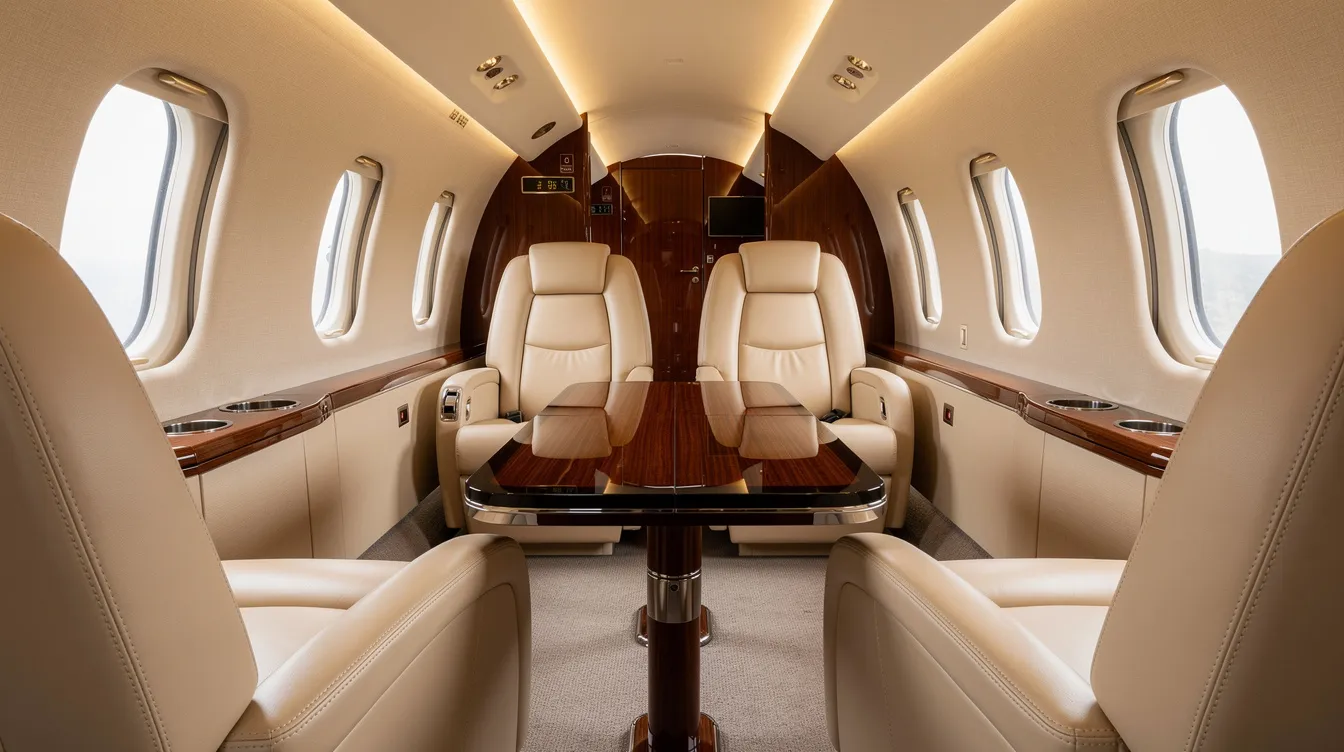
Flying privately is not simply commercial business class with fewer people. The cabin is a controlled environment designed for privacy, productivity, rest, and personalized service.
Cabin layouts vary by aircraft category:
Very light jets typically offer compact cabins for short flights and small groups.
Light jets often include club-four seating for conversation or work.
Midsize jets and super midsize aircraft may include more spacious cabins, tables, enclosed lavatories, and better baggage capacity.
Large cabin jets may offer private zones, divans, conference areas, lie-flat seating, and better range.
Ultra-long-range aircraft are designed for overnight and intercontinental missions.
Private jets offer luxury amenities not available on commercial flights, but a better way to assess the cabin is by utility. In-flight amenities in 2026 often include high-speed Wi-Fi, charging ports, quiet cabins, and inflight catering ranging from simple snacks to chef-designed meals.
For business jets, the practical value is confidentiality. The cabin can support document review, investor calls, legal discussions, board preparation, or quiet rest before arrival. For family travel, the value may be privacy, pet flexibility, children’s meals, and more control over timing.
Personalization should be discussed in advance with the charter operator or membership concierge. Specific beverage brands, dietary accommodations, pet policies, children’s needs, and preferred cabin temperature can usually be arranged when requested early.
FLYT focuses on consistent, business-ready cabins across its accessible, diverse fleet, prioritizing connectivity, privacy, and predictable standards over flashy extras. See FLYT premiums for cabin expectations.
Costs, Efficiency, and When Membership Makes Sense
On-Demand Charter vs Membership
A single private jet flight can cost tens of thousands of dollars. That is why the right model matters. On-demand charter may be efficient for rare trips, but frequent flyers often benefit from predictable pricing, guaranteed access, and the operational efficiency of a well-structured private aviation membership.
Annual Planning and Budgeting
Consider an executive or founder flying 60–120 hours per year between 2026 and 2028. If that traveler books ad hoc private charters, each trip may be priced differently based on season, route, positioning, and aircraft availability. Jet card programs may create more structure, but they can still be tied to specific operators, aircraft classes, or regional limitations.
A membership model can make annual planning easier because fixed hourly rates help companies forecast travel budgets. Fleet interchange also matters. If a traveler needs light jets for short meetings, midsize jets for domestic business trips, and large cabin jets for long-distance flights, one flexible membership can be more efficient than forcing every trip into the same aircraft type.
Ownership vs Chartering
Aircraft ownership introduces a different cost profile. The hidden costs of ownership include acquisition capital, financing, crew salaries, hangar, insurance, maintenance, annual operating costs, and residual value risk. Full ownership can make sense for very high utilization, but it creates capital lock-up and operational responsibility.
Fractional ownership reduces some of that burden but still involves acquisition cost, management fees, share commitments, and aircraft-type constraints. For many frequent travelers, membership provides a cost-effective alternative: access without ownership burden, predictable pricing without ownership costs, and flexible scheduling without the complexity of managing an aircraft.
FLYT’s asset-light fleet and risk pool approach shift many of these burdens away from the client while preserving global reach, concierge support, and flexible aircraft access. Learn more about FLYT vs charter, FLYT vs jet cards, FLYT vs fractional ownership, and FLYT vs brokers.

How FLYT approaches smarter private jet access
FLYT is a membership-based private aviation service built for executives, founders, investors, entrepreneurs, and high-net-worth travelers who value time, predictability, and access over ownership. The goal is not luxury for its own sake. It is a more intelligent way to structure private jet access.
Members access a global, floating, asset-light fleet with fixed hourly rates. This helps avoid the capital lock-up and operational complexity of fractional ownership or whole aircraft purchase while preserving the flexibility expected from premium private jet charter services.
FLYT’s model is built around several practical advantages:
Fleet interchange, so members can select different aircraft categories trip by trip without separate contracts or cards.
Fixed hourly rates, giving members clearer visibility into charter costs.
Global access through a managed network and a floating fleet model.
Concierge-level support for route design, airport selection, in-flight amenities, in-flight services, and ground transportation across multiple regions and time zones.
Operational efficiency for frequent flyers who want to replace repeated ad hoc charters with a more strategic structure.
For travelers who routinely fly private, FLYT membership can replace fragmented charter options with a more transparent, predictable model for global private jet travel.
Explore a membership model designed around efficiency, flexibility, and transparent private aviation access at FLYT memberships.
Frequently Asked Questions (FAQ)
For more detailed answers, visit the FLYT FAQ page.
How far in advance should I book a private charter flight?
Many private jet charter flights can be arranged within 24–48 hours, and some last-minute requests can be handled within hours if the right aircraft and crew are available. Booking 5–10 days ahead usually improves aircraft availability and charter pricing, especially around holidays, major events, and peak travel dates.
Can I change my itinerary after I book a charter flight?
Yes, one benefit of flying private is flexible scheduling, but changes may affect cost, crew duty time, airport slots, fuel planning, and aircraft availability. Confirm change and cancellation terms with the charter operator, charter company, or membership provider before signing.
What documents do I need to fly private internationally?
Passports and visas are required, and any current health or entry documents are still mandatory on charter flights. Private aviation simplifies the airport experience, but it does not remove immigration or customs requirements. A charter company or concierge can help confirm requirements for destinations such as the EU, UK, Middle East, or Caribbean in 2026.
Are pets allowed on private charter flights?
Most private jets are pet-friendly, but operators may require advance notice, vaccination records, approved carriers, or cleaning fees. Always confirm pet policies when requesting your quote so the correct aircraft and cabin preparation can be arranged.
Conclusion: The smarter way to charter private jets with FLYT
Chartering a private jet in 2026 is a strategic choice for executives, entrepreneurs, and frequent travelers who prioritize efficiency, flexibility, and operational control. Whether opting for on-demand charters or a membership model, understanding your travel needs, selecting reputable operators, and comparing transparent pricing are essential steps to optimize your private aviation experience.
FLYT offers a modern, membership-based approach that combines the benefits of charter flexibility with predictable pricing and global fleet access. Its asset-light floating fleet model eliminates the burdens of ownership while providing concierge-level support and fixed hourly rates. This approach enables members to seamlessly switch between aircraft classes depending on mission requirements, ensuring smarter capital allocation and superior travel convenience.
Explore how FLYT redefines private jet access by delivering operational efficiency, transparency, and global reach without ownership complexity. Learn more about how FLYT can transform your private aviation experience at www.flyt.com.
Discover a more intelligent, flexible, and cost-effective way to fly private with FLYT.