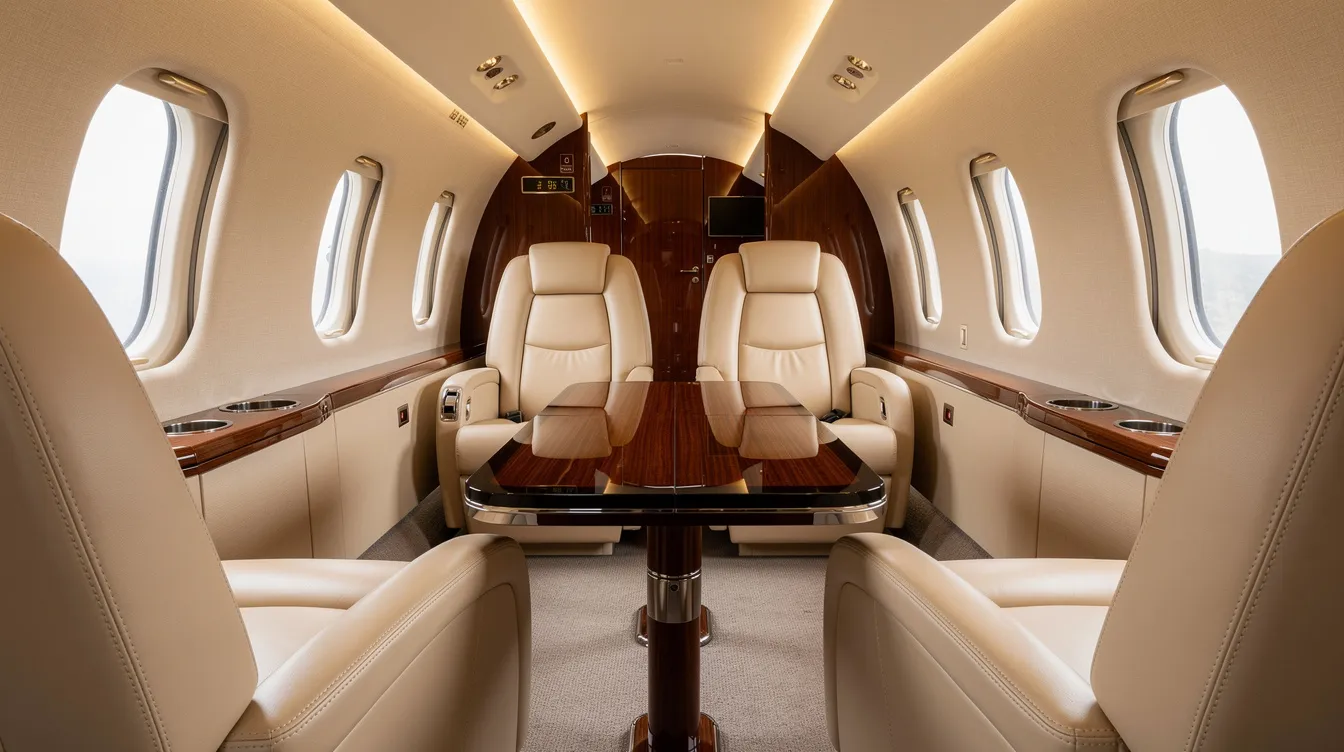
Chartering a private flight is a structured, client-focused process, but it does not need to be complicated. Whether you are flying for business, family, or a time-sensitive engagement, the core mechanics are straightforward once you understand the landscape. This guide walks through each step, from defining your trip requirements to evaluating providers, understanding charter pricing, and preparing for departure day.
Key takeaways
Charter flights let you rent the entire aircraft on your schedule, bypassing the constraints of commercial airlines, fixed routes, and crowded terminals.
The core steps to chartering a private jet are: define your trip details, choose the right aircraft types, compare charter operators or membership models, confirm charter pricing, and prepare for day-of travel.
Membership options like FLYT can offer fixed hourly rates, predictable costs, and access to multiple aircraft types without ownership obligations or long-term commitments.
Aircraft availability, safety standards, and transparent charter services matter more than simply chasing the best prices on a single trip.
Private jets save significant time compared to commercial flights, with access to over 20,000 airports globally that most commercial airlines cannot serve.
Platforms like Jettly provide access to over 20,000 unique aircraft worldwide, greatly expanding your options for aircraft type, size, and availability when chartering.
What is a charter flight, and why choose one?
A charter flight means renting the whole aircraft rather than buying a seat on someone else's schedule. You arrange it through an air charter service, a charter operator, or a membership like FLYT, and you control who flies, when the plane departs, and which airports it uses.
The differences from flying commercial are immediate and practical. You set the schedule rather than conforming to a carrier's timetable. You access private terminals and smaller airports closer to your actual destination, avoiding congested hubs. You fly with only the people you choose, which means privacy for sensitive business discussions or comfort for family travel. Chartering allows for highly customized travel options, from catering and cabin configuration to routing and ground transportation at both ends.
People charter a private jet for a range of reasons: executive travel between offices, family trips to destinations poorly served by commercial flights, corporate shuttles connecting facilities, or time-critical movements where missing a connection is not an option. Charter flights can even be booked with as little as 15 minutes' notice in some cases, though typical lead times are longer for optimal aircraft selection.
A few terms will appear throughout this article. A charter operator is the entity that holds the operating certificate and employs the flight crew. A charter broker is an intermediary who sources aircraft from operators on your behalf. On-demand charter means paying per trip with no ongoing commitment. A membership model, like FLYT, provides access to a fleet at fixed hourly rates. Charter pricing refers to the total cost structure of a given trip.
One realistic expectation to set early: flying private is more expensive per trip than commercial travel. But it is far cheaper and carries far less financial risk than owning your own private jet, which carries acquisition costs, crew salaries, hangar fees, insurance, and annual operating costs that can easily exceed seven figures.
Step 1: Define your private flight requirements
Clear trip details are the fastest way to get accurate quotes and appropriate aircraft recommendations. Gathering critical journey details before contacting any provider saves time for everyone and eliminates rounds of back-and-forth.
Here is what to define before reaching out:
Departure and arrival cities, or specific airports if you have a preference for convenient airports near your home, office, or final destination
Travel dates and preferred departure windows, including flexibility on timing
Whether the trip is one-way, round-trip, or multi-city
Passenger count, including any children, elderly travelers, or individuals with mobility needs
Whether pets will fly in the cabin
Your luggage profile matters more than most first-time charter clients expect. Standard bags are rarely an issue, but golf clubs, skis, strollers, trade show materials, or bulky equipment can require specific aircraft types with larger cargo holds. Always specify oversized items early, as they can affect aircraft selection and payload calculations.
Identify any must-haves that shape the experience. If you need Wi-Fi for work during the flight, an enclosed lavatory, lie-flat seating for longer sectors, or the ability to operate into smaller airports and regional airports close to a client site, state these upfront.
It also helps to separate business and leisure travel requirements. A domestic travel day visiting two client cities requires in-flight workspace and confidentiality. A family trip to South Florida prioritizes a relaxed cabin layout and flexible meal service. Different missions call for different private jet options.
Step 2: Understand aircraft types and what fits your trip
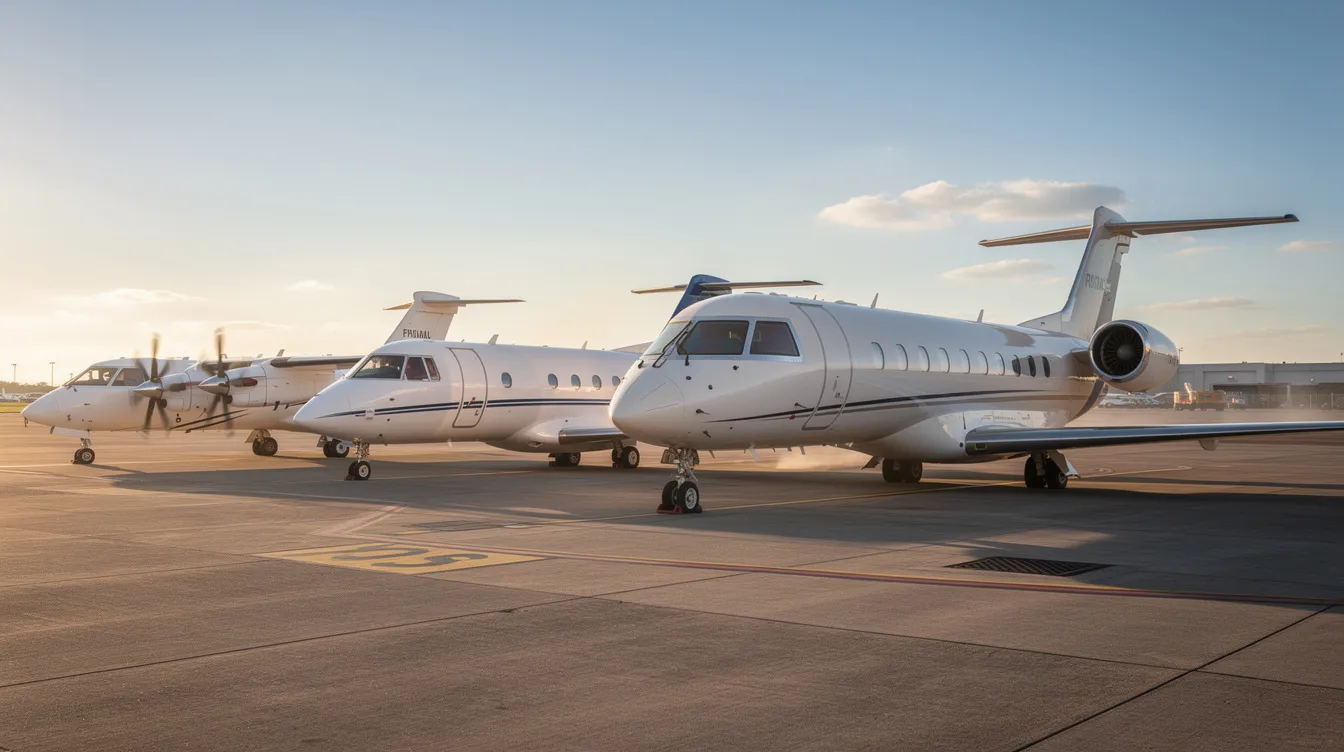
Aircraft types drive both charter pricing and the onboard experience, so basic familiarity helps you charter a private flight more intelligently. Aircraft size and suitability should always be considered based on passenger count, range requirements, and luggage needs.
Here is how the main categories break down:
Aircraft category | Passenger capacity | Typical range (miles) | Typical use cases and examples |
|---|
Turboprops | 4-6 | 500-800 | Access short runways, regional flights, cost-efficient; the Beechcraft King Air C90A is a common example and typically seats four to six passengers |
Light jets | 5-8 | Up to 1,500 | Short domestic trips, balance of cost and comfort |
Midsize & super midsize jets | 7-12 | Coast-to-coast (~2,500-3,500) | Stand-up cabins, longer domestic routes, enclosed lavatories; the Cessna Citation Latitude is a midsize example with a range of up to 2,700 nautical miles |
Heavy jets | 10-16 | ~7,000 | International flights, large groups, non-stop long distances |
Ultra-long-range jets | 12-19 | 6,750+ | Intercontinental flights, premium amenities, and nonstop capability; the Gulfstream G550 has a maximum range of 6,750 nautical miles |
Range, speed, and cabin size differ meaningfully between categories and directly impact whether fuel stops or crew overnights are required on longer sectors. A light jet can typically fly distances up to 1,500 miles, making it ideal for short domestic trips, while heavy jets average about 7,000 miles in range, suitable for nonstop international travel.
Modern membership models like FLYT's fleet interchange let you move between aircraft types trip-by-trip rather than being locked into a single jet size. One week, you use a smaller aircraft for short regional flights; the next, you book a long-range heavy jet for international travel. This flexibility means you are always in the right aircraft for the mission.
A common mistake: over-specifying the aircraft "just in case." Choosing the right size can materially improve cost efficiency without compromising comfort. If four passengers are flying for 90 minutes, a midsize jet is likely unnecessary when a light jet handles the trip well at a lower rate.
Step 3: Choose how you want to access private aviation
There are several ways to access private aviation, and the right model depends on how frequently you fly, how much capital you want to commit, and how much pricing variability you can tolerate. The main paths are on-demand charter, jet card programs, fractional ownership, and private jet memberships like FLYT.
On-demand charter flights
On-demand charter flights are pay-per-trip arrangements through a charter operator or broker. They are good for occasional use with no long-term commitments, but charter costs can vary significantly between quotes. Pricing depends on aircraft availability, positioning, demand, and the individual operator. Quote-to-quote variability of 30 to 50 percent for similar routes is not unusual.
Jet card programs
Jet card programs offer pre-paid blocks of hours with fixed or capped rates. They reduce some pricing uncertainty, but typically require meaningful upfront capital, carry restrictions around blackout dates or peak periods, and may limit you to specific aircraft options or regions.
Fractional ownership
Fractional ownership means buying a share of a private aircraft, for example, one-sixteenth, with a long-term contract (often five years or more) and monthly management fees. It works only at very high utilization, generally above 150 hours per year. Below that threshold, the capital and ongoing costs are difficult to justify. For a deeper comparison, see FLYT vs fractional ownership.
Membership models
Membership models like FLYT offer a different approach: access to a floating, asset-light fleet with fixed hourly rates, transparent pricing, and global aircraft availability without owning or co-owning a private plane. Members select the charter options that fit each trip, from light jets to heavy jets, without the balance-sheet exposure of ownership. To understand how this compares to traditional on-demand booking, see FLYT vs charter.
Frequent flyers, executives, and families who fly privately several times per year should compare on-demand private charter flights against membership to balance flexibility, capital commitment, and cost predictability. For many, the membership path provides buying power and priority access that ad-hoc booking cannot match.
Step 4: Evaluate air charter service providers
Safety, operational standards, and transparency should drive your provider selection more than headline pricing. The private aviation market includes a wide range of operators, and not all maintain the same standards.
Start with safety checks:
Verify that the operator holds a valid FAA Part 135 certificate, which is the legal authorization to conduct commercial charter operations in the United States
Look for operators with third-party safety audits from organizations like ARG/US, Wyvern, or IS-BAO; safety audits from third-party safety auditors are one of the most reliable indicators of crew training, maintenance discipline, and operational rigor
Ask about aircraft age, maintenance programs, pilot hours, and insurance levels
Understand whether you are working directly with a charter operator or a broker. A charter operator manages the private aircraft, employs private pilots, and is legally responsible for the flight. A broker arranges aircraft from multiple operators and acts as an intermediary. Both can serve you well, but you should know which entity will actually operate your flight. Broker fees are typically included in the quoted price when using a broker, so the financial impact is usually transparent.
Assess the service infrastructure beyond the aircraft itself. Does the charter company have a 24/7 operations team? Will you have a dedicated account manager? Can they handle international permits, customs coordination, and ground arrangements? For complex itineraries, this infrastructure matters as much as the aircraft.
Transparent charter pricing is essential. Quotes should clearly itemize what is included in the hourly rate and what falls outside it, such as de-icing, repositioning, catering upgrades, landing fees, and ground transportation. If a provider cannot give you a clear cost breakdown, consider that a signal.
A membership model like FLYT standardizes hourly rates across a fleet, reducing the need to re-learn pricing rules for every new operator. Members receive consistent, predictable pricing through a single relationship. Learn more about FLYT's approach to safety and security.
Step 5: compare charter pricing and confirm your itinerary
Once providers understand your trip, you will receive quotes. Comparing them on total price alone misses important differences in value, transparency, and flexibility.
Travel costs range based on aircraft size and distance. Typical hourly rates for private jet charters currently fall within these ranges:
Aircraft category | Typical hourly rate range (USD) | Notes |
|---|
Turboprops | $2,000 - $3,000 | Practical for regional flights |
Light jets | $3,000 - $5,000 | Popular for short domestic trips |
Midsize jets | $5,000 - $8,000 | Ideal for longer domestic routes |
Heavy jets | $9,000 - $15,000 | Suitable for international flights |
Charter rates typically start at around $2,000 per hour. Light jets generally cost between $4,000 and $6,000 per hour, while midsize jets average about $7,000 per hour to charter. Turboprops offer a cost-effective solution with rates from $2,000 to $3,000 per hour, suitable for shorter regional trips. Heavy jets, offering long-range capability and larger cabins, command the highest hourly rates, ranging from $9,000 to $15,000 per hour.
Beyond base hourly rates, several factors affect the final number:
Minimum flight time billing, where a 45-minute flight may be billed as 1.5 or 2 hours
Positioning flights to bring the aircraft to your departure airport
Peak-day surcharges during holidays, major events, or high-demand travel periods
Overnight crew costs on multi-day trips
Landing fees, fuel surcharges, and handling charges at specific airports
Requesting detailed quotes is essential to avoid unexpected charges. Ask whether the quote is a fixed rate or subject to fuel surcharges, taxes, or variable fees. Ask about cancellation and change policies before committing.
Empty leg flights, where an aircraft is repositioning without passengers, can offer substantial discounts on charter costs. These are worth watching for flexible travelers, though they come with limited schedule predictability.
Within a FLYT membership, the pricing model is simpler. Members know their per-hour cost in advance, can estimate a trip based on flight time and aircraft category, and avoid opaque surcharges. This is particularly valuable for executives and families who want personalized service without re-negotiating pricing on every booking. For a direct comparison with prepaid hour programs, see FLYT vs jet cards.
To confirm your itinerary, you will typically need a signed charter agreement or membership trip confirmation, a payment method on file, and the provision of passenger details and government-issued identification for all travelers.
Step 6: Prepare for the day of travel
The departure experience for private charters is fundamentally different from commercial airlines and typically far faster. Private jet travelers can check in just 15 minutes before departure for domestic flights, though arriving 20 to 30 minutes early is a comfortable buffer.
Most private charter flights depart from FBOs, which are fixed-base operators. Think of these as private terminals with parking, lounges, and direct ramp access to the aircraft. There are no security lines, no boarding groups, and no gate changes. You drive up, walk through the facility, and board.
For international travel or larger groups, allow more time. Customs processing, documentation checks, and coordination for weather conditions or routing adjustments may require an earlier arrival.
Typical pre-flight steps include:
The flight crew is verifying passenger IDs and confirming the manifest
Confirmation of pets, oversize items, or special cargo
A brief safety overview from the crew
Final routing and weather checks with operations
Share last-minute preferences in advance whenever possible. Catering choices, ground transportation at your arrival airport, meeting room configurations on board, or specific seating setups for working sessions are all standard requests that a good charter service handles seamlessly.
With a membership structure like FLYT's, many of these preferences are saved to the member profile so they apply automatically on future private flights. Your catering defaults, pet accommodations, preferred seating layout, and ground transport preferences carry forward without repeating instructions on every trip.

How FLYT approaches smarter private flight charter
FLYT is a membership-based way to charter a private jet with predictable costs and flexible aircraft access, built for travelers who value transparency and operational efficiency over the complexity of ownership.
The asset-light, floating fleet model works simply: rather than owning a static fleet of aircraft, FLYT leverages a vetted global network of operators and private aircraft, increasing aircraft availability across regions without the capital burden of fleet ownership. This model means members are not limited to aircraft based in a single city or tied to a single tail number.
Fixed hourly rates and transparent pricing sit at the center of the membership. Members know their cost per hour up front, with clear rules on what is and is not included, providing access to private jet travel without the quote-to-quote variability that characterizes much of the on-demand charter market.
Fleet interchange is where the flexibility becomes tangible. Members choose aircraft types trip-by-trip, from efficient light jets for short domestic hops to long range heavy jets for intercontinental sectors. Each trip is optimized for the mission, not constrained by a single aircraft purchase decision.
FLYT's global reach allows members to arrange charter flights across North America, Europe, the Middle East, and other key business and leisure travel corridors through the same platform and support team. Whether you are flying from New York to London or running a corporate shuttle between two regional offices, the platform handles it.
Concierge-level support ties everything together. A single point of contact understands your travel patterns, can arrange corporate shuttles between facilities, and proactively manages complex itineraries and last-minute changes at a moment's notice. For organizations, FLYT for business provides structured support for executive and team travel.
When does chartering a private jet make financial sense?
Private aviation is ultimately a decision about time and control, and the economics depend on how often you fly.
For occasional travelers making a few private charter flights per year, on-demand booking may be sufficient. The per-trip cost is higher and less predictable, but there is no membership fee or hourly commitment.
For frequent travelers, the math changes. Chartering a private jet is often more cost effective than ownership. Owning a private jet involves acquisition cost, crew salaries, hangar fees, maintenance reserves, insurance, avionics upgrades, and annual operating costs that can run well into seven figures, even when the aircraft sits idle. Fractional ownership reduces some of this, but still carries capital exposure and long-term contractual obligations. See FLYT vs fractional ownership for a detailed comparison.
For executives flying 25 to 150 hours per year, membership with fixed hourly rates and no asset on the balance sheet is often more rational. You gain priority access, providing access to the private aviation market without the overhead. There is no depreciating asset, no crew management, and no maintenance surprises.
Look beyond the sticker price of any single charter and factor in soft savings: fewer overnight hotel stays because you can depart after a late meeting, the ability to visit multiple cities in a single day, productive work time in a quiet cabin instead of hours lost to layovers, and access to smaller airports closer to your actual destination rather than connecting through congested hubs served by carriers like delta air lines.
Private jets can access over 20,000 airports globally and provide access to over 20,000 aircraft through various platforms and operators, offering unparalleled convenience for travelers whose schedules do not align with commercial flights. Private jets can operate from smaller airports than commercial airlines, opening up destinations and routing options that flying commercial simply cannot match.
FLYT can help model different usage scenarios so travelers can see whether membership or ad-hoc charter aligns better with their actual flying patterns and the booking process they prefer. Learn more in the FLYT FAQ.

Frequently asked questions
How far in advance should I charter a private jet?
For common domestic travel routes, two to seven days of notice typically secures good aircraft options and competitive charter pricing. High-demand travel dates such as major sporting events, holidays, and peak winter and summer weeks benefit from booking several weeks in advance to maximize aircraft availability. Charter flights allow for last-minute scheduling within three hours in many cases, and some providers can arrange flights even faster. With a membership like FLYT, members receive priority access and faster confirmations, including support for short-notice private flights when schedules change suddenly.
Can I change my itinerary after I have booked a charter flight?
Itinerary changes are usually possible, but they can affect price, crew duty limits, and aircraft suitability. Simple time shifts on the same day are generally easier to accommodate than wholesale route changes or adding new legs. Members and charter clients should review change and cancellation terms in their agreements. Membership programs like FLYT typically have clearer, standardized rules around modifications, which reduces ambiguity when plans shift.
What documents do I need to fly on a private charter?
For domestic flights, government-issued photo identification is required for all adult passengers, even though there is no standard commercial airline check-in process at private terminals. For international charter flights, valid passports and any necessary visas are mandatory, just as with commercial airlines. FLYT or any reputable air charter service can advise on country-specific entry rules, advance passenger information requirements, and documentation needed for pets or specialized cargo. You can also reference the FLYT airport directory for specific facility details.
Are there baggage limits on a private jet charter?
Private jets have flexible luggage policies, and charter flights typically allow more luggage than commercial airlines. However, each aircraft type has specific weight and size limits for combined passenger and cargo load. Larger aircraft naturally accommodate more, while light jets have smaller baggage compartments that may not fit oversized sporting equipment. Share details of any oversize items such as golf bags, skis, or trade show cases before the booking process so the right aircraft can be selected. A membership or charter operator like FLYT will flag luggage constraints during the quoting stage to avoid surprises on departure day.
Can I use charter flights for recurring corporate shuttles?
Many companies use private jet charter services to run regular corporate shuttles between key hubs, manufacturing plants, or regional offices, especially where commercial airline options involve indirect routing or inconvenient schedules. A membership model with predictable hourly rates and a floating fleet, like FLYT's, is well suited to scheduling repeat routes with consistent service levels and no fixed routes locked to a single aircraft. Organizations can standardize departure times, onboard setup, and branding touches across multiple flights, treating the shuttle almost like a customized private route with the cost efficiency of shared buying power across a membership base.
For more information or to discuss your specific travel needs, contact FLYT to explore how modern private aviation can work without ownership complexity.
Conclusion: charter smarter with FLYT
Chartering a private flight offers unparalleled flexibility, efficiency, and convenience for executives, entrepreneurs, and frequent travelers who value time and predictability. Understanding your trip requirements, selecting the right aircraft, and choosing a transparent, safety-focused provider are key steps to a seamless experience. Models like FLYT’s membership program combine fixed hourly rates, global aircraft access, and concierge-level support to deliver a smarter alternative to ownership and traditional charter.
Explore how FLYT’s asset-light floating fleet and fleet interchange options provide adaptable private jet access tailored to your travel needs. Whether flying domestically or internationally, FLYT ensures predictable private aviation costs without the complexities of ownership or fractional shares. For those seeking operational efficiency and a premium experience with less hassle, discover FLYT memberships and learn more about how modern private aviation pricing works.
Ready to elevate your travel? Contact FLYT to explore a membership model designed around flexibility and transparency, and see how private jet charter can be simpler, smarter, and more accessible.