In an era where time is one of the most valuable assets, understanding the true cost of chartering a private jet is essential for executives, entrepreneurs, and frequent travelers seeking efficient and flexible air travel solutions. Private jet chartering offers unparalleled convenience and access compared to commercial flights, but pricing can be complex and variable. This 2026 guide from FLYT breaks down the key factors influencing private jet rental prices, providing clear insights into hourly rates, trip costs, and strategies to optimize your private aviation experience. Whether you are considering ad-hoc charters or exploring membership models, this comprehensive overview will help you navigate the financial and operational aspects of flying private with confidence.
Key takeaways
Private jet charter costs range from about $2,000–$3,000 per hour for turboprops up to $12,000–$18,000+ per hour for ultra-long-range jets as of 2026. A two-hour private jet flight can cost between $8,000 and $37,000 depending on the aircraft category.
Total trip cost depends on aircraft type, flight time, routing, airport fees, federal excise tax in the U.S. (7.5% on domestic flights), and extras like catering, Wi-Fi, and de-icing.
Short legs can be disproportionately expensive because of minimum hourly charges, short leg fees, and repositioning time. Even a 25-minute hop may be billed at 1.0–2.0 hours.
Costs are influenced by aircraft size and flight distance, with peak demand, seasonality, and last-minute booking pushing prices further.
Rates for private jets can increase during peak travel seasons or holidays, impacting all aircraft categories.
FLYT's membership model and fixed hourly rates are designed to turn unpredictable charter quotes into more transparent, predictable private jet travel costs for frequent flyers.
What does it really cost to charter a private jet in 2026?
Hourly Rate Ranges by Aircraft
If you've ever requested quotes from multiple operators for the same route on the same day, you already know the problem. Private jet charter pricing is dynamic, inconsistent, and often opaque. Two brokers quoting a New York to Miami leg on a light jet might return numbers that differ by 30% or more, depending on aircraft availability, operator standards, and what's bundled versus line-itemed.
That inconsistency makes it difficult to plan, budget, or compare. And it's the primary reason many frequent private flyers eventually move toward structured access models rather than shopping every trip individually.
Here are the 2026 benchmark ranges for private jet charter costs by category. Charter rates can start as low as $2,000 per hour for turboprops, scaling up through the following tiers:
Aircraft Category | Hourly Rate Range (USD) | Typical Use Case |
|---|
Turboprops | $2,000 – $3,000 | Short regional flights under 500 miles |
Light jets | $4,000 – $7,000 | Domestic hops up to 2–3 hours, 4–7 passengers |
Super light jets | $5,000 – $8,000 | Coast-to-coast flights with moderate cabin size |
Midsize jets | $6,000 – $9,000 | Cross-country domestic flights, 5–7 passengers |
Super midsize jets | $7,500 – $12,000 | Coast-to-coast US or short international routes |
Heavy jets | $9,500 – $14,000 | Long-range travel, 12–18 passengers |
Ultra-long-range jets | $12,000 – $18,000+ | Non-stop intercontinental flights |
These are base hourly rates. Realistic all-in trip costs, including taxes, handling, repositioning, and extras, typically run 25–40% higher for domestic flights and more for international flights.
Sample Charter Scenarios
To put this in context with some concrete examples. A New York to Miami charter on a light jet, roughly 2.5 flight hours each way, might come in at $14,000–$18,000 one way all-in. A Los Angeles to Aspen weekend round trip on a midsize jet lands in the $25,000–$35,000 range depending on the season and aircraft. A New York to London round trip on a heavy jet or ultra-long-range aircraft can reach $80,000–$150,000 or more, depending on how far in advance you book and which specific aircraft you select. A round-trip from New York to Los Angeles costs about $102,000 on a heavy or large-cabin jet.
FLYT uses a membership model with fixed hourly rates to create more predictable pricing than ad hoc on-demand private jet rental. Rather than negotiating every trip from scratch, members know their rate by aircraft category before they confirm a flight.
Private jet hourly rates by aircraft type
Hourly Rate Ranges by Aircraft
Most private jets and turboprops are priced on a billable hourly rate, which forms the backbone of any charter cost calculation. Aircraft type significantly affects charter pricing, and the range across categories is substantial.
Here are the 2026 typical ranges and use cases by category:
Turboprop (e.g., King Air 350, Pilatus PC-12): $2,000–$3,000 per hour. Best suited for short regional flights under 500 miles, with cabin space for up to eight passengers. Turboprop charters start at around $2,000 per hour, making them the most cost-efficient option for shorter legs.
Light jet (e.g., Phenom 300, Citation CJ4): $4,000–$7,000 per hour. Domestic hops up to 2–3 hours, typically carrying 4–7 passengers with moderate luggage.
Super light jet: $5,000–$8,000 per hour. Slightly more range and cabin space than a standard light jet, useful for coast-to-coast flights where a midsize feels unnecessary.
Midsize jet (e.g., Hawker 800XP, Learjet 60XR): $6,000–$9,000 per hour. Cross-country domestic flights, 5–7 passengers, with more cabin amenities and stand-up headroom.
Super midsize jet (e.g., Challenger 350, Praetor 600): $7,500–$12,000 per hour. Coast-to-coast U.S. or shorter international routes, 8–10 passengers, full lavatory and in-flight entertainment options.
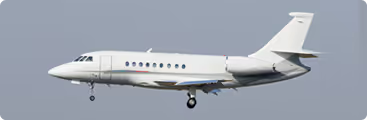
Heavy jet (e.g., Falcon 900, Gulfstream G450): $9,500–$14,000 per hour. Heavy jets typically accommodate 12 to 18 passengers for long-range travel, with multiple cabin zones. Heavy jet charters can cost closer to $10,000 an hour at the entry point of this category.
Ultra long range (e.g., Gulfstream G650ER, Global 7500): $12,000–$18,000+ per hour. Ultra-long-range jets can fly up to 7,000 nautical miles non-stop, covering routes like New York to Dubai or Los Angeles to Tokyo without refueling.
The hourly rate usually includes aircraft, crew, and standard fuel, but not all trip-specific extras or taxes. Larger and newer aircraft generally cost more to charter due to higher acquisition, maintenance, and crew costs.
Choosing the Right Aircraft
The "right" aircraft type for a given trip is driven by flight distance, passenger count, and luggage requirements rather than the headline hourly rate alone. Overpaying for a heavy jet on a 90-minute domestic leg or cramming eight people into a light jet to save money are both common and avoidable miscalculations.
Real-world private jet charter cost examples
Sample Charter Scenarios
The hourly rate table above provides a framework. But what does it actually look like when you price a specific trip? The following are illustrative estimates based on recent 2025–2026 private jet charter market data. Actual quotes depend on specific dates, aircraft availability, and the operator.
Example 1: New York (TEB) to Boston (BOS), same-day return
A same-day return on a turboprop like the King Air 350 involves roughly 2.5 total flight hours plus taxi and minimums. Expect approximately $8,000–$12,000 all-in before premium catering. Stepping up to a light jet doubles the hourly rate and pushes the all-in cost toward $15,000–$22,000. Light jets like the Cessna Citation CJ3+ cost $9,000–$11,000 for short flights of this type one way.
Example 2: Los Angeles (VNY) to Aspen (ASE), weekend round trip
Flight time is roughly 2–3 hours each way. Aspen's mountain airport carries higher landing and handling fees and operational restrictions. On a super light jet or midsize jet, overnight crew expenses, airport fees, and potential de-icing add up. All-in costs for this weekend trip typically fall between $25,000–$35,000 depending on the specific aircraft and time of year.
Example 3: Chicago (MDW) to San Francisco (SFO), business round-trip
A super midsize jet covers this route in about 4.5–5 hours each way. Total block hours, including taxi, minimums, and potential positioning, run approximately 10–11 hours. The all-in cost for this business round trip generally falls between $60,000 and $90,000. Longer flights increase fuel consumption and costs, and this route illustrates how block hours accumulate on cross-country itineraries.
Example 4: New York (TEB) to London (LTN), 3-night stay
An intercontinental private charter on a heavy or ultra-long-range jet involves 7–8 flight hours each way, plus overflight permits, customs, overnight expenses for crew, premium fuel surcharges, and repositioning. Heavy jets typically cost $80,000 to $90,000 for transatlantic flights, while ultra-long-range aircraft can push the total to $100,000–$150,000 or more. This is where the choice between a larger aircraft and routing efficiency has the biggest financial impact.
Seasonality, peak events, and last-minute booking can move all of these numbers meaningfully. Charter flights during Art Basel Miami, Davos, the Super Bowl, or peak European summer can see rates increase 20–40% above baseline, driven by scarcity and repositioning constraints.
What is included (and not included) in private jet charter pricing?
Cost Breakdown: What's Included?
Base private jet charter price quotes generally bundle the major operating costs. But important variables are often excluded or listed as add-ons, leading to invoice surprises that can represent thousands of dollars on longer trips.
Here's how it typically breaks down.
Included in Base Rate:
Aircraft usage for the booked flight hours
Flight crew (pilot and co-pilot)
Standard fuel for the route
Standard handling at most airports
Basic in-flight refreshments (water, light snacks)
Commonly Excluded/Billed Separately:
Premium catering and specialized meal service
A flight attendant on smaller jets (light and midsize categories often fly without one; adding one incurs a per-day fee plus overnight expenses)
De-icing (deicing fees can vary from $1,500 to $15,000 depending on aircraft size)
Wi-Fi data usage (Wi-Fi charges can range from $2 to $9 per megabyte on many aircraft)
A positioning fee may be charged when the desired aircraft is not at the departure airport, effectively adding an empty leg to your bill
Overnight crew expenses, which range from $200 to $600 per member, including lodging and meals if required for the trip
Out-of-hours operations and weekend surcharges
Ground transportation at origin or destination
Landing and handling fees are charged by airports for private jet usage, and these vary significantly by location
Chartering a jet avoids ownership costs like maintenance, depreciation, and hangar storage. But without a clear breakdown of what is and isn't covered in a given quote, the perceived savings can erode quickly.
FLYT emphasizes transparent, itemized quotes for members so all expected costs are visible before confirming a trip. When a member requests a flight, the quote shows the hourly rate, estimated taxes, airport-specific fees, and any known add-ons in a single view. This is a core part of the concierge services FLYT provides: reducing friction and eliminating the guesswork that comes with traditional private charter.
Key pricing drivers when chartering a private jet
Beyond the posted hourly rate, several structural factors drive the true cost of any private jet charter. Understanding these helps explain why two quotes for the same route can look very different.
Flight time and distance (block hours): Block hours include taxi, climb, cruise, descent, and taxi again. Short flights burn proportionally more fuel during climb and descent, making the per-mile cost higher, while longer flights consume more fuel and increase the total cost.
Aircraft type and age: Newer aircraft with advanced avionics, cabin interiors, and safety certifications command premium pricing. Operators with ARGUS or Wyvern ratings also tend to price higher.
Airport selection and associated landing, handling, and parking fees: Major hubs cost significantly more than smaller regional airports. Landing fees at major airports can exceed $8,000 for heavy jets.
Trip pattern (one-way vs round trip, same-day vs multi-day): One-way flights often require the operator to reposition the aircraft empty, and that cost gets passed along. Multi-day trips add crew overnight expenses and parking fees.
Market demand (holidays, major events, peak days): Peak demand can raise private jet charter prices substantially. Super Bowl, holiday weekends, and festival periods drive scarcity pricing across the private jet charter market.
Special services (catering level, in-flight entertainment, flight attendant on smaller jets): Upgraded catering, high-bandwidth connectivity, and adding crew members to a smaller aircraft all add to the final bill.
Short legs deserve special attention. Very short private flights can trigger short-leg fees, minimum daily usage billing, and higher per-hour maintenance costs from repeated takeoffs and landings. Most operators impose minimum billable flight times of 1.0–2.0 hours for smaller aircraft, meaning a 25-minute hop may still be billed at 1.5 or 2.0 hours.
Frequent itinerary changes, whether adjusting time or route, can also add repositioning legs and crew duty-day constraints, increasing total cost beyond the original quote. A fuel surcharge may also apply when fuel prices rise, adding another variable that's difficult to predict on ad-hoc charter flights.
Taxes, fees, and surcharges you should expect
Private jet charter services typically present a base price plus line-item taxes and airport or government fees on top. These are not optional and can add meaningfully to the total.
The U.S. federal excise tax is 7.5% on all domestic flights. This is applied to the total passenger flight charge and is a fixed, unavoidable cost on every domestic private flight. Federal excise tax at 7.5% applies to all domestic flights within the US, regardless of aircraft type or charter company.
Beyond the FET, expect the following government taxes and fees:
Landing and handling charges: airport landing fees can range from $100 to $1,500 per flight at smaller airports, while landing fees can range from $100 to $8,000 depending on the airport and aircraft weight. Airport authority charges vary widely.
Ramp and parking fees: charged when an aircraft is parked at an FBO or on a ramp between legs, especially during multi-day trips. Hangar fees may also apply if you want to protect the aircraft from the weather.
International fees: overflight permits, landing permits, customs, and immigration charges for international flights can add several thousand dollars per sector. These are particularly significant on heavy and ultra-long-range aircraft crossing multiple airspaces.
De-icing: In the winter months, de-icing fees can vary from $1,500 to $15,000 depending on aircraft size. Some operators offer hangar storage as an alternative, but hangar fees in busy airports can also be substantial.
For domestic flights, these non-hourly components typically add 25–40% overhead to the base hourly cost. For international private jet charter flights, the total markup can be higher, especially when landing permits and customs processing are involved. Understanding these line items is essential for anyone evaluating charter flight cost against other private aviation models.
How private jet memberships and fixed hourly rates change the cost picture
For those flying 25–150+ flight hours per year, moving from ad-hoc private jet rental to structured private jet membership can fundamentally reshape how private aviation costs behave.
The core issue with on-demand charter is volatility. Every trip is a new negotiation, influenced by aircraft availability, fuel prices, airport fees, and competitive demand. For a business traveler flying 50–100 hours annually, that volatility makes budgeting difficult and often leads to overpaying during peak periods.
Membership-based private aviation services offer flexible jet access without ownership. Fixed hourly rates, daily minimums, and guaranteed availability can make annual budgeting for private jet travel more predictable than purely on-demand charters. Jet cards allow frequent fliers to lock in fixed hourly rates, but they often lack fleet interchange flexibility.
FLYT's membership model is designed around several specific principles:
Access to a curated floating fleet rather than a single owned aircraft, creating an asset-light structure that avoids tying up capital in a depreciating asset
Fixed hourly rates by aircraft category, reducing the quote-to-quote volatility that defines the on-demand charter experience
Fleet interchange so members can right-size aircraft per mission without penalty, choosing a turboprop for a short regional hop and a heavy jet for a transatlantic leg without maintaining separate contracts
Risk pool model that shares fleet availability across members, smoothing pricing and reducing individual exposure to repositioning surcharges or one-off spikes
Concierge support that handles routing, aircraft selection, and cost optimization on each trip
This is an asset-light alternative to full ownership or large upfront jet card programs, focused on capital efficiency and operational flexibility. Members don't carry annual operating costs or depreciation risk. Instead, they pay for access and usage at predictable rates.
Chartering a private jet vs owning, jet cards, and fractional
Private aviation isn't one-size-fits-all. The right access model depends on how many hours you fly, how much capital you want to deploy, and how much operational complexity you're willing to manage. Here's how the main models compare:
Ad-hoc charter: Best for occasional use, roughly under 25 flight hours per year. You charter a private jet as needed with no upfront commitment. Maximum flexibility, but high cost variance and no guaranteed availability. You're essentially paying the entire aircraft cost at spot-market rates for each trip.
Jet card programs: Prepay for a block of hours at a fixed hourly rate, typically 25–50 hours. Provides rate certainty within the block but is often limited to specific aircraft categories and may include blackout dates. A jet card locks in pricing but lacks the fleet interchange and concierge depth of a full membership.
Fractional ownership: Purchase a share (typically 1/16 to 1/4) of a specific aircraft. Comes with fixed acquisition cost, annual management fees, and maintenance obligations. Typically, economical only above roughly 200–300 flight hours per year. You own a depreciating asset.
Full ownership: Buying a jet requires a capital investment of $3–75 million, depending on the aircraft. Owning a private jet can exceed $1 million annually in operating costs, including crew, maintenance, insurance, hangar fees, and management. Only makes sense with consistently high utilization and comfort with asset risk. A private plane at this level is a serious financial commitment.
FLYT positions itself between these models:
Combines the rate predictability of a jet card with the flexibility of charter and the access depth of fractional ownership, without the asset risk
Fleet interchange means you're never locked into one aircraft type, and the risk pool model shares fleet availability across members, reducing individual exposure to repositioning or peak-period surcharges
No capital tied up in a depreciating asset; no ownership costs beyond the membership and usage fees
Chartering offers flexibility without long-term commitments, and FLYT's membership layers predictability and direct access to that flexibility for those who fly enough to benefit from structure.
Practical ways to reduce the cost of flying private
Cost management in private aviation isn't about cutting corners. It's about making structural decisions that reduce waste without compromising safety, comfort, or productivity. Here are practical strategies for managing private jet rental costs:
Choose smaller airports and secondary airports to reduce landing fees significantly. Teterboro instead of LaGuardia, Van Nuys instead of LAX, Midway instead of O'Hare. Smaller regional airports often charge a fraction of what major hubs charge for landing and handling. A private terminal or Fixed Base Operator (FBO) can also streamline the experience and sometimes reduce fees.
Fly on shoulder days or off-peak times to avoid demand spikes. Tuesday and Wednesday departures are typically less competitive than Thursday afternoon or Sunday evening. Booking during off-peak seasons can yield cost savings of 15–25%.
Right-size aircraft type to passenger count and range. A turboprop for a sub-500-mile leg with four passengers costs a fraction of a midsize jet. Matching multiple passengers to the right cabin space avoids paying for unused capacity.
Consolidate meetings into fewer, more efficient itineraries rather than multiple short legs that incur short leg fees and daily minimums. Two cities in one day with efficient routing costs less than two separate day trips.
Consider empty leg flights when schedule and routing are flexible. Empty legs can be discounted by 20%–50% for one-way flights, and in some cases, empty leg flights can save up to 75% on charters. The trade-off is limited flexibility on timing and route.
Book in advance when possible. Booking 1 to 3 months in advance is ideal for domestic flights to secure better aircraft selection and routing. For major events, securing preferred travel dates several weeks or months ahead avoids scarcity surcharges.
Evaluate membership if you're flying 25+ hours annually. A membership model like FLYT's can layer additional cost savings via fixed hourly rates and reduced exposure to last-minute market pricing swings, turning unpredictable charter costs into a budgetable line item.
How FLYT approaches transparent private jet pricing
FLYT's philosophy centers on access without ownership, predictable economics, and transparent cost structures rather than opaque per-trip negotiations. The goal is to make private aviation feel like a well-managed operating expense rather than a series of unpredictable transactions.
Specifically, FLYT handles pricing through:
Upfront disclosure of hourly rates and expected taxes and fees before a member confirms any trip
Clear differentiation between included costs (aircraft, crew, fuel, standard handling) and variable trip costs (catering upgrades, de-icing, specific airport surcharges)
Consistent pricing across aircraft types via fleet interchange, not one-off spot quotes that fluctuate with market conditions
For business and leisure travel, this approach means FLYT's members can plan annual travel budgets with more confidence. The hourly rate, aircraft category, and typical ancillary costs are known in advance, reducing the financial uncertainty that characterizes ad-hoc charter. Lower operating costs per trip, compared to ownership, combined with rate stability, compared to on-demand charter, create a middle path that works for frequent private flyers.
Whether you're flying tens of thousands of miles per year across domestic and international routes or maintaining a focused regional schedule, the economics are clearer when the pricing model is designed around transparency.
Explore how FLYT's membership model can bring predictability and efficiency to your private aviation costs.
Frequently asked questions
Is there a minimum income or net worth to make flying private financially reasonable?
The financial justification for flying private depends more on annual flight hours, the value of your time, and business use than on a specific income threshold. That said, most regular private jet travelers typically have seven-figure incomes or substantial liquid assets, simply because consistent private aviation use involves spending tens of thousands per trip.
For executives whose time is valued at several hundred or several thousand dollars per hour, the productivity and time savings from avoiding commercial airlines, especially on multi-city itineraries, can more than offset the charter costs. Private flights eliminate security lines, connection delays, and schedule inflexibility.
FLYT does not require a public income threshold. The conversation is about whether a membership aligns with your travel pattern, your capital strategy, and whether the time recovered from flying private justifies the investment.
How many hours per year do I need to fly before a membership makes more sense than an ad-hoc charter?
For many travelers, somewhere around 25–50 flight hours per year is the point where structured access like a membership or jet card starts to be worth evaluating. Below that level, the flexibility of ad-hoc charter, despite its cost variance, is often sufficient.
Above approximately 75–100 hours per year, the predictability of fixed hourly rates and guaranteed access typically outweighs any marginal savings from shopping every charter individually. The administrative burden of sourcing quotes, comparing operators, and managing logistics on each trip also becomes significant at higher volumes.
FLYT can analyze a prospect's last 12–24 months of travel to show whether membership would have reduced volatility or total spend. The analysis is data-driven and focused on whether the numbers support structured access for that particular travel pattern.
How far in advance should I book a private jet charter to get better pricing?
For most domestic flights, 10–30 days' notice allows better aircraft selection, more efficient routing, and lower positioning costs compared to last-minute requests. A charter company can usually offer more competitive pricing with adequate lead time.
For major events such as Art Basel Miami, Davos, or the Super Bowl, booking several weeks or even months ahead is advisable. Peak-period inventory shrinks rapidly, and remaining aircraft often carry repositioning surcharges and limited availability. European summer routes to the Mediterranean similarly tighten well in advance.
FLYT members benefit from structured access, so availability and pricing are generally less sensitive to these demand spikes than pure on-demand charter. But even within a membership framework, earlier notice improves routing efficiency and aircraft selection.
Do I always need a flight attendant on a private jet, and does it affect the cost?
Larger cabin classes, including super midsize, heavy, and ultra long-range aircraft, typically include a flight attendant as standard, with their cost built into the hourly rate. On these aircraft, a flight attendant manages catering service, cabin safety, and passenger comfort throughout the flight.
Light jets and turboprops often operate without a flight attendant by default. One can be added at an extra per-day fee plus expenses if desired. Having a flight attendant becomes more relevant on longer legs, with complex catering requirements, or when traveling with a larger group. For many clients, it is an integral part of the overall private jet travel experience, especially on long-haul flights.
How do short leg fees and daily minimums affect very short flights?
Most operators impose daily minimum flight times, often 1.0–2.0 hours for smaller aircraft and 2.0–3.0+ hours for heavy and ultra-long-range jets. This means a 25-minute hop may still be billed at 1.0–2.0 hours of flight time.
Short leg fees help offset the higher fuel burn and maintenance costs from repeated takeoffs and landings, which create disproportionate wear on engines and airframes. Grouping short meetings into a more efficient route or choosing a turboprop for very short distances can mitigate the impact of these structural costs. An air carrier certificate holder incurs real costs on every cycle regardless of flight length, and those costs have to be recovered.
FLYT's team typically advises members on when a very short private leg is economical and when a different plan, such as combining destinations or using ground transportation for a final segment, might make more financial sense.
Conclusion
Understanding how much it costs to charter a private jet is crucial for executives and frequent travelers seeking efficient, flexible, and predictable private aviation solutions. While hourly rates vary widely based on aircraft type, flight distance, and additional fees, the key to managing costs lies in transparency and strategic planning. FLYT offers a modern membership model designed to simplify private jet access with fixed hourly rates, fleet interchange flexibility, and concierge-level support, eliminating the unpredictability and complexity of traditional charter pricing. By choosing FLYT, travelers gain global access to a curated floating fleet without the burdens of ownership, ensuring operational efficiency and cost control.
Explore how FLYT’s innovative approach can transform your private aviation experience by providing smarter, more transparent access to private jets tailored to your unique travel needs. Discover a more flexible and predictable way to fly private at www.flyt.com.