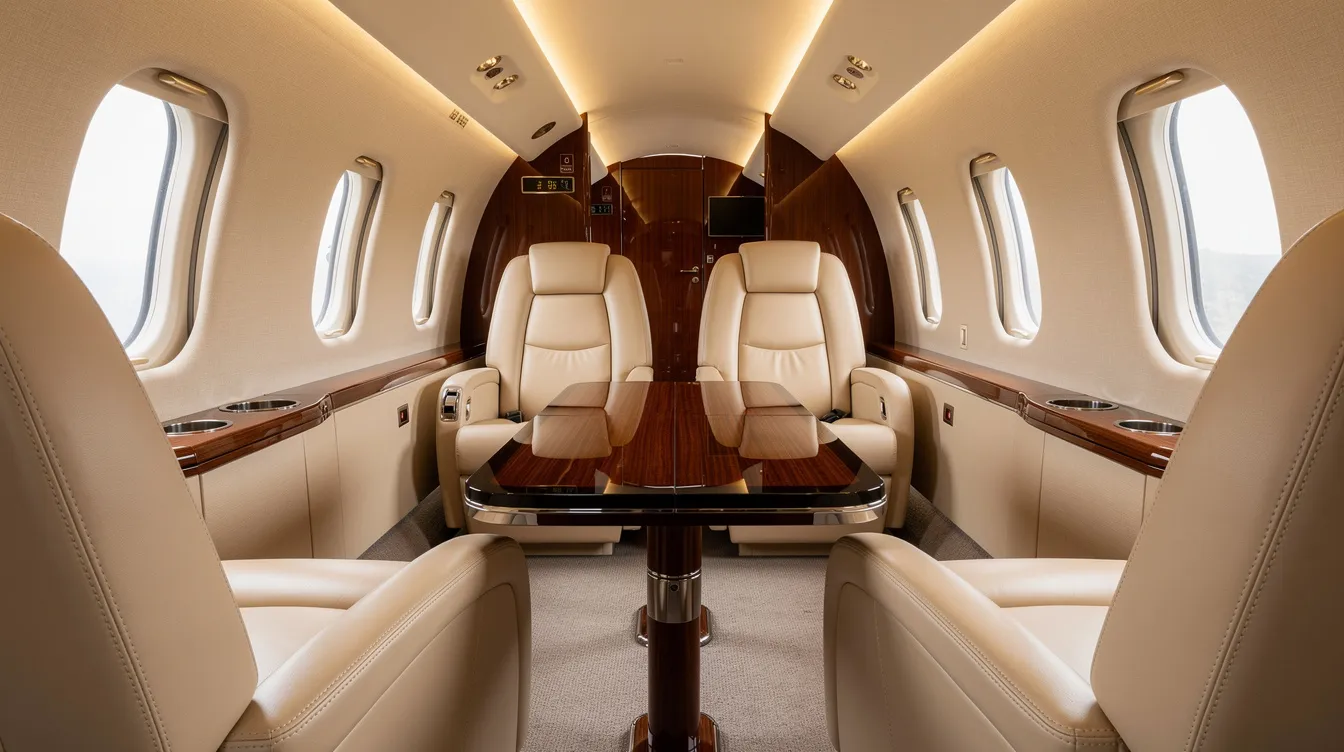
A flight charter is the business of renting an entire aircraft for a specific journey. For executives and frequent flyers, flight charter offers unmatched flexibility, privacy, and time savings compared to commercial air travel. For executives and frequent flyers, it represents one of the most direct ways to reclaim time, control schedules, and move between cities without the friction of commercial air travel. But the way you access charter matters just as much as the decision to fly privately.
This article breaks down how charter flights work, what they cost, how the major access models compare, and how FLYT's membership approach offers a more efficient path for those who fly regularly.
Key takeaways
Flight charter allows travelers to book an entire aircraft on-demand, while FLYT offers a membership model that delivers similar flexibility with more predictable costs through fixed hourly rates and transparent pricing.
FLYT provides private jet charter access without requiring members to purchase or co-own an aircraft, removing capital risk and balance sheet complexity. Learn more about our asset-light, floating fleet approach.
Members can interchange across multiple aircraft types - light, midsize, super midsize, and large cabin - based on each trip's requirements, instead of being locked into a single jet. See details on aircraft interchange.
FLYT's asset-light, floating fleet and global partner network improve aircraft availability and support international charter flights year-round across key regions. Discover how our AI fleet engine optimizes this.
This article is written for executives and frequent flyers comparing private jet charter, jet cards, fractional ownership, and membership models, and will help them identify the most efficient structure for their travel needs. For a comparison, visit FLYT vs charter and others.
What flight charter is and why executives use it
At its core, a charter flight is a non-scheduled service designed around the passenger's itinerary. You select the departure time, origin, and destination. The aircraft, crew, and routing adapt to you rather than the other way around. This stands in contrast to commercial airlines, which usually fly between major hubs on fixed, public schedules that may not align with where you actually need to be.
Private charters offer significant advantages over commercial airlines for certain profiles of travelers. Private charter flights provide a quiet, secure environment suitable for working or relaxing, and private charters allow for total privacy and security during travel. Private charters eliminate long check-in lines, security hassles, and wait times - which, for someone running a tight schedule between a board meeting in Chicago and a site visit outside Atlanta, translates directly into hours recovered.
The use cases are practical. Same-day meetings across multiple cities - Boston to New York to Washington, D.C. - become feasible when you control departure timing. Board travel to quarterly meetings in smaller markets with limited airline service is far simpler with private flights. Family trips to destinations only served by regional airports no longer require layovers or overnight stops. Private jets access over 20,000 airports worldwide, and private charters can access over 5,000 airports in the U.S. alone. That reach opens destinations and route combinations that scheduled services simply cannot accommodate.
The travelers who rely most on private charter include founders, PE partners, family offices, project teams, and high-net-worth families who fly 25 to 200 or more hours per year. For these individuals, the cost of waiting in terminals and adjusting schedules around airline timetables often exceeds the cost of chartering.

How a private charter flight actually works
The process starts with a trip request and an initial plan built around the itinerary before aircraft options are quoted. An executive needing to fly from New York to San Francisco on short notice would contact a charter broker, operator, or membership platform with the route, departure window, number of passengers, and any specific requirements - baggage volume, catering preferences, or onward connections. The provider then returns one or more proposals with different aircraft types, factoring in aircraft availability and positioning.
Charter flights allow you to choose the departure time, origin, and destination. Once the traveler selects a proposal, there is a contract, payment (often upfront or via deposit), and the operator begins preparations: crew scheduling, maintenance verification, flight planning, and FBO ground handling coordination. Booking can be completed in four simple steps, and charter flights can be booked within three hours of signing a contract when the situation demands speed. Learn more about how it works.
Here is what determines which aircraft is proposed:
Route length and number of passengers - a light jet for New York to Boston, a super midsize for Dallas to San Francisco
Cabin comfort requirements - stand-up cabin for longer flights, enclosed lavatory, WiFi
Baggage and cargo needs - heavier loads push toward larger categories
Repositioning - if the aircraft is not already at the departure airport, a positioning leg adds time and cost
Several parties play distinct roles in making a charter flight happen:
Operators hold the aircraft, employ the pilots, manage maintenance, and ensure safety compliance
Brokers connect customers to operators, often vetting quality and negotiating pricing
Membership platforms like FLYT combine elements of both - setting fixed rates, vetting operators for safety standards, handling dispatch, and managing the customer interface. See our platform overview.
Passengers bypass long security lines at large terminals when using charter services. Charter flights save time by bypassing crowded terminals and instead operating from FBOs - Fixed-Base Operators - at airports such as Teterboro (TEB), Van Nuys (VNY), and London Luton (LTN). Charter flights can depart when you want, allowing arrival just minutes before takeoff. Travelers can customize every detail of their trip, including aircraft model and catering menus, and passengers can customize their in-flight catering and trip itinerary to fit the journey precisely.
Private jet charter services vs on-demand charter
The term private jet charter services covers a broad category. It includes ad hoc or one-off charter (on-demand), jet cards with prepaid hour blocks, fractional ownership, and modern membership models. On-demand charter refers specifically to single-trip bookings - you need a plane, you request a quote, you fly.
Traditional on-demand charter often delivers variable pricing. Each trip generates a separate quote influenced by aircraft availability, operator positioning legs, aircraft category, fuel costs, and market demand. This creates unpredictability. An identical route on two different weekends can produce quotes that differ by 20 percent or more. For executives who fly frequently, this variability complicates budgeting and creates friction in every booking.
More structured models reduce that volatility. Fixed hourly rates, guaranteed access windows, and minimum notice periods for booking provide a layer of consistency that on-demand charter lacks. Jet cards offer some of this through prepaid hour blocks, but often come with category restrictions, expiration dates, and peak surcharges.
FLYT's position sits between the flexibility of private charter and the predictability of structured access. As a membership-based platform, FLYT retains the ability to fly any route at any time with the aircraft category that fits the mission. But it removes the need to negotiate pricing on every trip, replacing per-quote volatility with fixed hourly rates across categories. For executives who value both flexibility and financial clarity, this combination matters. See our detailed comparisons: FLYT vs jet cards, FLYT vs fractional ownership, and FLYT vs brokers and jet cards.
Aircraft types commonly used in charter flights
Aircraft types determine cost, range, cabin comfort, and which airports a charter can access. The ability to select from a diverse fleet of categories - rather than being locked into a single aircraft - gives frequent flyers greater flexibility to match each trip to the right plane.
Over 20,000 unique aircraft are available for charter worldwide, spanning a range of categories. Understanding them helps executives make smarter booking decisions.
Turboprops like the King Air 350, which has a maximum range of 1,806 nautical miles, are often used as air taxis for flexible regional trips and short-runway access, serving regional hops efficiently and landing at runways that jets cannot access. Very light jets and light jets - such as the Embraer Phenom 300E, with a range of up to 2,010 nautical miles - handle domestic legs of two to three hours well and offer cabin comfort that suits small groups.
Midsize jets, including the Cessna Citation Latitude, which accommodates up to nine passengers, provide stand-up cabins, enclosed lavatories, and enough range for coast-to-coast U.S. travel. Super midsize aircraft like the Challenger 350 extend that range and payload further, making them a strong fit for transcontinental routes. Heavy jets such as the Gulfstream G600, with a range of approximately 6,500 nautical miles and seating for 16 to 19 passengers, handle long international legs with generous cabin space. Ultra-long-range jets like the Gulfstream G650 can fly up to 7,000 nautical miles nonstop, connecting cities like New York and Tokyo or Los Angeles and London without refueling.
Charters can utilize thousands of smaller, private airports, and private jets can land at smaller, private terminals and regional airports - a critical advantage when the destination is a factory, resort, or secondary market without major airline service.
An executive might choose a turboprop or light jet for short regional hops under 500 miles, a super midsize for U.S. coast-to-coast routes like New York to Los Angeles, and a large cabin or ultra-long-range aircraft for transatlantic trips such as Miami to London or New York to Geneva. FLYT's membership is designed around fleet interchange, allowing members to move up or down in size trip by trip instead of committing to one aircraft. This means a member can fly a light jet to a Monday meeting in Chicago and a heavy jet to London later that week, all under the same membership structure.
Common charter aircraft categories and examples
Category | Typical Aircraft Examples | Range (nautical miles) | Passenger Capacity | Typical Use Case |
|---|
Turboprops | King Air 350 | ~1,800 | 6-9 | Short regional trips, small airports |
Very Light Jets | Embraer Phenom 100, HondaJet | ~1,000 - 1,200 | 4-5 | Short hops, quick business trips |
Light Jets | Embraer Phenom 300E | ~2,000 | 6-8 | Domestic legs, small groups |
Midsize Jets | Cessna Citation Latitude | ~2,700 | 7-9 | Coast-to-coast U.S., business travel |
Super Midsize Jets | Challenger 350 | ~3,200 | 8-10 | Transcontinental, longer trips |
Heavy Jets | Gulfstream G600 | ~6,500 | 16-19 | Long international flights |
Ultra-Long Range | Gulfstream G650 | ~7,000 | 16-19 | Intercontinental, nonstop global routes |
Private jet charter pricing, instant pricing tools, and hidden variables
Charter flights are priced based on the cost of operating the entire aircraft for the journey. The foundation is flight time, measured in block hours - from engine start to engine shutdown. On top of that base, providers layer repositioning costs, crew overnight fees, airport handling, fuel surcharges, and applicable taxes. The all-in cost often runs 25 to 40 percent above the base hourly rate.
Hourly rate ranges in 2026 offer a useful frame of reference. Charter rates for turboprops start around $2,000 per hour. Light jets in the U.S. range from roughly $3,000 to $5,500 per hour. Midsized jets typically cost about $7,000 per hour to charter. Super midsize aircraft run $6,500 to $9,000, and heavy jets range from $9,000 to $14,000 or more. Ultra-long-range jets can cost $12,000 per hour or more.
Instant pricing engines have become more common. Platforms like Jettly offer instant pricing for private jet charters, and Jettly connects users to over 20,000 aircraft globally. These tools provide indicative charter costs in seconds based on route, date, and aircraft type. They are useful for ballpark comparisons but often omit hidden fees or assume standard availability. Estimates tend to be more accurate for domestic point-to-point missions and less reliable during peak periods, for remote airports, or on international segments.
Key cost drivers that create variability include:
Distance and flight time, including any repositioning legs
Aircraft category - the spread between a light jet and a large cabin aircraft is substantial
Peak versus off-peak periods, such as late December in the U.S. or major events like CES or Art Basel, where charter costs fluctuate based on peak travel days and aircraft type
Overnight crew costs and de-icing during colder months
International handling, customs, and overflight fees for destinations like the Caribbean or Europe
Empty leg flights offer significant discounts on standard charter rates when an aircraft needs to reposition without passengers, though availability is unpredictable and routing is fixed.
Membership models like FLYT's approach pricing differently. Fixed hourly rates across aircraft categories reduce the uncertainty of per-trip quotes. Transparent pricing includes all taxes and fees within the rate structure, giving executives predictable budgets across a fiscal year. This all-inclusive pricing approach means fewer surprises on the invoice and clearer forecasting for travel spend. Learn more about our pricing and charter volatility protection.

Flight charter models compared: on-demand, jet cards, fractional ownership, and membership
Frequent flyers have several ways to access private jets beyond basic charter flights, each with different capital commitments and risk profiles. The right structure depends on how often you fly, where you go, and what kind of financial exposure you're comfortable with.
On-demand charter is pay-per-trip with no long-term commitment. It offers maximum flexibility but the highest variability in pricing and aircraft quality. There is no guaranteed availability, and each booking requires a new round of quoting and negotiation. This model tends to be most cost-efficient for those flying fewer than 25 hours per year.
Jet cards involve pre-purchasing a block of hours - often 25 to 50 - at fixed or semi-fixed rates for a given aircraft category. They provide more predictability and guaranteed access with advance notice, but hours may expire, blackout dates can apply, and peak surcharges are common. Jet cards generally make sense in the 25 to 100-hour-per-year range.
Fractional ownership means purchasing a share - typically 1/16th to 1/4 - in a specific aircraft, with a multi-year commitment of three to five years. Upfront capital requirements can range from $500,000 to over $1.2 million for a midsize share, plus monthly management fees and hourly occupied charges. Depreciation risk and illiquid exit options are real concerns. This model becomes economical beyond roughly 100 to 200 hours per year, when heavy usage justifies the capital.
Private jet membership, as FLYT offers, involves minimal or no asset ownership. Members pay membership fees and access private jets at fixed hourly rates through a floating fleet. Private jet memberships allow booking without long-term commitments, and membership programs provide lower upfront costs than ownership. Private jet memberships can offer fixed hourly rates for flights, and the fleet interchange feature means members are not locked into a single aircraft category.
Key considerations for executives evaluating these charter options:
Annual flight hours - below 25 hours versus 25 to 200 hours significantly changes the calculus
Desire for balance sheet simplicity and avoiding aircraft as an asset
Need for global private jet access versus mainly domestic U.S. routes
Tolerance for long-term contracts and residual value risk
For those who do not want an aircraft on their balance sheet but still want reliable access and transparent pricing, a membership model represents smarter capital allocation. See our advantages and risk pool details.
How FLYT approaches private jet charter services through membership
FLYT is a membership-based private aviation service focused on flexibility, operational efficiency, and transparent pricing. The model is built around providing access to private jet charter without the traditional burdens of ownership or the unpredictability of ad hoc booking.
The key components of the FLYT model include fixed hourly rates across multiple aircraft categories, fleet interchange so members can switch aircraft type per mission, a floating asset-light fleet drawing on a vetted operator network, and concierge-level trip planning and support. Memberships typically include concierge support for travelers, covering everything from ground transport coordination to flight details management and last-minute itinerary adjustments. Private jet membership offers flexible access to aircraft across the categories that matter - light jets through large cabin.
FLYT uses a risk pool model and an asset-light approach to balance availability and cost. By working with a network of vetted operators rather than owning a large fleet outright, FLYT avoids passing aircraft ownership risks - depreciation, maintenance downtime, hangar costs - onto members. This keeps the cost structure leaner and pricing more predictable.
The membership is designed for executives and families who typically fly within ranges of 25 to 150 hours per year and want global reach without capital lock-up. For this profile, the model offers the benefits of structured access - fixed rates, fleet flexibility, dedicated support - without the multi-year capital commitment and residual value exposure that come with fractional ownership.
Learn more on our homepage and contact us anytime via our contact page.
Operational advantages of a floating, asset-light charter model
A floating fleet means aircraft are not tied to a single home base. Instead, they are repositioned dynamically across regions based on demand patterns. When travel surges on a corridor - New York to South Florida during winter, Los Angeles to Las Vegas during a major conference - a floating model can respond by positioning available aircraft where they are needed most.
This approach improves aircraft availability on high-demand corridors and supports same-day trip changes. If a member's schedule shifts mid-morning, the platform can source a substitute aircraft from a nearby operator rather than relying on a single tail number that may be hours away.
The asset-light concept means FLYT focuses on access and coordination rather than owning large numbers of aircraft. This keeps fixed overhead lower and pricing more predictable, because the capital burden of idle aircraft sits with the operators who choose to participate in the network.
Several operational advantages follow from this structure:
Resilience when weather or maintenance disrupt a particular aircraft - alternate tails can be matched quickly
Ease of scaling access across North America, Europe, and other key regions without building owned infrastructure in each market
Reduced exposure to residual value swings of business jets, which can be significant over multi-year ownership cycles
For readers who think in terms of capital efficiency and portfolio risk, the floating fleet model mirrors the logic of an asset-light platform business: the service layer captures value through coordination, safety vetting, and customer experience, while the capital-intensive layer is distributed across specialized operators.
Flexible scheduling, global reach, and concierge support
One of the primary benefits of private air travel and charter flights is flexible scheduling. Early morning departures, late-night returns, and multi-stop itineraries that are not practical on commercial airlines become routine. Private jet travel offers no lines or layovers compared to commercial flights, and charter services accommodate last-minute travel plans effectively.
FLYT's membership is built to support short-notice bookings within defined windows, back-to-back meetings in multiple cities, and repositioning to pick up different passengers on the same day, where allowed. This kind of flexible scheduling is essential for executives whose calendars shift frequently and who need the ability to adapt without penalty.
Global reach extends the value further across the world. Travelers can fly to any destination with private charters, and private jet charters allow access to hundreds of additional airports beyond what commercial carriers serve. Typical high-traffic routes include New York to London for quarterly investor meetings, Los Angeles to Cabo San Lucas for family weekends, and intra-Europe hops between Paris, Zurich, and Milan.
Concierge-level support rounds out the experience. FLYT's team handles ground transfers, catering coordination, customs and immigration logistics, and communication with assistants and family offices. When a passenger list changes the morning of a flight, or a meeting runs long, and the departure needs to shift by two hours, the concierge layer absorbs that complexity. Private jets offer a more comfortable flying experience than commercial airlines, and having a dedicated team manage logistics makes that comfort extend well beyond the cabin. Chartering allows for personalized travel itineraries and schedules that fit the way executives actually work and travel.
When flight charter is the right solution (and when it isn't)
Charter flights and membership access are powerful tools, but they are not the correct choice for every itinerary or budget. The goal is to match the access model to the travel pattern.
Private charter or membership access makes strong sense in several scenarios:
Frequent trips to secondary airports closer to factories, plants, or portfolio companies where airline service is limited or nonexistent
Tight schedules with multiple meetings across cities in one day - a pattern that commercial connections simply cannot support
Confidential routes where discretion is important, such as M&A negotiations or sensitive board discussions
Flight charter services offer unmatched flexibility, time savings, and privacy for private travel in these situations. The time saved, the airports accessed, and the schedule control provided justify the cost.
Commercial premium cabins may be more efficient in other cases:
Predictable, long-haul trunk routes booked far in advance, such as a monthly New York to London run where first-class service is adequate
Travelers with flexible schedules and limited luggage needs who are not pressed for time on either end
When deciding whether charter or a FLYT-style membership is justified, consider annual flight hours, the opportunity cost of time lost in layovers and connections, and how often you need to make last-minute changes. Reviewing the past 12 to 24 months of your travel - hours flown, destinations served, schedule volatility - gives a clear picture of whether private aviation membership would deliver measurable value.

Frequently asked questions about flight charter and FLYT membership
How far in advance do I need to book a private charter flight?
Many charter flights can be arranged within 24 to 48 hours, and in urgent cases, charter flights can be booked within three hours of the contract. However, aircraft availability and pricing are typically better with more notice, especially around holidays and major events. FLYT members benefit from defined booking windows and structured access via instant booking features, which reduce uncertainty compared with purely ad hoc charter. Executives planning quarterly or annual travel calendars can work with FLYT's aviation experts and concierge team to reserve capacity on key dates well in advance. See more FAQs at FLYT FAQ.
Can I choose the exact aircraft for my charter flight?
You can reliably choose an aircraft category - light, midsize, super midsize, or large cabin - but selecting a specific tail number depends on operator scheduling, maintenance cycles, pilot duty limits, and safety requirements. FLYT focuses on matching each trip with an appropriate aircraft category and vetted operator, with cabin standards and amenities aligned to executive expectations. On peak dates, some flexibility on aircraft model can improve both price and schedule options.
What is included in a typical private jet charter quote?
Standard inclusions cover the aircraft, crew, fuel, basic catering, standard airport and handling fees, and applicable taxes. De-icing, extended ground waits, crew overnight lodging, and certain international fees may be extra with some providers. FLYT emphasizes transparent pricing and fixed hourly rates for members, reducing hidden fees and giving clearer forecasting for total trip costs. Always review the quote breakdown and search for potential variable charges when comparing offers from different providers.
How does safety oversight work in private charter?
Charter operators must hold specific regulatory approvals, such as FAA Part 135 in the U.S. or equivalent certifications in other jurisdictions, and adhere to maintenance and crew duty standards. FLYT works only with vetted operators that meet or exceed industry safety benchmarks and third-party audit standards. When evaluating any private jet charter provider, ask about operator certifications, pilot experience, and safety audit status.
Is a private jet membership with FLYT right for me if I only fly a few times a year?
Occasional charter users - those flying fewer than 15 to 20 hours annually - may be well served by selective on-demand charter for one-off events, leisure trips, or infrequent business travel. FLYT's membership model is typically most efficient for those flying enough hours each year to value fixed hourly rates, fleet interchange, and concierge coordination across multiple trips. To discover whether membership fits your profile, review your last 12 to 24 months of travel patterns - destinations, hours flown, and schedule volatility - and then contact FLYT to map those needs against available membership structures. Reach out via Contact Us.
Explore how FLYT's membership model can provide a more flexible, transparent approach to global private jet travel - without the complexity of ownership.
Conclusion
Flight charter remains a strategic choice for executives and frequent flyers seeking flexibility, privacy, and time efficiency in their travel. However, how you access this service significantly impacts cost predictability and operational ease. FLYT’s membership model offers a smarter alternative by combining the flexibility of private charter with fixed hourly rates, fleet interchange, and a global asset-light approach. This structure eliminates ownership burdens, reduces financial risk, and delivers concierge-level support tailored to complex travel needs.
For those who fly regularly and value operational efficiency without capital lock-up, FLYT provides a premium, transparent, and flexible private aviation experience. By leveraging a floating fleet and a vetted operator network, FLYT ensures availability across key global markets while maintaining predictable pricing and personalized service.
Discover how FLYT redefines private jet access with a membership designed around your schedule and priorities. Learn more at www.flyt.com.