Executive jet flights are a smarter way to access private aviation. For senior leaders, the real cost of air travel is rarely the ticket price alone. It is the time lost to security lines, boarding windows, delays, connections, and rigid schedules that do not align with the day’s most important meetings.
This guide covers how executive jet flights work, their benefits for business and personal travel, pricing models, membership options, and how to choose the right aircraft. It is designed for business leaders, frequent flyers, and anyone considering private aviation as an alternative to commercial airlines. The topic matters because executive jet flights offer significant time savings, flexibility, privacy, and control—key factors for those whose schedules and productivity are critical.
Executive jet flights are private aviation services that offer unmatched speed and privacy for business travel. They allow for flexible scheduling according to passenger itineraries, can accommodate last-minute meeting changes, and serve as confidential enclosed boardrooms during flights. Unlike commercial flights, executive jet flights provide direct access to thousands of airports, minimize time spent on the ground, and ensure a private, secure environment for both business and personal travel.
Key takeaways
Executive jet flights are not simply about comfort. They are about time, control, privacy, and the ability to move around the world on a schedule built around the passenger itinerary.
FLYT offers membership-based private aviation access with fixed hourly rates, flexible aircraft types, global reach, and concierge support without the capital lock-up of buying an aircraft or entering fractional ownership.
On popular business routes such as New York–Miami, London–Geneva, or Dubai–Riyadh, charter flights can often be arranged on short notice, with some private jet charter services supporting departures in as little as 2–4 hours when aircraft availability, crew duty rules, and airport operations allow.
An asset-light, floating fleet model helps improve aircraft availability by giving members access to a diverse fleet rather than tying every flight to one owned aircraft or a narrow set of charter options.
FLYT is designed as a modern alternative to traditional jet card programs and fractional shares, combining predictable private aviation costs with fleet interchange, concierge-level service, and global private jet travel support. Learn more about how it works and membership benefits.
What executives really gain from flying private
Most senior leaders already understand that commercial flights are not measured only in flight time. A one-hour sector can become a three-hour travel experience once early arrival, security, boarding, taxiing, baggage, delays, and ground transportation are added. By contrast, passengers on executive jet flights often arrive at private terminals just 15 minutes prior to departure, with many private flights moving from curb to wheels up in roughly 20–30 minutes.
Industry estimates often place the door-to-door time savings from flying private at 75–150 minutes per trip, with some averages near two hours. Private aviation can reduce total travel time by eliminating layovers and taxiing through large commercial terminals. Private jets allow for direct flights without layovers or long waits, and private jets can access over 5,000 airports globally, giving passengers more ways to land closer to the actual meeting.
The value is clearest in business travel. A CEO can fly from New York to Chicago for a board discussion and return the same day without building the schedule around airline frequencies. A management team can run a London–Frankfurt–Zurich roadshow in one day. A founder can attend a last-minute investor meeting in San Francisco without losing half the itinerary to commercial airline constraints.
Executive jet flights offer unmatched speed and privacy for business travel. The cabin also changes the productivity equation. Private jets serve as confidential enclosed boardrooms during flights, where board pre-reads, earnings preparation, portfolio reviews, and M&A conversations can happen without exposure in a commercial premium cabin.
That privacy matters for CEOs, family offices, investors, and clients handling sensitive negotiations. Secure Wi-Fi, quiet cabins, controlled passenger lists, and direct access to the entire aircraft make the flight itself part of the workday rather than a pause in it. For many executives, the decision is less about indulgence and more about protecting leadership time.
How executive jet flights work today
Modern private jet charter starts with a request: origin, destination, preferred departure time, passenger count, luggage requirements, and any special travel needs. From there, aviation experts match the trip to the right aircraft, confirm charter costs, and coordinate flight details such as catering, ground transport, crew timing, and airport handling.
Digital platforms simplify booking with instant pricing options, and users can compare aircraft options easily through digital platforms. Private jet charters can be booked with minimal notice via digital platforms, and digital booking platforms enhance flexibility in private jet travel. The booking process is now faster than it was nearly two decades ago, but the quality of the operator network and service team still plays a significant role in the final outcome. Discover FLYT’s platform and pricing transparency.
Aircraft types are matched to the mission. A light jet such as a Citation CJ4 may work well for Boston–Toronto, New York–Washington, DC, or London–Paris. The Cessna Citation Encore has a range of approximately 1,700 nautical miles, making it suitable for many regional trips. The Embraer Phenom 300E accommodates 6-8 passengers comfortably, which is why it is often used for efficient short-haul corporate flights.
Midsize and super midsize jets add range, cabin comfort, and luggage capacity. A Citation Latitude is often considered for longer domestic sectors and starts around $7,000 per hour in many charter markets. Long-range and ultra-long-range aircraft serve intercontinental missions. The Gulfstream G650 can fly up to 7,000 nautical miles, while ultra-long-range jets are commonly used for New York–London, Los Angeles–Tokyo, or Dubai–Singapore.
Aircraft availability depends on route, crew, aircraft position, and airport restrictions. On popular routes in North America, Europe, and the Middle East, same-day private jet charter flight options may be possible. Charter flights can be booked with as little as 4 hours' notice in some cases, and on dense business corridors, aircraft may sometimes be arranged in 2–3 hours. More complex long-range international trips typically benefit from 24–48 hours of planning.
Flexible scheduling is one of the core reasons private jet travelers choose executive jet flights. Executive jets allow for flexible scheduling according to passenger itineraries, and flexible schedules on private jets can accommodate last-minute meeting changes. If a meeting finishes early, the aircraft may depart early. If a board session runs late, the return flight may shift, subject to crew duty limits, airport hours, and slot rules.
Executive jet charter vs ownership, fractional, and jet cards
Frequent flyers now have several ways to gain access to executive jet flights. Each model carries a different mix of capital exposure, service consistency, cost predictability, and flexibility.
Full ownership gives maximum control but also the highest fixed cost. Buying a jet can require $5 million to $70 million or more, depending on aircraft size and capability. Owners then carry crew salaries, insurance, hangarage, maintenance, training, compliance, depreciation, and management fees. For executives flying fewer than 200–300 hours per year, underutilization can make the cost of private jet ownership difficult to justify.
Fractional ownership lowers the burden compared with owning an entire aircraft, but it still requires buying a share. The structure typically includes multi-year agreements, monthly management fees, occupied hourly charges, peak-day rules, minimum billing periods, and aircraft substitution provisions. It can suit some heavy users, but it still ties capital to a specific program. See the comparison of FLYT versus fractional ownership.
A traditional jet card works differently. The customer prepays for a block of hours to lock in access and rates. Jet card programs typically require a minimum deposit of $50,000, and many require significantly more. A jet card may offer convenience, but the details matter: blackout dates, fuel surcharges, peak-day premiums, minimum flight hour rules, and cancellation terms can materially affect the final cost. Learn more about FLYT versus jet cards.
Executive jet charter is more flexible than ownership, but ad-hoc charter options can vary in price and availability. One-way charters offer flexibility for uncertain return plans, while empty leg flights offer significant discounts on private jet travel. These flights occur when jets reposition without passengers. Travelers can book empty leg flights at reduced rates, and discounted empty leg flights can be booked last minute. Empty leg flights are ideal for flexible travelers seeking savings, but they are usually less predictable than a membership model.
FLYT’s membership-based executive jet flights are designed as an asset-light alternative. Members do not buy an aircraft, purchase a fractional share, or accept traditional jet card lock-ups. Instead, FLYT focuses on predictable fixed hourly rates, guaranteed charter options where available, fleet interchange, transparent pricing, and access to a curated global network of operators. See how FLYT compares to charter and brokers.
Inside an executive jet: what the experience actually looks like
The experience begins at the FBO, the private terminal used for business aviation. Passengers arrive close to departure time, complete a quick ID check, walk directly to the aircraft, and board without the sequence of check-in counters, security queues, group boarding, and crowded gates. For many trips, the transition from car to cabin is measured in minutes.
A light jet typically seats 6–8 passengers and works best for regional charter flights with modest luggage. A super midsize jet may seat 8–9 passengers and support longer domestic trips such as New York–Dallas, Chicago–San Francisco, or Toronto–Los Angeles. Heavy jets typically accommodate 12 to 18 passengers and are more appropriate for intercontinental travel, larger teams, or family groups needing more cabin zones.
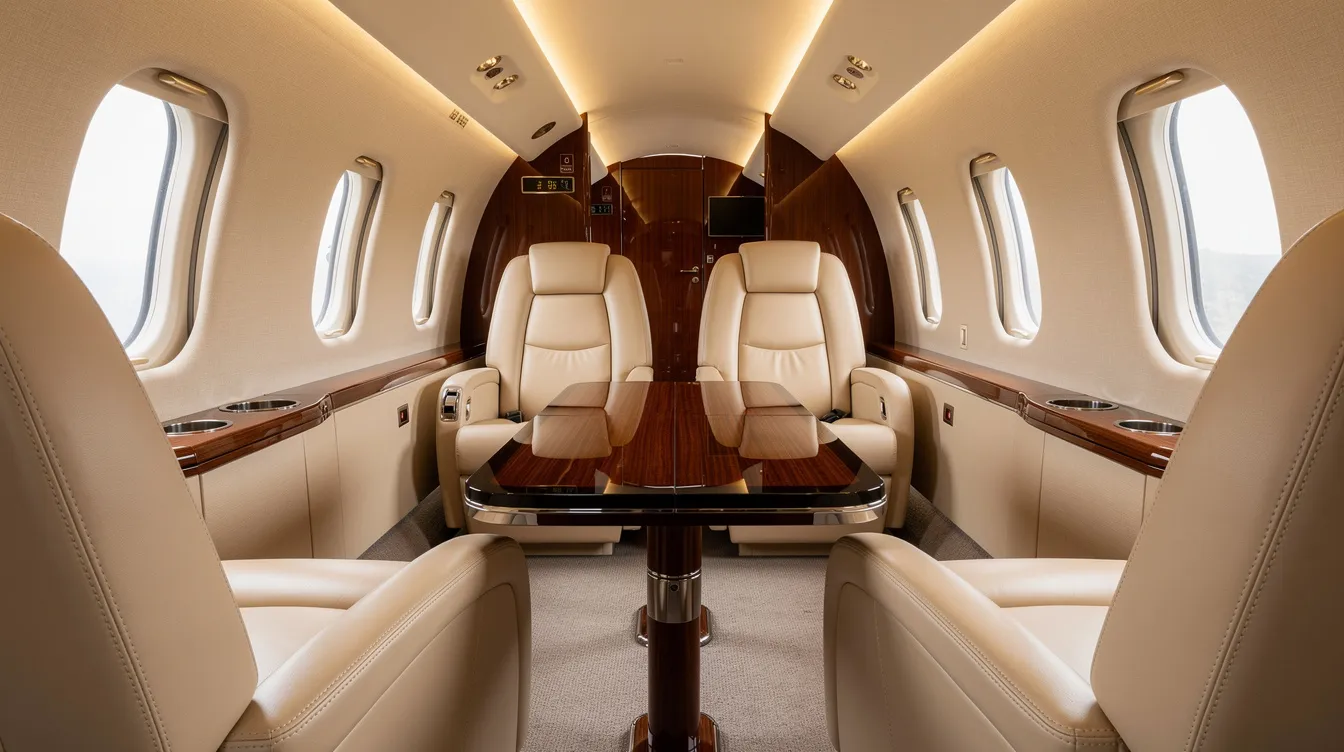
The cabin is practical before it is indulgent. Club seating allows face-to-face discussion. Larger aircraft may offer lie-flat options, enclosed lavatories, dedicated work areas, and separate rest spaces. Starlink-class Wi-Fi, where available, allows teams to handle email, video calls, documents, and market updates in flight.
Executives use the time in direct ways. A board can review materials between London and Zurich. A finance team can prepare earnings remarks on a New York–Dallas leg. An investor can conduct a confidential call during a late-night return flight. The best aircraft is the one that supports the mission without unnecessary cost or complexity.
For larger groups, larger aircraft and vip configured airliners may be relevant, but most executive jet flights are not about excess capacity. They are about selecting the aircraft that fits the passengers, range, baggage, runway, schedule, and privacy requirements. Learn more about aircraft interchange.

Safety, reliability, and operational discipline
Safety is the top priority in private aviation. For executive jet flights, that includes physical safety, operational discipline, maintenance standards, crew experience, and data privacy for business travelers who may be discussing sensitive matters in flight.
In the United States, FAR Part 135 governs commercial charter operations for safety. Equivalent regulatory frameworks apply in other regions. FLYT expects operators in its network to meet applicable local standards and to demonstrate disciplined operating procedures, maintenance controls, crew training, and Safety Management Systems.
Third-party standards also matter. IS-BAO or comparable programs, ARGUS ratings, and Wyvern-type reviews help clients assess whether operators follow strong safety processes. As market examples, Airshare has received IS-BAO Stage 3 and ARGUS Platinum designations. Stratos Jets is an ARGUS-certified broker ensuring safety standards. Paramount Business Jets requires ARGUS Gold certification for operators.
Crew experience is another important signal. Some providers publish benchmarks; for example, EJM pilots average over 9,000 flight hours each. FLYT evaluates operator quality with attention to pilot experience, recent type experience, recurrent training, and legal crew duty limits.
Reliability is also operational. If one aircraft goes tech or a schedule shifts at short notice, a membership platform with access to multiple operators and aircraft types can reduce disruption risk. The asset-light model is not only about cost. It is about redundancy, substitution, and the ability to keep travel plans moving.
Pricing of executive jet flights and cost control
Private aviation pricing is usually built around an hourly rate by aircraft category, plus route-specific costs. Charter costs vary based on aircraft type and route specifics, including positioning, airport fees, handling, taxes, crew overnights, catering, international permits, and peak-period demand.
Private jets typically run between $2,000 and over $11,000 per flight hour, while ultra-long-range jets can cost $12,000 per hour or more. Charter rates typically start around $2,500 per hour, and a turboprop like the King Air 200 starts at $2,500 per hour in many markets. Airshare's charter pricing starts at $4,000 per hour for turboprops. A light jet may run roughly $3,000–$6,500 per flight hour, while midsize jets, super midsize jets, and heavy jets rise from there.
Typical private jet charter pricing examples:
Turboprop like the King Air 200: starts at $2,500 per hour in many markets
Airshare's charter pricing for turboprops starts at $4,000 per hour
Light jet: approximately $3,000–$6,500 per flight hour
Midsize jets, super midsize jets, and heavy jets: higher rates, often $7,000 per hour and up
Ultra-long-range jets: $12,000 per hour or more
Aircraft capability also affects pricing. The King Air 350 has a maximum range of 1,806 nautical miles, making it useful for efficient regional missions. The Cessna Citation Encore has a range of approximately 1,700 nautical miles, while long-range and ultra-long-range jets cost more because of crew, fuel burn, maintenance, and aircraft value.
Ad hoc private jet charter services can be volatile. Fuel changes, high-demand dates, limited aircraft availability, major events, and one-way positioning can all move the final quote. Paramount Business Jets offers on-demand charter at the best market price, while other platforms use broader inventory models. Jettly offers access to over 20,000 aircraft globally. Jettly provides access to over 20,000 aircraft globally. Stratos Jets provides access to over 2,500 vetted aircraft. These examples show how broad marketplaces compete on access, but access alone does not solve predictability.
Empty leg flights offer discounted rates for flexible travelers, and private jet travel can match or undercut commercial business-class fares when several passengers share the entire aircraft or when an empty leg aligns with the route. Still, chartering or owning an executive jet is significantly more expensive than commercial flights in most cases.
FLYT’s membership structure is built around fixed hourly rates across aircraft categories. Members can plan around known rates, select the right aircraft for each mission, and reduce exposure to ownership overhead. The model is designed for frequent flyers who want predictable pricing without ownership costs, with members paying for flight time rather than carrying the fixed cost of an underused aircraft.
Transparent pricing is essential for CFOs, family offices, and travel managers. A clear quote should explain the hourly rate, taxes, airport fees, positioning assumptions, cancellation terms, and change policy. Without that discipline, private travel can become difficult to approve internally. Learn more about FLYT’s charter volatility protection and risk pool model.
Executive jet flight pricing overview
Aircraft category | Typical hourly charter rate (USD) | Typical passenger capacity | Typical range (nautical miles) | Common use cases |
|---|
Turboprop (e.g., King Air 350) | $2,500 – $4,000 | Up to 9 | ~1,800 | Regional flights, short-haul trips |
Light jet (e.g., Citation CJ4) | $3,000 – $6,500 | 6–8 | ~1,700 | Short to mid-range business trips |
Midsize / Super midsize jet (e.g., Citation Latitude) | $7,000 – $9,000 | 6–9 | ~2,700 | Longer domestic routes, small groups |
Heavy jet (e.g., Gulfstream G450) | $10,000 – $12,000 | 12–18 | 3,500+ | Intercontinental, larger teams |
Ultra-long range jet (e.g., Gulfstream G650) | $12,000+ | 12+ | 7,000+ | Long-haul international missions |
How FLYT structures executive jet access
FLYT is a membership-based private aviation service providing access to a curated network of aircraft worldwide. The model is designed for customers who want the efficiency of private jets without buying or co-owning an aircraft.
Private jet memberships offer flexible access to aircraft. Memberships provide predictable pricing without ownership costs. Private jet memberships typically require lower upfront costs than ownership. Membership models allow access to a global fleet of aircraft. Private jet memberships cater to frequent flyers and business executives who fly often enough to need consistency but not necessarily enough to justify full ownership.
FLYT’s asset-light, floating fleet model works through a risk pool approach. Instead of tying every trip to one tail number, FLYT works with a broad pool of vetted operators. This improves aircraft availability, supports flexible scheduling, and helps align cost with actual flying rather than fixed ownership obligations.
Fleet interchange is central to the model. A member may use a light jet for a regional business meeting, move to a super midsize aircraft for a transcontinental route, and select a long-range aircraft for a transatlantic flight. This gives members flexible aircraft access without forcing every trip into the same aircraft size. Learn more about fleet interchange.
FLYT also emphasizes concierge private aviation support. A dedicated team of aviation experts can design multi-city itineraries, align departure times with meeting calendars, coordinate ground transportation, arrange catering, manage ground transport, and handle last-minute schedule changes. For clients with complex calendars, the booking experience is as important as the aircraft itself.
This is especially relevant for founders, investors, and executives who need global private jet access across North America, Europe, the Middle East, and Asia. The objective is not to make private aviation feel more complicated. It is to make access, cost, and service easier to manage.
When to choose a light jet, midsize, or long-range aircraft
Choosing the right aircraft is a practical decision. It should balance range, passengers, luggage, runway access, cabin needs, cost, and onboard productivity.
A light jet is usually the efficient choice for short charter flights. Routes such as New York–Washington, DC; Los Angeles–San Jose; Boston–Toronto; or London–Paris often work well with 4–6 passengers and limited luggage. The lower hourly rate can make a light jet the better answer when speed and direct access matter more than cabin size.
Midsize and super midsize jets suit longer missions and larger teams. Routes such as Chicago–San Francisco, Toronto–Los Angeles, or London–Athens require more range, cabin comfort, and baggage capacity. A Citation Latitude is often used in this category because it offers a stronger cabin profile than smaller aircraft while remaining efficient for many business routes.
Long-range and ultra-long-range jets support missions such as New York–London, Miami–São Paulo, Dubai–Singapore, or Los Angeles–Tokyo. These aircraft offer nonstop capability, larger cabins, multiple zones, and better rest options for overnight travel. Heavy jets typically accommodate 12 to 18 passengers, making them suitable for leadership teams, families, or longer international trips.
FLYT’s aviation experts help members select the right aircraft rather than simply defaulting to larger jets. That matters because the lowest-friction private jet travel plan is usually the one where aircraft size, route, passengers, and schedule are aligned from the start.

Optimizing executive travel with membership-based charter
For frequent flyers in the range of 50–150 private flight hours per year, membership-based private charter can bring structure to a category that otherwise feels inconsistent. Pre-approved hourly rates, known aircraft standards, and a consistent service model help companies manage corporate flights without restarting the procurement process for every trip.
Membership can also simplify internal travel policy. A company can define when executive jet flights are appropriate, which aircraft categories are approved, how passengers are authorized, and how flight details are reported. This gives finance teams better control while preserving flexibility for leadership.
Consider an investment firm using FLYT for recurring London–Zurich–Milan diligence trips. The same membership can support early-morning departures, multiple same-day stops, confidential in-flight calls, and coordinated ground transportation. Or consider a U.S.-based technology company flying executives between Austin, Seattle, and New York on a regular cadence, with aircraft selected according to passenger count and schedule.
The growing demand for private jet membership reflects a broader shift in the aviation industry. Private jet travelers are not only comparing comfort. They are comparing capital allocation, schedule control, aircraft availability, safety, sustainability, and the administrative burden of each model.
There is also an environmental reality to acknowledge. Private jets emit significantly more carbon per passenger than commercial planes. Serious private aviation users increasingly evaluate aircraft efficiency, routing discipline, load factor, sustainable aviation fuel availability, and whether a given flight is operationally justified.
Used well, a membership-based charter becomes a strategic operations decision. It helps protect leadership time, reduce travel friction, and make private aviation more predictable for customers who value access without a long-term commitment to aircraft ownership.
FAQ: executive jet flights with FLYT
How much notice do I need to book an executive jet flight through FLYT?
Many domestic missions on popular routes such as New York–Miami, Los Angeles–Las Vegas, London–Geneva, or Dubai–Riyadh can often be arranged within 12–24 hours. In some markets, aircraft may be available with less notice, and charter flights can be booked with as little as 4 hours' notice when aircraft availability and crew duty limits allow.
Long-range international flights usually benefit from 24–48 hours of notice. This gives the team more time to secure the optimal aircraft, airport slots, handling, customs arrangements, and permits.
FLYT members receive priority access within the risk pool model, which improves the likelihood of securing preferred departure windows on short notice.
Can I change my departure time or route after I’ve booked?
Yes, flexible scheduling is a core part of executive jet flights. FLYT works to accommodate earlier or later departures when meetings shift, subject to crew duty regulations, airport operating hours, and aircraft availability.
Simple time changes on the same day and route are often possible with limited cost impact. Major route changes, overnight extensions, or international revisions may adjust pricing because they affect crew timing, permits, airport fees, and aircraft positioning.
Members receive clear information about change and cancellation terms so travel managers can make fast, informed decisions. See more frequently asked questions.
Do I have to commit to a long-term contract or buy a jet card with FLYT?
FLYT is a membership-based model, not a traditional jet card or fractional ownership program. Members do not need to purchase an aircraft share or buy an entire aircraft.
The structure is designed to provide fixed hourly rates and priority access without tying capital into large non-refundable deposits or multi-year fractional contracts. Any minimum annual usage or membership terms are presented transparently and aligned with the real usage patterns of frequent flyers.
Can FLYT support both business and family travel on the same membership?
Yes. FLYT memberships are intended to support corporate flights, personal trips, and family travel under a single structure, provided that use aligns with the member’s internal policies, accounting treatment, and tax guidance.
Many executives use private jet travel for board meetings during the week and family trips on weekends. The same access model can support different aircraft types, cabin layouts, catering preferences, pet travel where permitted by operators, and family-focused ground arrangements.
What if I already own or co-own an aircraft?
FLYT can complement existing ownership by providing supplemental lift when an owner’s aircraft is already in use, in maintenance, or unsuitable for a specific route. This is common when a short regional trip does not require a large cabin aircraft or when an occasional long-range mission exceeds the owner’s usual aircraft capability.
Fleet interchange allows owners to right-size each flight. They can use smaller jets for regional trips and larger cabins only when distance, passengers, or onboard productivity requirements justify the cost.
For many aircraft owners, this improves overall fleet efficiency and reduces the need to upgrade or acquire a second aircraft purely for occasional missions.
Conclusion
Executive jet flights are most valuable when they are treated as an operational tool rather than a lifestyle signal. The right model gives business leaders faster movement, private working time, flexible scheduling, and predictable access without unnecessary capital exposure.
FLYT’s membership approach is built for that reality: fixed hourly rates, fleet interchange, global reach, concierge support, and an asset-light structure designed around how frequent flyers actually move.
Explore a more flexible approach to global private jet travel with FLYT. For inquiries, visit Contact Us.